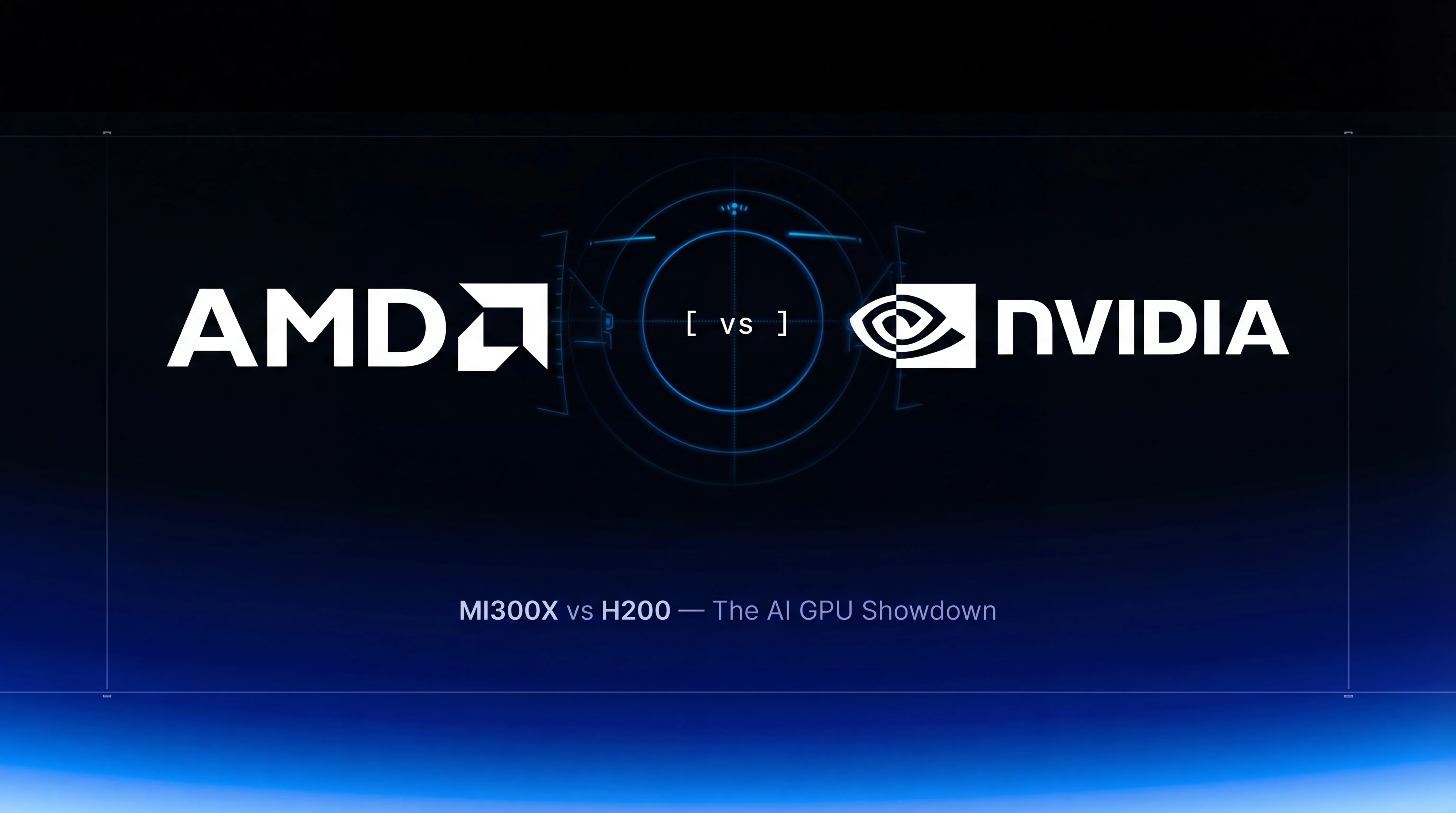
AMD's Instinct MI300X and NVIDIA's H200 represent the two most compelling data center GPUs for production AI workloads in 2026. Both target the same market: large-scale model training, LLM inference, and high-performance computing, but they approach it from very different angles.
The MI300X leads on raw memory capacity with 192 GB of HBM3 and 5.3 TB/s bandwidth, making it the GPU of choice for memory-bound models that don't fit on a single H200. NVIDIA's H200, built on the mature Hopper architecture, counters with 141 GB of faster HBM3e memory, a deeply optimized CUDA software stack, and consistently lower inference latency across most benchmarks.
This guide breaks down the full comparison: architecture, specs, real-world benchmarks, software ecosystem, pricing, and which GPU makes sense for your specific workload. Both GPUs rent on Spheron. Since 10 Sep 2026 that includes on-demand MI300X access in 1x and 2x VMs with a ROCm image, next to H200 SXM5, so you can benchmark your own model on each instead of relying only on the numbers below. For the next-generation comparison between AMD's CDNA 4 MI350X and NVIDIA's Blackwell B200, see our MI350X vs B200 guide. For how the H200 stacks up against NVIDIA's own newer Blackwell options rather than AMD's, see our H200 vs B200 vs GB200 comparison. If your actual production decision is MI300X against the H100 most teams are still running rather than the newer H200, our MI300X vs H100 memory and cost comparison works through that specific pricing and memory tradeoff.
TL;DR: AMD MI300X vs NVIDIA H200, Which Wins?
Neither wins outright: the AMD MI300X wins on memory (192GB vs 141GB per GPU), and the NVIDIA H200 wins on software maturity through CUDA. Check H200 rental pricing.
| Spec | MI300X | H200 |
|---|---|---|
| VRAM | 192GB HBM3, 5.3 TB/s | 141GB HBM3e, 4.8 TB/s |
| Software | ROCm | CUDA, TensorRT-LLM |
| Spheron on-demand | $3.59/hr per GPU, as of 17 Sep 2026 | $4.80/hr per GPU (H200 SXM5), as of 17 Sep 2026 |
| Verdict | Pick for models over 141GB on one GPU and FP64 HPC (163.4 vs 34 TFLOPS) | Pick for CUDA-only tooling such as TensorRT-LLM and Transformer Engine FP8 |
Pricing fluctuates based on GPU availability. Spheron rates above are live as of 17 Sep 2026; other providers reflect their most recent published rates and may have changed. Check current GPU pricing → for live rates.
Architecture Overview
AMD Instinct MI300X: CDNA 3
The MI300X is built on AMD's CDNA 3 architecture using an advanced chiplet packaging design with over 153 billion transistors across 8 GPU compute dies (GCDs), 3 I/O dies (IODs), and 8 HBM3 memory stacks. It features 304 compute units totaling 19,456 stream processors, eight HBM3 memory stacks providing 192 GB of total capacity, and an Infinity Fabric interconnect running at 896 GB/s for multi-GPU communication. For a detailed architectural comparison with the previous-generation H100, see our H100 vs H200 guide.
AMD designed the MI300X specifically for AI and HPC workloads. The CDNA 3 architecture includes dedicated Matrix Cores optimized for mixed-precision operations (FP8, BF16, FP16) that are critical for transformer-based model training and inference.
NVIDIA H200: Hopper
The H200 shares the same Hopper architecture as the H100 but upgrades the memory subsystem significantly. It features 16,896 CUDA cores, 528 fourth-generation Tensor Cores, and 141 GB of HBM3e memory, a 76% capacity increase and 43% bandwidth improvement over the H100.
NVIDIA's Transformer Engine, built into the Hopper Tensor Cores, dynamically switches between FP8 and FP16 precision during training. This hardware-level optimization gives the H200 a measurable edge in transformer workloads where mixed-precision performance matters most.
The HBM3 vs HBM3e distinction here isn't unique to this matchup, it's the same memory generation gap that separates H100 from H200 within NVIDIA's own lineup. Our HBM3e vs HBM4 vs HBM4e guide covers why that memory-type jump matters more than the capacity numbers alone suggest.
Specifications Comparison
| Specification | AMD Instinct MI300X | NVIDIA H200 (SXM) |
|---|---|---|
| Architecture | CDNA 3 | Hopper |
| Process Node | 5 nm (TSMC) | 4 nm (TSMC) |
| Transistors | 153 billion | 80 billion |
| GPU Cores | 19,456 stream processors | 16,896 CUDA cores |
| Tensor / Matrix Cores | 304 Matrix Core units | 528 Tensor Cores (4th gen) |
| Memory Type | HBM3 | HBM3e |
| Memory Capacity | 192 GB | 141 GB |
| Memory Bandwidth | 5.3 TB/s | 4.8 TB/s |
| Peak FP16 / BF16 | 1,307 TFLOPS (dense) | 1,979 TFLOPS (sparse†) |
| Peak FP8 | 2,615 TFLOPS (dense) | 3,958 TFLOPS (sparse†) |
| Peak FP32 | 163.4 TFLOPS | 67 TFLOPS |
| Peak FP64 | 163.4 TFLOPS | 34 TFLOPS |
| Interconnect | Infinity Fabric (896 GB/s) | NVLink (900 GB/s) |
| TDP | 750 W | 700 W (SXM) |
| PCIe | Gen 5 x16 | Gen 5 x16 |
| Software Stack | ROCm | CUDA / TensorRT-LLM |
| Cloud Rental (approx.) | $1.85-$7.86/hr (early 2026); Spheron $3.59/hr on-demand | $3.50-$8.00/hr (early 2026); Spheron $4.80/hr on-demand |
†FP8 and FP16/BF16 Tensor Core values reflect NVIDIA 2:4 structured sparsity. Dense (non-sparse) FP16/BF16 is approximately 989 TFLOPS; dense FP8 approximately 1,979 TFLOPS.
Pricing fluctuates based on GPU availability. Spheron rates above are live as of 17 Sep 2026; other providers reflect their most recent published rates and may have changed. Check current GPU pricing → for live rates.
The MI300X wins on memory capacity (36% more), memory bandwidth (10% more), FP32 throughput (2.4x), FP64 throughput (4.8x, important for HPC/scientific workloads), and dense FP16/BF16 compute (1,307 vs ~989 TFLOPS). The H200 surpasses the MI300X on FP16/BF16 and FP8 throughput when NVIDIA's 2:4 structured sparsity is applied (1,979 vs 1,307 TFLOPS and 3,958 vs 2,615 TFLOPS respectively), and benefits from faster HBM3e memory chips despite having less total capacity. NVLink's 900 GB/s figure here is the SXM5 number specifically; our H100 NVL vs SXM5 vs PCIe guide covers how that interconnect bandwidth changes across H100 form factors, which matters just as much for tensor-parallel serving as the MI300X comparison above.
AI Training Performance
Training performance is where the CUDA ecosystem advantage becomes most visible. Despite the MI300X's higher theoretical FLOPS and larger memory, NVIDIA's software stack (including cuDNN, NCCL, and years of framework-level optimization) delivers more consistent training throughput in practice. For deeper insights into GPU performance benchmarks, see our GPU cloud benchmarks article.
Key Training Benchmarks
Independent benchmarks from SemiAnalysis showed that getting MI300X training performance within 75% of H100/H200 levels required significant effort, including custom Dockerfiles built from source with direct AMD engineering support. By contrast, NVIDIA's pre-built containers and libraries work out of the box with minimal configuration.
That said, the gap is closing. AMD's ROCm 6.x releases have improved PyTorch and JAX support substantially, and teams running large-scale training on MI300X clusters report that the software experience has improved dramatically compared to 2024.
We measured our own version of that gap on a smaller job. In a timed H100 vs MI300X LoRA fine-tune on 13 Sep 2026, the MI300X's per-step time ran roughly 33% longer than the H100's on an identical torchtune recipe, wider than the 14% BF16 GEMM gap that isolated kernel benchmarks report, which is what a full training loop adds on top of raw matrix-multiply throughput.
Where MI300X Training Shines
The MI300X's 192 GB memory capacity gives it a real advantage for training very large models that require significant activation memory. Models that would need tensor parallelism across multiple H200s can sometimes fit on fewer MI300X GPUs, reducing communication overhead and simplifying the training setup.
For HPC workloads that rely on FP64 double-precision compute (scientific simulations, computational fluid dynamics, molecular dynamics), the MI300X delivers nearly 5x the FP64 throughput of the H200, making it the clear choice for these use cases.
LLM Inference Performance
Inference is where the MI300X vs H200 comparison gets nuanced. The H200 generally delivers higher throughput and lower latency for most LLM inference workloads, but the MI300X's memory advantage creates specific scenarios where it outperforms.
Throughput Benchmarks
Multi-GPU inference benchmarks show the MI300X achieving approximately 74% of the H200's single-GPU throughput at around 18,752 tokens per second versus the H200's higher figures. The MI300X maintains strong scaling efficiency at 95% for two-GPU configurations, dropping to 81% at four GPUs.
In DeepSeek R1 benchmarks, the H200 achieved 6,311 tokens/s in offline throughput scenarios, while the MI300X reached 4,574 tokens/s, suggesting that inference backends for AMD still need optimization to fully leverage the hardware's capabilities.
Latency Comparison
The H200 consistently delivers 37-75% lower latency than the MI300X across tested configurations. This gap is largely attributed to the maturity difference between NVIDIA's TensorRT-LLM and AMD's vLLM ROCm implementations rather than hardware limitations.
Where MI300X Inference Shines
The MI300X excels at serving very large models (70B+ parameter models with long context windows). Its 192 GB memory allows hosting models like Llama 3 405B or DeepSeek V3 670B on fewer GPUs, and for memory-bound inference tasks, the MI300X can sometimes double H100/H200 performance by keeping entire models in GPU memory without offloading.
For Llama 3 405B and DeepSeek V3 670B specifically, the MI300X beats the H100 in both absolute performance and performance per dollar, making it a strong choice for teams deploying the largest open-weight models.
Software Ecosystem
NVIDIA CUDA
CUDA remains NVIDIA's strongest competitive moat. With over 15 years of development, the CUDA ecosystem includes mature libraries for every AI workflow: cuDNN for deep learning, TensorRT and TensorRT-LLM for optimized inference, NCCL for multi-GPU communication, and pre-built containers for every major framework.
Most AI frameworks (PyTorch, TensorFlow, JAX, and Triton) are optimized for CUDA first. Developers can typically deploy models on H200 hardware with minimal configuration changes from their existing H100 workflows.
AMD ROCm
ROCm has made significant progress since 2024. PyTorch now has first-class ROCm support, vLLM runs natively on MI300X hardware, and AMD's growing partnerships with framework developers have expanded compatibility. However, the ecosystem still has gaps: some specialized libraries lack ROCm ports, documentation can be sparse, and debugging tools are less mature than their CUDA equivalents.
Teams considering MI300X should factor in additional engineering time for software stack optimization, particularly for training workloads. For inference with popular frameworks like vLLM and SGLang, the ROCm experience has become significantly smoother.
For a detailed breakdown of ROCm vs CUDA framework support, see our ROCm vs CUDA GPU cloud guide.
Pricing and Total Cost of Ownership
Cloud Rental Pricing
Across providers in early 2026, MI300X cloud instances were generally cheaper than H200 instances on a per-GPU-hour basis. MI300X rentals ranged from approximately $1.85/hr on budget providers like Vultr and TensorWave to $7.86/hr on Azure, while H200 instances typically started around $3.50/hr and ran up to $8.00+/hr on major cloud providers. Spheron added the MI300X on 10 Sep 2026 and rents it on-demand at $3.59/hr per GPU as of 17 Sep 2026, as 1x or 2x VMs. For the provider-by-provider AMD numbers, including spot and bare-metal tiers, see the MI300X and MI355X pricing guide. The hyperscaler end of the H200 range is worth seeing separately, in what Azure charges for H200 capacity.
However, raw hourly cost doesn't tell the full story. Because the H200 delivers higher throughput for most workloads, the cost per token or cost per training step can favor NVIDIA even when its hourly rate is higher. Teams should benchmark their specific workloads on both platforms before making a cost decision.
Pricing fluctuates based on GPU availability. Spheron rates above are live as of 17 Sep 2026; other providers reflect their most recent published rates and may have changed. Check current GPU pricing → for live rates.
Hardware Purchase Pricing
The MI300X carries an estimated unit price of approximately $10,000 to $15,000, while the H200 SXM is priced at roughly $25,000 to $35,000 per GPU. For organizations building their own clusters, the MI300X offers significantly lower upfront hardware costs, but this must be weighed against potentially higher software integration costs and lower per-GPU throughput.
Availability
NVIDIA H200 GPUs remain in high demand with longer lead times from major cloud providers. MI300X availability has improved significantly, with providers like Vultr, TensorWave, Crusoe, Oracle, and DigitalOcean all offering instances, and Spheron renting it on-demand since 10 Sep 2026. For teams that need GPU capacity immediately, MI300X availability can be a deciding factor.
When to Choose MI300X
The AMD MI300X is the better choice when your workload meets one or more of these criteria:
- Memory-bound models: You're serving 70B+ parameter models with long context windows that benefit from 192 GB per GPU
- Large model hosting: You need to fit models like Llama 3 405B or DeepSeek V3 on fewer GPUs
- HPC and FP64 workloads: Scientific computing, simulations, or any workload requiring high double-precision throughput
- Budget-constrained clusters: You're building owned infrastructure and want lower per-GPU hardware costs
- ROCm-compatible stack: Your team has experience with AMD GPUs or your frameworks already support ROCm
When to Choose H200
The NVIDIA H200 is the better choice when:
- Latency-sensitive inference: You need the lowest possible time-to-first-token for production serving
- Training at scale: You're training large models and need the most mature multi-node scaling
- Software simplicity: You want out-of-the-box compatibility with every framework and library
- Existing CUDA investment: Your team's tooling, profiling, and deployment pipelines are built around CUDA
- Peak FP8 throughput: Your inference pipeline leverages FP8 quantization where the H200's Transformer Engine excels
For more context on NVIDIA's GPU lineup and which is best for LLMs, see our guide to the best NVIDIA GPUs for LLMs.
AMD's Next-Generation Roadmap
AMD is not standing still. The Instinct roadmap includes several upcoming releases that will further close the gap with NVIDIA:
The MI325X, generally available since Q4 2024, upgrades to 256 GB of HBM3e memory with 6 TB/s bandwidth while maintaining the same CDNA 3 architecture. This is a direct response to the H200's HBM3e advantage.
The MI350 series (MI350X and MI355X), built on the next-generation CDNA 4 architecture at TSMC 3 nm, began shipping in 2025. It delivers up to 288 GB of HBM3e memory, 8 TB/s bandwidth, and native FP4/FP6 support. AMD has cited a "35x inference improvement" in marketing materials, but this refers to a specific cherry-picked scenario (FP4 vs. FP8 on a much older baseline). The actual FP8 dense throughput improvement over MI300X is approximately 1.8× based on published TFLOPS figures (MI350X: ~4,600 TOPS FP8 vs. MI300X: ~2,600 TOPS FP8).
Looking further ahead, the MI400 series based on "CDNA Next" is planned for 2026, paired with AMD's "Helios" rack-scale infrastructure supporting up to 72 GPUs in a tightly coupled scale-up domain.
Deploy High-Performance GPUs on Spheron
Whether you need AMD MI300X for memory-intensive inference or NVIDIA H200 and H100 for latency-critical workloads, Spheron provides on-demand GPU access with transparent pricing and no long-term contracts.
Deploy on MI300X, H100, H200, A100, and RTX 4090 GPUs with flexible hourly billing. Scale your AI infrastructure without the overhead of managing physical hardware. The full Spheron GPU rental catalog has live per-hour pricing across every available SKU.
Run the same model on a 192GB MI300X and a 141GB H200 SXM5 on Spheron, and let your own tokens per second and cost per token decide which one wins for your workload.
Frequently Asked Questions
It depends on the workload. The MI300X has more memory capacity (192 GB vs 141 GB) and higher memory bandwidth (5.3 vs 4.8 TB/s), and leads on FP32/FP64 compute for scientific workloads. On a like-for-like dense basis, MI300X FP16/BF16 (1,307 TFLOPS dense) is actually higher than the H200's dense FP16/BF16 (~989 TFLOPS). The H200 reaches 1,979 TFLOPS FP16/BF16 and 3,958 TFLOPS FP8 only when NVIDIA's 2:4 structured sparsity is applied, a feature AMD does not apply to its published MI300X figures. In real-world AI benchmarks, the H200 typically delivers higher inference throughput and lower latency due to NVIDIA's mature software optimization (Transformer Engine, TensorRT-LLM). The MI300X excels specifically in memory-bound workloads where its 192 GB capacity provides a meaningful advantage.
Yes, for specific use cases. The MI300X is particularly strong for serving very large models (70B+ parameters) with long context windows, where its 192 GB memory allows hosting models that would require multi-GPU setups on H200. For latency-sensitive production inference on smaller models, the H200 generally delivers better performance.
ROCm has improved significantly. PyTorch has first-class ROCm support, and popular inference frameworks like vLLM and SGLang run natively on MI300X hardware. However, CUDA remains more mature with broader library support, better documentation, and simpler deployment. Teams should expect some additional engineering effort when working with ROCm, particularly for training workloads.
It depends on the model size. For very large models (405B+ parameters), the MI300X can offer better cost per token because fewer GPUs are needed to host the full model. For smaller models (7B-70B), the H200 typically delivers better cost efficiency due to higher throughput per GPU, even though most providers listed it at a higher hourly rate than MI300X in early 2026.
Memory. The MI300X's 192 GB HBM3 capacity is 36% larger than the H200's 141 GB, and its 5.3 TB/s bandwidth is 10% higher. This makes it uniquely suited for workloads that are bottlenecked by GPU memory capacity rather than raw compute, including large model serving, long-context inference, and scientific computing with large datasets.