B300 (Blackwell Ultra) shipped January 2026. B200 has been in production since mid-2025 and has a mature software stack. So the question now isn't "when will B300 be available?", it's whether the B300 premium pays off for your specific workload. The answer depends on model size, batch size, and whether your serving stack supports FP4.
This post works through the real numbers: specs, throughput benchmarks, live cost-per-token math, and a binary decision checklist. The same cost-per-token framework applies when you evaluate non-GPU silicon like the Etched Sohu transformer ASIC.
TL;DR: Is the NVIDIA B300 Worth the Premium Over B200 for AI Inference?
The B300 is worth its premium for 70B+ models served in FP4 at large batch sizes; for sub-70B models or FP16-only stacks, the B200 stays cheaper per token. Both share 8 TB/s of memory bandwidth.
| Spec | B300 (Blackwell Ultra) | B200 (Blackwell) |
|---|---|---|
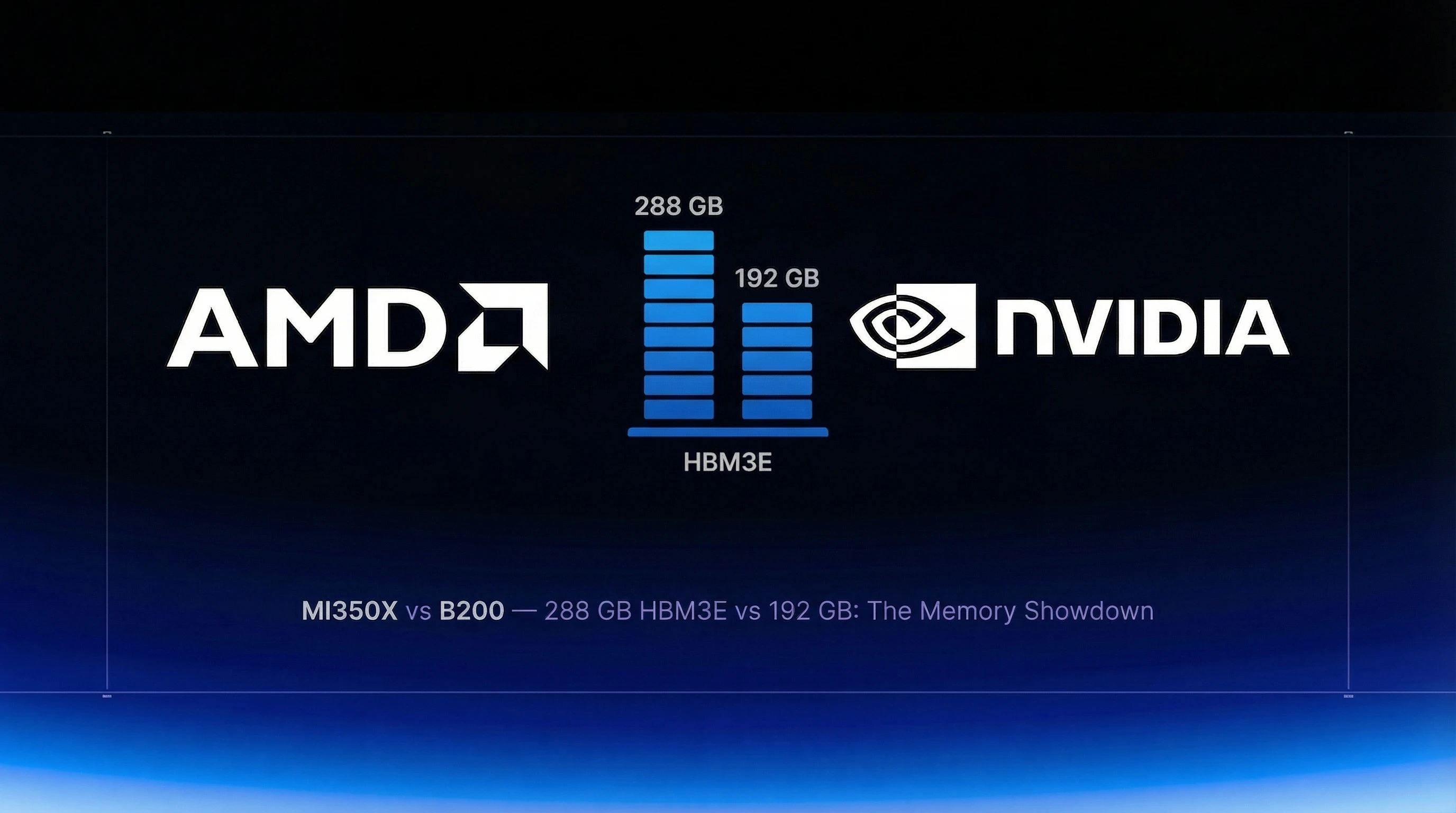
| VRAM | 288 GB HBM3e | 192 GB HBM3e |
| FP4 dense compute | 15,000 TFLOPS | 9,000 TFLOPS |
| Llama 3.3 70B FP4 cost/1M tokens, 10 Jun 2026 | ~$0.055 | ~$0.074 |
| Spheron spot per GPU/hr | $7.99/hr | $5.31/hr |
| Spheron on-demand per GPU/hr | $5.40/hr | $11.12/hr |
Pricing fluctuates based on GPU availability. Spheron rates above are live as of 17 Sep 2026; other providers reflect their most recent published rates and may have changed. Check current GPU pricing → for live rates.
Where the Extra VRAM and FP4 Compute Actually Matter
Memory-bound vs compute-bound: how to tell which one you have
A workload is memory-bandwidth-bound when the GPU's tensor cores sit idle waiting for data from VRAM. It's compute-bound when the tensor cores are saturated and data movement isn't the bottleneck. For LLM inference, the line between these two regimes depends on model size and batch size together.
Small models at low batch sizes are almost always memory-bandwidth-bound. The GPU loads weight matrices from VRAM faster than it can accumulate enough requests to fill the tensor cores. Large models at large batch sizes become compute-bound as the matrix multiplications grow large enough to saturate the FP4 units. A practical test: if doubling your batch size roughly halves your cost-per-token, you're bandwidth-bound. If it doesn't, you're entering compute-bound territory.
For a detailed cross-GPU cost-per-token benchmark covering A100, H100, H200, and B200 models at various batch sizes, see our GPU cost-per-token benchmark guide.
Long-context workloads and KV cache
Both the B300 and B200 run at 8 TB/s, so raw decoding speed at small batch is similar when models fit in memory with headroom. Where B300 pulls ahead is VRAM capacity for KV cache. At 32K+ context windows or high concurrency, the B200's 192 GB starts evicting KV cache blocks to CPU memory via paged attention's eviction policy, which increases tail latency as hot blocks get swapped back. The B300's 288 GB defers that eviction pressure with 96 GB more headroom.
For a 70B FP16 model (140 GB weights) at batch size 32, the B200 has about 52 GB left for KV cache. A single forward pass of Llama 3 70B at 32K context per request can consume 8-16 GB of KV cache depending on the number of heads and layers. At 32 concurrent users you hit the ceiling fast. The B300 gives you 148 GB of KV cache headroom under the same conditions.
Large-batch inference and FP4 compute
At batch sizes where the workload becomes compute-bound, the B300's 67% FP4 advantage translates directly to 67% more tokens per second. For a high-traffic API serving 100+ concurrent users on a 70B model, this means running fewer B300s than B200s for the same throughput target. Cost-per-token breaks in favor of B300 once you're in this regime, and when that scale calls for a full rack of Blackwell Ultra rather than single cards, you can reserve GB300 NVL72 capacity on Spheron: put your GPU count, timeline, and workload on the form and the team confirms availability within a business day. Before committing to a rack, check the GB300 NVL72 vs GB200 NVL72 pricing comparison to see whether the Ultra premium pays off for your workload.
The compute advantage only kicks in with FP4-compatible serving. TensorRT-LLM 0.15+ and vLLM with FP4 support are required. Both tools have been FP4-capable since Q1 2026, so this is not a future-roadmap requirement; it's a configuration step.
MoE models
Mixture-of-Experts models like DeepSeek V3 and Qwen 3 MoE have high total parameter counts but sparse active-parameter density per token. They're memory-capacity-bound before they're compute-bound because the full expert weight matrices must reside in VRAM even if only a fraction activates per forward pass. For MoE models that exceed B200's 192 GB, the B300 with 288 GB is the only single-GPU option. For the largest MoE runs that need a full rack rather than a single card, GB200 NVL72 on Spheron is available to reserve now: put your GPU count, timeline, and workload on the form, and the team confirms availability and follows up within a business day.
Full Spec Head-to-Head
| Spec | B300 | B200 | H200 | H100 |
|---|---|---|---|---|
| Architecture | Blackwell Ultra | Blackwell | Hopper | Hopper |
| VRAM | 288 GB HBM3e | 192 GB HBM3e | 141 GB HBM3e | 80 GB HBM3 |
| Memory Bandwidth | 8 TB/s | 8 TB/s | 4.8 TB/s | 3.35 TB/s |
| FP4 Dense (TFLOPS) | 15,000 | 9,000 | N/A | N/A |
| FP8 Dense (TFLOPS) | 7,000 | 4,500 | ~1,979 | ~1,979 |
| FP16 Dense (TFLOPS) | 3,500 | 2,250 | ~989 | ~989 |
| TDP | 1,400W | 1,000W | 700W | 700W |
| NVLink | NVLink 5 (1.8 TB/s) | NVLink 5 (1.8 TB/s) | NVLink 4 (900 GB/s) | NVLink 4 (900 GB/s) |
| Networking | ConnectX-8 (1.6T) | ConnectX-7 (800G) | ConnectX-7 (800G) | ConnectX-7 (800G) |
| Cooling | Liquid required | Air viable | Air viable | Air viable |
All TFLOPS values are dense (non-sparse). NVIDIA publishes 2:4 structured-sparsity figures that are roughly 2x higher but require sparse weight patterns. The dense figures represent realistic production throughput for general inference workloads.
For a full B300 technical breakdown including infrastructure requirements and DGX vs HGX configurations, see our NVIDIA B300 Blackwell Ultra guide. For B200 deep-dive specs and historical pricing, see the NVIDIA B200 complete guide.
Inference Benchmarks and Cost-Per-Token
The table below uses throughput estimates based on published MLPerf data and architectural scaling ratios, with Spheron spot pricing recorded on 10 Jun 2026 and frozen so the arithmetic holds (live rates are in the TL;DR table above).
| Model | GPU | Precision | Est. Throughput | $/hr (Spheron spot) | Cost/1M tokens |
|---|---|---|---|---|---|
| Mistral 7B | B200 spot | FP16 | ~8,500 tok/s | $2.68 | ~$0.09 |
| Mistral 7B | B300 spot | FP4 | ~13,000 tok/s | $3.29 | ~$0.07 |
| Llama 3.3 70B | B200 spot | FP4 | ~10,000 tok/s | $2.68 | ~$0.074 |
| Llama 3.3 70B | B300 spot | FP4 | ~16,500 tok/s | $3.29 | ~$0.055 |
| Llama 3.1 405B | 3x B200 spot | FP8 | ~5,500 tok/s | $8.04 (3x GPUs) | ~$0.41 |
| Llama 3.1 405B | 2x B300 spot | FP8 | ~3,700 tok/s | $6.58 (2x GPUs) | ~$0.49 |
Cost/1M tokens formula: ($/hr) / (tok/s × 3600 / 1,000,000). For multi-GPU rows, the $/hr reflects the full cluster cost (GPU count times per-GPU spot price), not the per-GPU rate.
The 405B row shows the memory-fit advantage of B300. Two B300s (2 × 288 GB = 576 GB total) hold the full 405B model at FP8, where three B200s are needed (3 × 192 GB = 576 GB). Saving one GPU reduces hardware overhead and lowers the hourly cluster cost from $8.04 to $6.58 at the 10 Jun 2026 rates. However, the 2-GPU B300 cluster has less total memory bandwidth (2×8 TB/s = 16 TB/s) than the 3-GPU B200 cluster (3×8 TB/s = 24 TB/s). For a 405B model at FP8, inference is memory-bandwidth-bound at typical batch sizes, so throughput scales primarily with total bandwidth. The 50% bandwidth advantage of the 3-GPU configuration explains why 3x B200 delivers higher tokens per second and better cost-per-token for throughput-intensive workloads. 2x B300 is the right call when minimizing GPU slot count matters more than maximizing per-token throughput. B200 isn't the only accelerator being priced this way either; our Google TPU v7 Ironwood vs B200 inference cost breakdown runs the same cost-per-token math against Google's silicon for teams weighing GPU against TPU capacity.
The cost-per-token table above is a worked example at Spheron spot rates recorded on 10 Jun 2026. Pricing fluctuates based on GPU availability; check current GPU pricing → for live rates.
When B300 Pays for Itself
At the 10 Jun 2026 spot rates, a single B300 cost $3.29/hr versus $2.68/hr for a B200, a $0.61/hr premium. Running 24/7, that's $14.64 per day more.
For Llama 3.3 70B FP4, the B300 delivers ~16,500 tok/s versus ~10,000 tok/s on B200. The cost-per-token gap is $0.074/M on B200 versus $0.055/M on B300, a saving of $0.019 per million tokens.
To cover the $14.64/day premium purely from lower cost-per-token, you need to be serving approximately 770 million tokens per day on a single GPU. That works out to roughly 9,000 tokens per second sustained throughput, or about 90% of B200's single-GPU capacity for 70B FP4.
In practice, you're not running a single GPU at 90% utilization before you add capacity. The real break-even for teams scaling a fleet is lower: once you'd otherwise add a second B200 to handle demand, the math often favors one B300 instead.
For the full FP4 throughput breakdown on Blackwell including quality tradeoffs and framework setup, see our guide on FP4 quantization on Blackwell GPUs.
When B200 (or H200) Is the Smarter Rent
Models fitting in 192 GB with VRAM headroom. For 7B through 70B models at FP8 or FP4, the B200's 192 GB is sufficient and its lower price wins on cost-per-token. No VRAM advantage from upgrading to B300, and both share the same 8 TB/s bandwidth.
FP16-only serving stacks. If your framework doesn't support FP4, the B300's extra FP4 compute does nothing. Although B300 has 55% more FP8 compute (7,000 vs 4,500 TFLOPS), most inference workloads at small-to-medium batch sizes are memory-bandwidth-bound, not compute-bound. Both GPUs share the same 8 TB/s bandwidth, which is the actual bottleneck in this regime, so the extra compute doesn't translate to higher throughput. At the 10 Jun 2026 spot rates ($3.29/hr versus $2.68/hr), B300 cost 23% more for effectively the same tokens per second on FP8/FP16 stacks at typical batch sizes, making B200 the clear choice.
Sub-70B inference at low concurrency. Memory-bandwidth-bound workloads don't benefit from additional compute. The bottleneck is 8 TB/s, which both GPUs share. For small models at low batch sizes, B200 and B300 will deliver similar tokens per second, so B200 wins on cost.
Fine-tuning 70B models. QLoRA on a single B200 (192 GB) gives ample VRAM headroom for the base model plus optimizer states. The B300 premium is not justified for single-run training jobs where VRAM isn't the constraint.
For B200 pricing and availability, explore B200 on Spheron. For a three-way comparison that includes GB200, see the H200 vs B200 vs GB200 guide. H200 is also worth considering when neither Blackwell GPU is needed, with pricing starting lower than both, though which H200 SKU you rent matters too: our H200 NVL vs SXM5 form factor guide covers the NVLink and rack-density differences before you pick one. If AMD's competing accelerator is also on your shortlist, our AMD MI400 vs NVIDIA B300 comparison runs the same cost-per-token framework against CDNA 5.
Availability and Pricing Reality in Mid-2026
Both B300 and B200 are available on Spheron today as spot and dedicated instances. Spot pricing gives access to hardware for interruptible jobs, and spot capacity can be reclaimed without notice. Dedicated instances guarantee availability for production inference SLAs.
Spheron aggregates compute from 5+ providers, which is why pricing reflects real competition rather than a single provider's margin structure. B300 spot runs $7.99/hr per GPU and B200 spot $5.31/hr per GPU as of 17 Sep 2026.
Pricing trajectory follows the H100 pattern: as B300 supply scales across the Spheron provider pool, rates will compress. The H100 dropped from $8+/hr in early 2024 to roughly $3/hr spot by Q1 2026. B300 spot was at roughly $3.29/hr on 10 Jun 2026, down from $6.80/hr at launch. If you're evaluating long-term contracts, per-minute billing on spot is the better model for workloads with unpredictable utilization. If you're weighing renting these GPUs directly against routing traffic through a managed per-minute serving platform instead, our Baseten pricing breakdown works out the utilization threshold, GPU tier by GPU tier, where a flat-rate rental starts beating per-minute serving billing.
Pricing fluctuates based on GPU availability. Spheron rates above are live as of 17 Sep 2026; other providers reflect their most recent published rates and may have changed. Check current GPU pricing → for live rates.
Decision Checklist: Which Blackwell SKU to Rent
Does your model exceed 192 GB in VRAM?
Yes: B300 is your only single-GPU option. Rent B300 on Spheron →
No: Continue.
Does your model require more than 128 GB of VRAM (for example, 70B FP16 at ~140 GB)?
Yes: B200 fits it; B300 gives more KV cache headroom at scale. Both are viable.
No: H200 handles it at lower cost.
Is your inference stack FP4-capable (TensorRT-LLM 0.15+, vLLM FP4)?
Yes: B300 delivers 67% more FP4 throughput. Run the break-even math above.
No: Both GPUs share 8 TB/s bandwidth, so FP8 throughput is similar for bandwidth-bound workloads at typical batch sizes. B200 wins on cost.
Are you serving 100+ concurrent users on a 70B model?
Yes: Compute-bound territory at high batch sizes. B300 reduces cost-per-token at scale.
No: Likely bandwidth-bound at low concurrency. B200 is enough.
Is guaranteed availability required for a production SLA?
Yes: Use B300 or B200 dedicated instances (no spot interruption risk).
No: B300 or B200 spot for the lowest hourly rate.
Both B300 and B200 are available on Spheron as spot and dedicated instances. Benchmark your actual workload on real hardware before committing to a migration path.
Frequently Asked Questions
For 70B+ models at scale, usually yes. The B300's 288 GB VRAM fits a full 70B FP16 model with 148 GB of headroom for KV cache, and its 15,000 dense TFLOPS FP4 delivers lower cost-per-token than the B200 for large-batch workloads. For sub-70B models or FP16-only stacks, the B200 is typically cheaper per token.
At the Spheron spot rates recorded on 10 Jun 2026 ($3.29/hr for B300, $2.68/hr for B200), the B300 delivered approximately 26% lower cost-per-token for Llama 3.3 70B FP4 inference: $0.055/M tokens versus $0.074/M tokens. Live spot rates are $7.99/hr for B300 and $5.31/hr for B200 as of 24 Oct 2026. For Mistral 7B, the gap narrows to about 20% because both GPUs share the same 8 TB/s memory bandwidth and the workload is bandwidth-bound at small batch sizes, not compute-bound.
Yes. A 70B model in FP16 requires roughly 140 GB of VRAM. The B300's 288 GB fits the full model with 148 GB left for KV cache and batch overhead. The B200 at 192 GB also fits 70B in FP16, but leaves only 52 GB spare, which is enough for moderate batch sizes but tight at high concurrency.
Both GPUs support FP4 via the Blackwell Transformer Engine. The B300 has 15,000 dense TFLOPS FP4 versus the B200's 9,000, a 67% compute advantage. This gap materializes when the workload is compute-bound, which happens at large batch sizes with models that fit well in VRAM. TensorRT-LLM 0.15+ and vLLM with FP4 support are required to see the improvement.
Both are available now on Spheron. If your model fits in 192 GB and you don't need FP4 compute at scale, the B200 is the lower-cost option today. If you need 288 GB VRAM or the B300's throughput advantage for production inference, rent B300 now.
TensorRT-LLM 0.15+ or vLLM with FP4 quantization support. The B300 uses the same CUDA 12.x and cuDNN 9.x toolchain as the B200. Migrating from B200 to B300 requires no code changes; unlocking FP4 requires pre-calibrated model weights and a compatible serving framework.