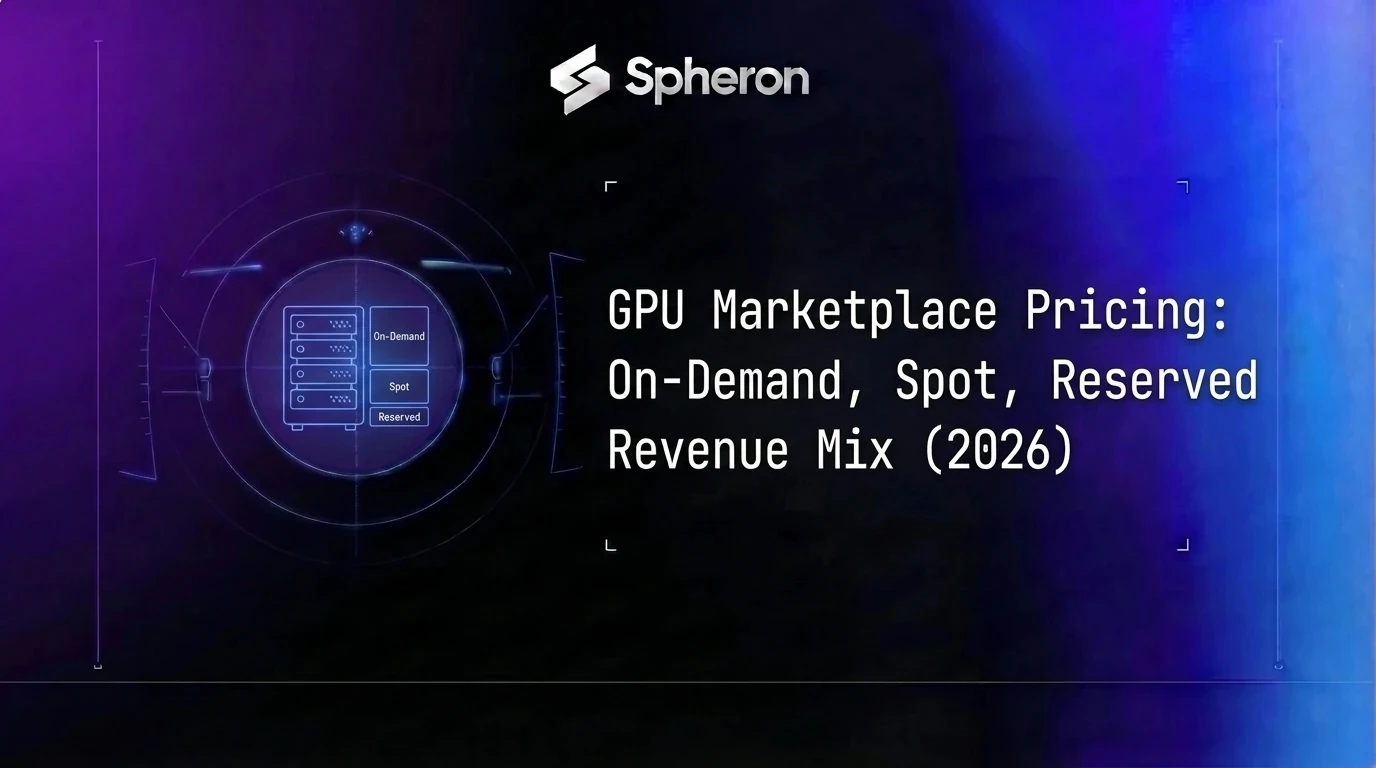
Once onboarding to a marketplace closes and a fleet is actually listed, every GPU owner runs into the same question: how much goes on-demand, how much goes spot, and how much gets carved off as a reserved floor? GPU marketplace pricing, from the owner's side, is a capacity-allocation decision before it's a rate-card decision. Too much reserved and you've locked in a discount during the weeks you could have billed full on-demand rate; too little and a slow month wipes out the margin the reserved floor was supposed to protect. This post builds that allocation call from what providers publish about their own discount tiers, a live spot-pricing example that moves week to week, and what happens on our own fleet when a spot GPU gets reclaimed.
TL;DR: GPU Marketplace Pricing Across On-Demand, Spot, and Reserved
Reserve only the slice of a fleet that clears a consistent utilization threshold, let on-demand carry the volatile middle, and treat spot as a separate pool that has to actually get reclaimed sometimes to be real spot.
| Tier | Real-world rate (p6-b200.48xlarge, Aug 2026) | vs. on-demand |
|---|---|---|
| On-demand | $113.93/hr | baseline |
| Reserved (3-yr Compute Savings Plan) | $49.22/hr | -57% |
| Spot | $98.84/hr | -13% |
| Nebius B300 spot, us-north1, 8-21 Oct 2026 | ~63% of list price | n/a |
Spheron's GPU Supplier Program lists on-demand, spot, and reserved demand from one intake with an owner-set price floor, as of 14 Nov 2026. See the Supplier Program.
What Each Demand Channel Actually Pays Per GPU-Hour
On-demand is the baseline rate a buyer pays with no commitment attached. Reserved and spot are both discounts off that baseline, but from opposite directions: reserved trades a lower rate for a buyer's upfront commitment, spot trades a lower rate for the owner's right to take the GPU back. The "up to" ceilings providers publish for each tier rarely describe what the newest hardware actually trades at, as one real AWS example from August 2026 shows on a single node, across all three tiers.
| Tier | Published ceiling | Real example (p6-b200.48xlarge, Aug 2026) |
|---|---|---|
| On-demand | Baseline, no discount | $113.93/hr |
| Reserved / committed | CoreWeave: "up to 60% discounts" off on-demand; AWS Capacity Blocks and Savings Plans: up to 60% off, paid upfront | $49.22/hr on a 3-year Compute Savings Plan, a 57% discount |
| Spot | AWS: up to 90% off, reclaimable at any time | $98.84/hr, only a 13% discount |
The reserved row lands close to its stated ceiling; the spot row doesn't come close to its own. A buyer or owner reading "up to 90% off" and budgeting around it on a B200-class node is budgeting against a ceiling that didn't apply the one time AWS's own guide shows it checked. The newer and scarcer the hardware, the less spare capacity there is to discount, and the closer spot drifts back toward on-demand.
Pricing fluctuates with GPU availability and provider capacity. The AWS, CoreWeave, and Nebius figures above reflect each provider's own most recently published or reported rates as of 14 November 2026 and may have changed since; check each provider's own pricing page for what you'd pay today.
Nebius's own spot pricing shows the other side of that mechanic. Rather than a fixed discount, Nebius lets B300 spot float with live demand: in its us-north1 region, average spot prices ran about 63% of list price between 8 and 21 October 2026, a 13-day window in which the number moved rather than held still. That's the signature of a market clearing supply against demand hour to hour, not a static markdown set once and forgotten.
The Revenue-Smoothing Case for a Reserved Floor
Reserved capacity exists to solve a specific problem: a fleet billed entirely at variable rates earns differently every month, which is hard to plan payroll, debt service, or a next hardware purchase against. Revenue management is the pricing discipline that "maximizes revenue and profit from a fixed or semi-fixed capacity," the same logic airlines and hotels apply to perishable seats and rooms: cap how much sells at a lower price so the rest stays protected for higher-paying demand later. A GPU fleet is the same kind of asset, whether it's owned hardware or a colocated rack an owner is paying to keep powered and cooled: a GPU-hour that goes unsold tonight is gone, exactly like an empty airline seat after takeoff, which is why the allocation question is really about how much of that inventory to pre-sell at a discount versus hold for whatever on-demand or spot pays this week.
The discount an owner gives up for that stability is real, and it's the same number buyers are shopping on the other side of the trade. CoreWeave's pricing page states plainly that it offers "up to 60% discounts over our On-Demand prices for committed usage," negotiated through its sales team rather than published as a tier table. That's a meaningful floor to give up on a slice of a fleet, which is why Runpod's guidance for sizing a private reserved pool is to commit only what a team can use consistently, screening a baseline against whether it clears roughly 60-70% utilization before locking it in. A reserved block running below that range is paying for stability on capacity that would have sat idle at the on-demand rate anyway, which erases the point of reserving it.
The formula underneath this decision doesn't change once a split is picked: monthly revenue on any slice of a fleet is rate times hours times utilization times GPU count, the same math this blog's GPU cluster profit margin calculator walks through node by node. A reserved floor fixes the rate and, ideally, the utilization at once; on-demand and spot leave both open. The terms worth negotiating into a reserved block once its size is set, minimum commitment, overage rate, exit clauses, are their own exercise, covered in this blog's guide to negotiating a GPU cluster reservation. And because reserved demand runs through its own acquisition mechanics on the buyer's side, Capacity Blocks, resale markets, or a negotiated MSA, the mirror-image post on reserved GPU capacity bidding shows what a buyer is comparing your quote against.
How Spot Demand Fills the Rest Without Tanking Your Rate
Spot is supposed to be the release valve: capacity an owner can price low because it can be taken back the moment a higher-paying buyer shows up. The trap is listing a slice of a fleet as "spot," pricing it at a modest discount, and then never actually reclaiming it. That isn't spot pricing, it's an underpriced on-demand rate wearing a spot label, and it shows up in the data as a discount that never moves and a reclaim rate of zero.
Genuine spot looks different, and the clearest evidence is what happens when hardware is scarce enough that there isn't much surplus to auction off. GMI Cloud describes true spot or preemptible capacity for rack-scale GB300 NVL72 as "rare to nonexistent". At that end of the catalog, the honest allocation answer is often that spot isn't a real third tier yet; the split is reserved versus on-demand, full stop, until enough surplus capacity exists to support one.
Lower on the hardware stack, reclaims are real and frequent, not a theoretical risk an owner lists as a disclaimer. That's not a reason to avoid spot capacity, it's a reason to architect around it the way any genuine spot consumer has to. We tested what that buys us under live failure conditions on a four-node 8xB200 inference fleet through the production gateway: killing a spot node mid-stream let in-flight responses finish on the other copy after about 7 seconds, with zero failed; killing a node mid-tool-call still left 16 of 16 requests ending with one complete, valid tool call; a crashed engine restarted on the same node in 3 minutes; and gateway and control-plane restarts dropped zero of 832 requests during a hand-over.
That redundancy cost is the price of running real spot, and it's exactly the cost a "fake spot" listing skips by never actually reclaiming anything. If an owner's spot tier never shows the volatility Nebius's live B300 pricing shows, or the reclaim pattern our own fleet logged in October, the simplest explanation is that it was never priced as spot to begin with.
A GPU Marketplace Pricing Allocation Framework by Fleet Size
The right split scales with how much surplus a fleet actually has to work with, not with a fixed percentage copied from a bigger operator's rate card.
- Small fleets (a handful of nodes): skip the reserved floor entirely. There isn't enough scale to protect a committed tier without starving on-demand, so split between on-demand and spot, and let buyer demand set which one fills faster.
- Mid-size fleets: reserve the baseline that clears Runpod's roughly 60-70% utilization screen, and let on-demand and spot absorb everything above it. This is the range where a reserved floor actually smooths revenue instead of just discounting hours that would have sold anyway.
- Rack-scale fleets (GB300 NVL72 and similar): expect the split to be mostly reserved versus on-demand. As GMI Cloud's own description of this hardware tier shows, there usually isn't enough surplus capacity at that scale to run a genuine spot market on top of the other two.
Executing any of those splits is its own operational problem: on-demand, spot, and reserved buyers show up through different acquisition paths, and chasing them separately means running three sales processes instead of one. Spheron's GPU Supplier Program is built around that gap, and its partner page sums up the pitch in four words: "set the floor, you approve the deal." A supplier applies once with fleet details (SKU, region, data center tier), sets and keeps their own on-demand and reserved price floor instead of being pushed into a reverse auction, and gets buyer requests pre-qualified by SKU, region, contract length, budget, and use case before approving a match, with Spheron handling metering and invoicing on a monthly settlement. It routes qualified demand to a split an owner has already decided on; it doesn't pick the split or guarantee a utilization outcome, and it doesn't publish a self-serve rate card or a live bidding engine the way AWS's Capacity Block pricing does, so an owner who wants to price-discover a tier in public before listing won't find that here.
Once you've worked out how much of your fleet belongs on each tier, Spheron's GPU Supplier Program routes on-demand, spot, and reserved demand through one pipeline and lets you set the floor at every price point.
Frequently Asked Questions
There's no universal number, but there is a screening test. [Runpod's own guidance for private GPU pools](https://www.runpod.io/blog/private-gpu-pools) is to reserve only the capacity a team can use consistently, and to check a baseline commitment against whether it clears roughly 60-70% utilization before locking it in. Below that threshold, the discount a reserved rate offers gets eaten by the hours the GPU sits idle anyway, so the safer move is to keep that slice on-demand or spot until booked hours justify carving out a floor.
No, and the gap can be small. A real August 2026 example from [AWS's own GPU procurement guide](https://awslabs.github.io/accelerated-compute-tutorials/ai-infra/purchase-options/) shows a p6-b200.48xlarge node at $113.93/hr on-demand against $98.84/hr on spot, only a 13% discount, even though AWS advertises spot at up to 90% off on-demand as a ceiling. [GMI Cloud goes further for the newest rack-scale hardware](https://www.gmicloud.ai/en/blog/gb300-spot-reserved-pricing-vs-on-demand), describing true spot or preemptible capacity for GB300 NVL72 as 'rare to nonexistent'.
[CoreWeave's pricing page advertises 'up to 60% discounts](https://coreweave.com/pricing) over our On-Demand prices for committed usage,' arranged through its sales team rather than a published tier table. [AWS's Capacity Blocks for ML](https://awslabs.github.io/accelerated-compute-tutorials/ai-infra/purchase-options/) carry the same up-to-60%-off ceiling, paid 100% upfront and non-cancellable. The same AWS August 2026 example shows what that looks like on real hardware: a p6-b200.48xlarge node at $113.93/hr on-demand fell to $49.22/hr on a 3-year Compute Savings Plan, a 57% discount, close to both providers' stated ceiling.
The honest ones let it float with demand instead of pinning it to a fixed discount off on-demand. [Nebius's us-north1 region is a documented example](https://fourweekmba.com/ai-nebius-b300-spot-hours-averaged-up-to-63-of-list-price/): average B300 spot prices ran about 63% of list price between 8 and 21 October 2026, a figure that moves week to week rather than sitting at a flat markdown. A spot listing that never moves, and never gets reclaimed, usually isn't pricing spot capacity at all. It's an on-demand rate wearing a spot label.