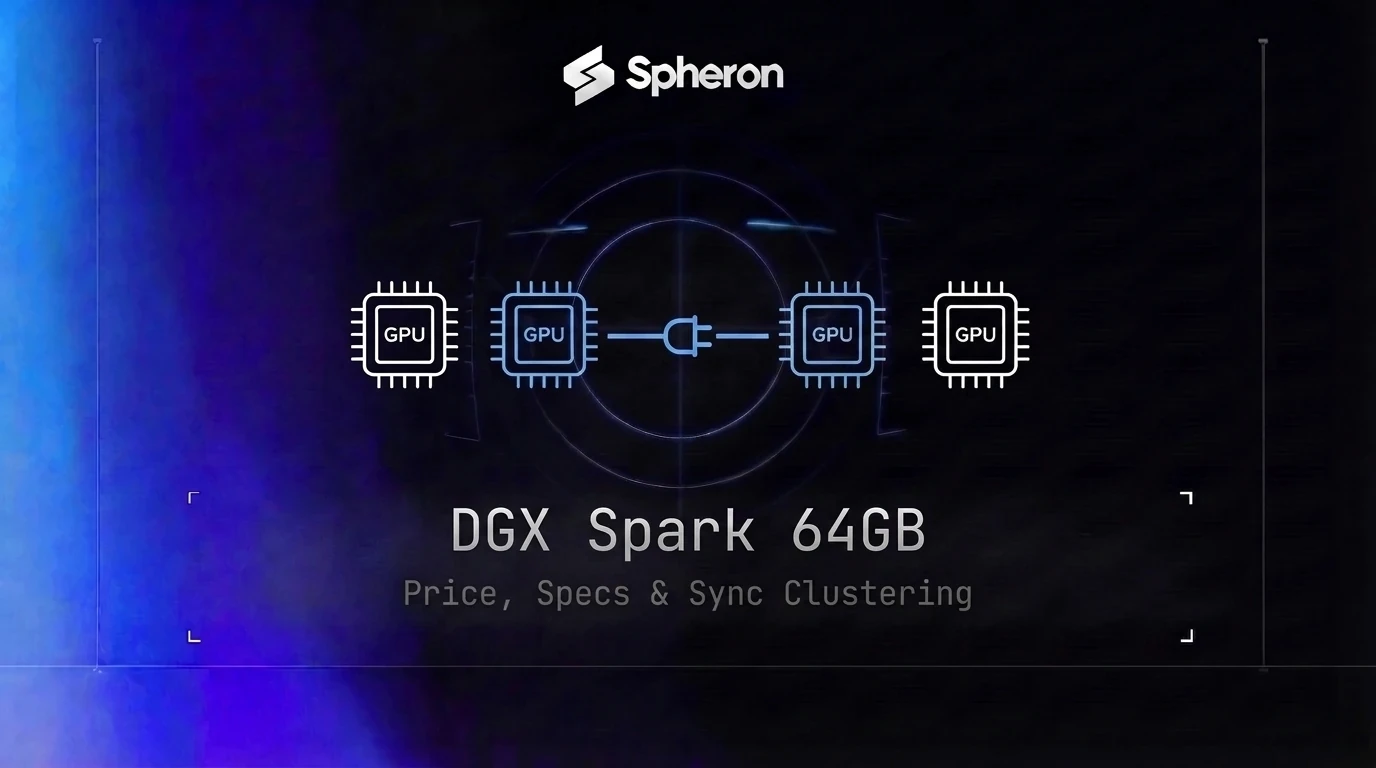
NVIDIA's DGX Spark lineup split into three real purchase decisions on October 23, 2026: one $4,999 64GB box, one $6,950 128GB box, or two 64GB boxes clustered together for roughly $9,998. All three run the identical GB10 Grace Blackwell Superchip. The only variable that changes the math is what you're actually trying to buy, more memory, more bandwidth, or the cheapest entry point, because those three things no longer come bundled the way they did when DGX Spark had one SKU.
TL;DR: DGX Spark 64GB Price, Specs, and Sync Clustering
- Price: NVIDIA's 64GB DGX Spark launched at $4,999, shipping October 23, 2026 through Acer, ASUS, Dell, Gigabyte, HP, and MSI.
- Same chip: Both tiers run the identical GB10 Grace Blackwell Superchip, 20-core Arm CPU, 273 GB/s bandwidth, and ConnectX-7 200GbE networking; only memory capacity changes.
- Sync Cluster: NVIDIA's Sync Cluster Assistant links two units over one QSFP cable through their ConnectX-7 ports, pooling memory to 128GB and bandwidth to 546 GB/s.
- Measured gain: NVIDIA's testing on Qwen3.8-27B showed a clustered pair delivering up to 1.7x a single unit's performance.
- Cloud alternative: Spheron rents B200 (192GB) on-demand by the minute past a clustered pair's ~200B-parameter ceiling. Compare live GPU pricing.
What's New: DGX Spark 64GB Price, Specs, and the October 23 Release
NVIDIA's 64GB DGX Spark configuration is priced at $4,999 and ships October 23, 2026 through Acer, ASUS, Dell, Gigabyte, HP, and MSI, according to ServeTheHome's launch coverage. It's a new entry tier sitting below the existing 128GB Founders Edition, sold by six OEM partners rather than NVIDIA alone. For the full roster of certified GB10 boxes and how they differ on storage and warranty, our DGX Spark alternatives comparison covers all eight systems built on this chip.
Why the 128GB Tier Jumped From $3,999 to $6,950
The 128GB Founders Edition didn't stay at its launch price. It opened at $3,999 and now lists at $6,950, a jump of nearly 74% inside a year, driven by DRAM cost pressure rather than a spec change. Patrick Kennedy, ServeTheHome's chief analyst, pinned the cause directly on memory sourcing: "we are paying $2000 for 64GB ECC RDIMMs, so pricing logically must increase." That's the same LPDDR5X-class memory pressure sitting underneath the new 64GB tier's price too, just applied to half the capacity. A $4,999 64GB unit now undercuts the $6,950 128GB unit by nearly $2,000, for half the memory and, as the Sync Cluster math below shows, a real bandwidth trade-off if you try to make up that memory gap by buying two.
Spec-for-Spec: 64GB vs 128GB DGX Spark
Strip away the memory line and the two configurations are the same machine. Both run the identical GB10 Grace Blackwell Superchip, 20-core Arm CPU, and ConnectX-7 200GbE networking, with 273 GB/s of unified memory bandwidth on a single unit either way, confirmed across both tiers by ThePCEnthusiast's coverage of the 64GB launch.
| Spec | DGX Spark 64GB | DGX Spark 128GB |
|---|---|---|
| Chip | GB10 Grace Blackwell Superchip | GB10 Grace Blackwell Superchip |
| CPU | 20-core Arm | 20-core Arm |
| Unified memory | 64GB | 128GB |
| Memory bandwidth (solo) | 273 GB/s | 273 GB/s |
| Networking | ConnectX-7 200GbE | ConnectX-7 200GbE |
| Price | $4,999 | $6,950 (launched at $3,999) |
| Release | October 23, 2026 | Shipping now |
| OEM partners | Acer, ASUS, Dell, Gigabyte, HP, MSI | NVIDIA plus 7 OEM partners |
Nothing in that table explains why you'd pick one over the other on compute grounds, because there's no compute difference to pick on. It's purely a memory-capacity-for-price trade, which is exactly what makes the clustering option below worth working through before you buy either one solo.
Sync Clustering Explained: How Two 64GB Units Pool to 128GB
NVIDIA's Sync Cluster Assistant connects two DGX Spark units with a single QSFP cable through their built-in ConnectX-7 ports over the 200GbE fabric, with automatic detection, validation, and network configuration, per ThePCEnthusiast's reporting on the 64GB launch. Clustering two 64GB units this way pools memory to a combined 128GB and doubles memory bandwidth to 546 GB/s, which is the detail that separates this from simply running two boxes side by side: a clustered pair isn't just more memory, it's also a faster memory pool than either unit has alone.
What the Sync Cluster Assistant Actually Does (QSFP Cable, ConnectX-7, Setup)
The mechanism is straightforward. Every DGX Spark, 64GB or 128GB, ships with a ConnectX-7 port built in. Plug a QSFP cable between two units' ConnectX-7 ports, run the Sync Cluster Assistant software, and it handles the rest: detecting both units, validating the link, and configuring the network so the pair presents as one pooled resource to whatever inference stack you're running on top. No separate switch is required for a two-node pair, since the ConnectX-7-to-ConnectX-7 link does that job directly. For readers planning to use a clustered pair as a local dev step before scaling further, our local-to-cloud AI pipeline guide covers what the handoff to multi-GPU cloud infrastructure looks like once a desk-side setup, clustered or not, runs out of room.
Measured Gains: Memory Bandwidth, Model Size Ceiling, and the 1.7x Qwen Number
One number matters more than the headline 128GB figure: bandwidth. A solo 64GB unit runs at 273 GB/s, and a clustered pair doubles that to 546 GB/s, according to ThePCEnthusiast.
NVIDIA's own testing backs the bandwidth gain up with a real throughput number: on Qwen3.8-27B, the clustered two-unit configuration delivered up to 1.7x the performance of a single 64GB unit, according to Back2Gaming's coverage of the launch. That 1.7x isn't a 2x doubling even though bandwidth doubled, which is the honest caveat here: clustering adds network-hop latency between the two units that a single unit's internal memory bus doesn't have, so gains on a real model land below the raw bandwidth multiplier. It's still a large jump for a $4,999 incremental purchase, just not a free lunch.
A clustered pair running for hours at a time is also two GB10 units sharing the same thermal and power ceiling as a solo unit, not a cooler setup by virtue of splitting the workload. If you're planning to run one at sustained, multi-hour load rather than short interactive sessions, our DGX Spark thermal throttling and power draw measurements cover what clock decay and chassis temperature actually look like under continuous inference on this chip, before you commit to running two of them at once.
Sync Cluster Assistant's Roadmap: Beyond the Two-Node Pair
The two-node pair isn't the ceiling for Sync Cluster Assistant's software. It also supports 3- and 4-node topologies, built as ring or switch-based configurations, pooling up to 512GB of unified memory across four 128GB units for large MoE models, according to NVIDIA's own developer blog on multi-node clustering. For most buyers weighing a 64GB purchase today, that's a reason to treat the two-node pair as a starting point rather than a hard wall: the same QSFP-and-software mechanism that pools two 64GB units to 128GB scales, with more hardware, to pooling four 128GB units to half a terabyte. It's also a reminder that a 64GB-to-128GB cluster is the cheapest rung on a ladder NVIDIA built to go considerably higher, for buyers who actually need that scale on a desk rather than in a data center.
DGX Spark Alternatives: Where This Fits Against Strix Halo, Mac Studio, and RTX 5090
"DGX Spark alternatives" used to mean picking between eight boxes that all ran the same chip. The 64GB tier and Sync Cluster Assistant add a second axis: do you even stay inside the GB10 ecosystem, or does a different architecture entirely fit the workload better.
Against a single RTX 5090, the comparison isn't close on raw single-stream speed. Our measured DGX Spark vs RTX 5090 benchmarks show the RTX 5090 decoding roughly 3-4x faster tokens per second on models that fit inside its 32GB of GDDR7, which is most chat-scale models under about 32B parameters. Where DGX Spark, 64GB or 128GB, pulls ahead is capacity: a 32GB card physically can't load a 70B dense model or a 100B+ MoE model like gpt-oss-120b, regardless of how much faster it decodes the things it can load. A clustered 64GB pair pushes that ceiling further still, to roughly 200B parameters, a size no single consumer GPU touches at any price.
Against Apple's Mac Studio, the trade is architecture rather than raw numbers. Our DGX Spark vs Mac Studio comparison found the two trading single-stream throughput leads depending on model and context length, with Mac Studio's larger unified memory configurations running considerably more expensive than even the 128GB DGX Spark. The real divide is software: DGX Spark runs NVIDIA's full CUDA stack, including vLLM and SGLang, where Mac Studio runs Apple's Metal/MLX stack. A buyer already committed to CUDA tooling, or planning to fine-tune with the same stack used in production, has a reason to stay on GB10 that a tokens-per-second table alone won't capture.
AMD's Strix Halo platform (branded in various mini-workstations as a GB10 competitor) targets the same unified-memory, desk-side niche at a lower price point, trading NVIDIA's CUDA ecosystem and Sync Cluster's clustering path for a cheaper entry cost. For a buyer who specifically wants two-unit clustering to reach a 128GB or 200B-parameter pool, that clustering path only exists on GB10 hardware right now, which is the single biggest reason to stay inside the DGX Spark family rather than chase a cheaper unified-memory box that can't be paired the same way.
64GB Solo vs 128GB Single Unit vs Clustered Pair: Which to Buy
Laid out side by side, the three real purchase options stop looking like a simple "which tier" question and start looking like a question about which ceiling you're actually buying against.
| Configuration | Price | Memory | Bandwidth | Practical model ceiling |
|---|---|---|---|---|
| One 64GB unit | $4,999 | 64GB | 273 GB/s | ~50B-class models comfortably |
| One 128GB unit | $6,950 | 128GB | 273 GB/s | ~100B parameters |
| Two 64GB units, clustered | ~$9,998 | 128GB (pooled) | 546 GB/s | ~200B parameters |
The middle row is the one worth sitting with before buying the bottom row. A single 128GB unit matches the clustered pair's memory capacity for $3,048 less, and the only thing the clustered pair adds over that single 128GB unit is the doubled 546 GB/s bandwidth and the move up to a roughly 200B-parameter ceiling instead of 100B. If your actual target model fits in 128GB and you don't need the bandwidth, the single 128GB unit is the cheaper way to get there. If you specifically need headroom past what one 128GB unit's 273 GB/s can push through, or you're chasing the 200B-parameter range the pooled pair reaches and the 128GB solo doesn't, the clustered pair is the only configuration on this table that gets you there.
Cost Per GB and the Break-Even Math on Buying a Second 64GB Unit
Run the numbers per gigabyte and the picture sharpens. A solo 64GB unit costs about $78/GB. A solo 128GB unit costs about $54/GB, a genuinely better rate per gigabyte than the entry tier, because NVIDIA's own 128GB configuration absorbs the GB10 chip and chassis cost once rather than twice. A clustered pair of 64GB units costs about $9,998 for 128GB, or roughly $78/GB, the same rate as buying one 64GB unit, because you're paying for a second full chip, CPU, and chassis just to double the memory and bandwidth.
That math makes the decision concrete: buying a second 64GB unit to cluster is never the cheapest way to reach 128GB of memory. It's the only way to reach 128GB of memory at 546 GB/s instead of 273 GB/s. If bandwidth isn't the bottleneck for your workload, specifically interactive single-stream inference or fine-tuning runs that are compute-bound rather than memory-bandwidth-bound, the second unit is money spent on a number you won't feel. If it is the bottleneck, the extra $3,048 over a single 128GB unit buys a real, measured 1.7x throughput gain on at least one tested model.
Where Even a Clustered Pair Hits Its Ceiling, and the Path to Spheron's Cloud GB200/B200
A clustered pair's roughly 200B-parameter ceiling and 546 GB/s of bandwidth are real numbers, and they're also a wall. Past that point, whether you're loading a 400B+ parameter MoE model, serving more than a handful of concurrent users, or need 24/7 uptime with an SLA neither desk unit offers, no amount of additional DGX Spark hardware gets you there affordably. NVIDIA's own rack-scale systems pick up exactly where a clustered pair stops; our GB200 NVL72 guide covers what that step up looks like in memory, bandwidth, and cloud pricing once you're training or serving models well past what two desk units can hold.
For a reader who hits that wall before October 23 stock even arrives, or who wants to test whether a model actually needs cloud-scale memory before spending another $4,999 on a second unit, cloud rental is the faster way to find out. GB200, GB300, and R100 capacity is also available on Spheron, but only as reservation or pre-order inventory right now, not an on-demand hourly rate, so a reader wanting rack-scale NVL72 systems available the moment they're billed should expect to go through the GB200 reservation page rather than spin one up instantly.
Pricing fluctuates based on GPU availability. Spheron rates above are live as of 12 Oct 2026; DGX Spark and OEM GB10 prices reflect NVIDIA's and partners' most recently published figures as of this post's date and may have changed. Check current GPU pricing → for live rates, and each OEM's own listing for current DGX Spark pricing.
None of that replaces what a clustered DGX Spark pair is actually for: offline, private, no-meter-running local inference and fine-tuning that doesn't depend on a network connection or an hourly bill. A solo developer whose workload stays under a 200B-parameter ceiling and doesn't need multi-user concurrency is still better served owning the hardware than renting it by the hour. Cloud compute is the answer once that ceiling, not the budget, is the actual constraint.
Once a clustered DGX Spark pair's 200B-parameter ceiling isn't enough, Spheron's on-demand B200 and H200 instances pick up the workload the same day, no hardware purchase required.
Frequently Asked Questions
NVIDIA's 64GB DGX Spark configuration is priced at $4,999 and ships October 23, 2026 through Acer, ASUS, Dell, Gigabyte, HP, and MSI. That undercuts the Founders Edition 128GB tier, which launched at $3,999 and now lists at $6,950, by nearly $2,000 for half the memory. Street pricing varies by OEM and retailer, so check each vendor's own listing before buying.
Sync Cluster Assistant is NVIDIA's software for linking two DGX Spark units into one working pool. It connects both units through their built-in ConnectX-7 ports over the 200GbE fabric using a single QSFP cable, then handles detection, validation, and network configuration automatically. Two 64GB units clustered this way present as a combined 128GB pool with double the memory bandwidth of one unit, 546 GB/s instead of 273 GB/s.
Yes. Every DGX Spark, 64GB or 128GB, ships with a ConnectX-7 200GbE port built in, and NVIDIA's Sync Cluster Assistant uses a single QSFP cable between two units' ConnectX-7 ports to pool them. The broader Sync Cluster software also supports 3- and 4-node ring or switch topologies, pooling up to 512GB of unified memory across four 128GB units for large MoE models.
Memory capacity only. Both tiers run the identical GB10 Grace Blackwell Superchip, the same 20-core Arm CPU, the same 273 GB/s memory bandwidth, and the same ConnectX-7 200GbE networking. The 64GB unit costs $4,999 at launch; the 128GB Founders Edition now lists at $6,950. Nothing about compute, bandwidth, or networking changes between the two, only how much unified memory you get for the price.
It depends on which of three configurations you're pricing against the others: one 64GB unit at $4,999, one 128GB unit at $6,950, or two 64GB units clustered for roughly $9,998 to reach the same 128GB pool a single 128GB unit already covers for $3,048 less. A single 64GB unit is worth it for models under roughly 100B parameters with no appetite for a second box. A clustered pair only makes sense if the extra 546 GB/s of bandwidth, not just the memory, is the point. Past a 200B-parameter ceiling either way, renting a cloud GPU by the hour is cheaper than a third desk unit.