Qualcomm's only real prior data center product was Cloud AI 100, and it saw limited hyperscaler adoption. On October 27, 2025, Qualcomm announced two new chips: the AI200, arriving in 2026, and the AI250, arriving in 2027. Neither is a GPU. Both are inference-only accelerators built around a bet that most teams evaluating H100s and B200s have never had to make explicitly: memory capacity matters more than raw FLOPS for serving large language models.
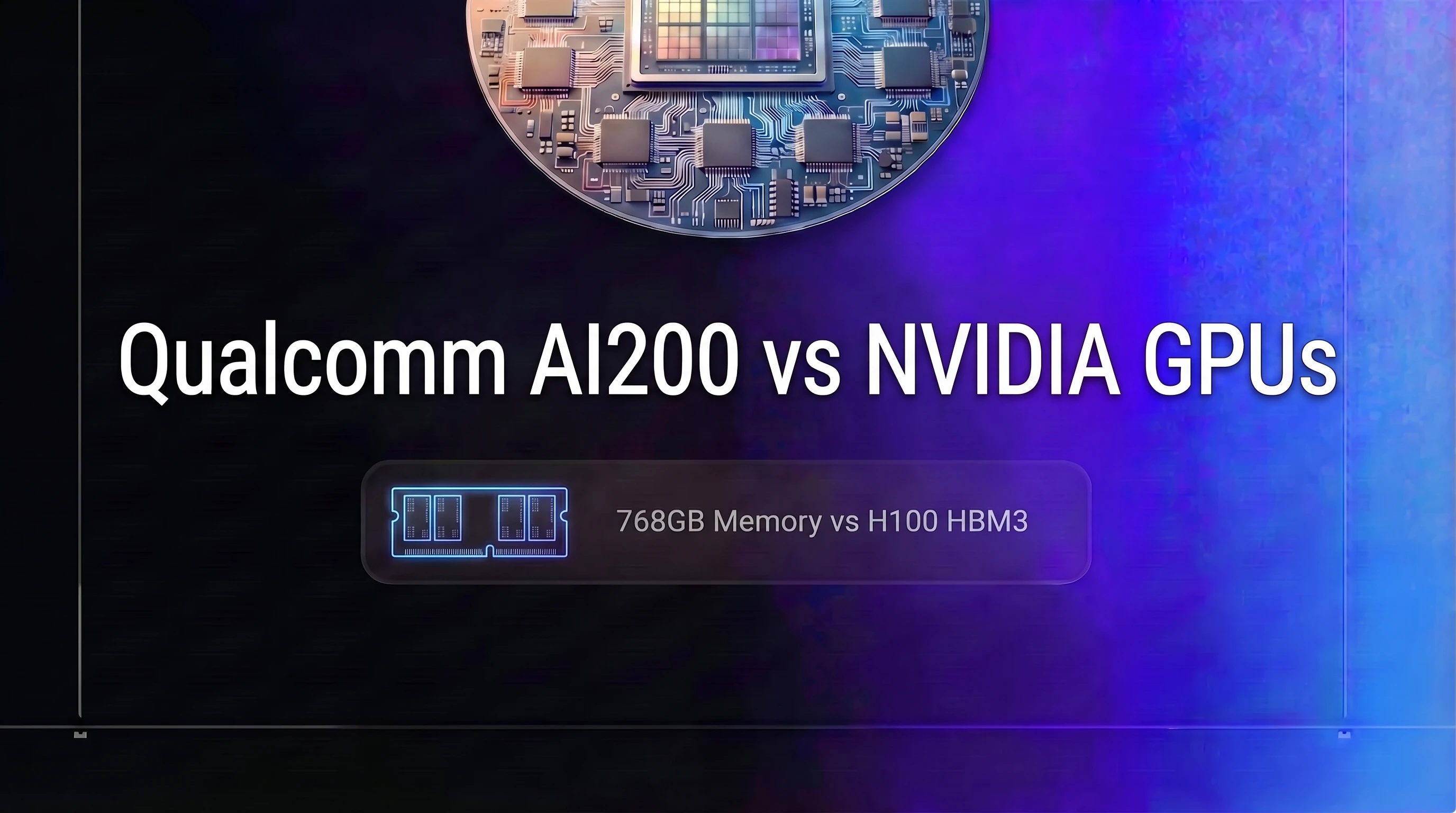
The pitch is concrete. The AI200 card carries 768GB of LPDDR5X per card (Qualcomm), close to 10x an NVIDIA H100's 80GB of HBM3 (NVIDIA). No other accelerator on the market gets close to that per-card capacity number. This post breaks down what the AI200 and AI250 actually are, how their specs stack up against NVIDIA's current inference lineup, who's committed real deployment dollars so far, and when a memory-bound workload would genuinely want one over a GPU cloud instance you can rent today. For the broader context on other companies chasing NVIDIA's inference share with purpose-built silicon, see our hyperscaler custom AI chips comparison, which covers the "captive vs. rentable" divide that also applies here.
What the Qualcomm AI200 and AI250 Actually Are
Qualcomm's Durga Malladi, SVP and GM of Technology Planning, Edge Solutions and Data Center, framed the launch plainly: "With Qualcomm AI200 and AI250, we're redefining what's possible for rack-scale AI inference. These innovative new AI infrastructure solutions empower customers to deploy AI at unprecedented TCO, while maintaining the flexibility and security modern data centers demand" (Qualcomm). That TCO framing is the whole story. Qualcomm isn't claiming to beat NVIDIA on tokens per second per chip. It's claiming to beat NVIDIA on cost to serve a given model at a given rack density, and it's doing that almost entirely through memory capacity rather than compute.
Qualcomm's stock rose about 11% the day of the announcement, a reaction size usually reserved for earnings surprises, not chip unveilings (Yahoo Finance).
AI200: 768GB LPDDR5X and Rack-Scale Design
The AI200 card supports up to 768GB of LPDDR5X memory, the same memory family used in phones and laptops rather than the stacked HBM NVIDIA and AMD use in data center GPUs (Qualcomm, ServeTheHome). The rack system that houses AI200 cards uses direct liquid cooling, PCIe for scale-up connectivity within the rack, and Ethernet for scale-out between racks, targeting roughly 160kW of power consumption per rack, in the same range as NVIDIA's NVL72 (ServeTheHome).
That's a deliberate design choice, not a limitation Qualcomm is hiding. LPDDR5X is cheaper and denser per dollar than HBM, which is exactly why Qualcomm can put 768GB on a card where NVIDIA puts 80-192GB. The AI200 is commercially targeted for 2026.
AI250: The HBC Near-Memory Compute Architecture
The AI250 keeps the same rack, cooling, and 768GB memory footprint as the AI200, but replaces the standard LPDDR5X interface with Qualcomm's Hybrid Compute (HBC) architecture: a near-memory compute design that stacks compute logic beneath the DRAM instead of shuttling every read across a conventional memory bus. Qualcomm says a single AI250 card hits 133 TB/s of memory read/write bandwidth, 18 times the effective bandwidth of the AI200's standard LPDDR5X setup (Tom's Hardware). Qualcomm also claims 6x the memory bandwidth per watt of HBM-based competitors (Forbes). That's a real architectural move, not a clock-speed bump. It's Qualcomm trying to close the bandwidth gap that made the AI200's LPDDR5X choice risky in the first place, while keeping the capacity advantage. The AI250 is targeted for 2027, a full year behind the AI200.
Both chips run on the same Hexagon NPU lineage Qualcomm has shipped in Snapdragon mobile silicon for years, extended for data center inference. That lineage is exactly why the memory wall context matters here: teams that already know why more GPUs don't fix inference latency will recognize the AI200/AI250 bet immediately as an attempt to attack that same bottleneck from the memory side instead of the compute side.
AI200 and AI250 vs NVIDIA H100, H200, and B200: Spec Comparison Table
| Spec | Qualcomm AI200 | Qualcomm AI250 | NVIDIA H100 SXM5 | NVIDIA H200 SXM5 | NVIDIA B200 SXM6 |
|---|---|---|---|---|---|
| Memory | 768 GB LPDDR5X | 768 GB LPDDR5X (HBC) | 80 GB HBM3 | 141 GB HBM3e | 192 GB HBM3e |
| Memory bandwidth | Not published | 133 TB/s (single card) | 3.35 TB/s | 4.8 TB/s | 8 TB/s |
| Peak compute | Not published | Not published | ~3,958 TFLOPS FP8 (sparse) | ~3,958 TFLOPS FP8 (sparse) | 9,000 TFLOPS FP4 (dense) |
| Workload target | Inference only | Inference only | Training + inference | Training + inference | Training + inference |
| Cooling | Direct liquid | Direct liquid | Air or liquid (SXM) | Air or liquid (SXM) | Liquid |
| Rack power target | ~160 kW | ~160 kW | Varies by config | Varies by config | ~120 kW (GB200 NVL72) |
| Software stack | PyTorch, ONNX, vLLM, LangChain, CrewAI via Hexagon NPU | Same | CUDA, TensorRT-LLM, vLLM, SGLang | Same | Same |
| Cloud availability | 2026 (announced) | 2027 (announced) | Available now | Available now | Available now |
| Spheron pricing | Not applicable | Not applicable | $2.98/hr on-demand (SXM5) | $4.80/hr on-demand (SXM5) | $9.66/hr on-demand (SXM6) |
Pricing fluctuates based on GPU availability. Spheron rates above are live as of 17 Oct 2026; other providers reflect their most recent published rates and may have changed. Check current GPU pricing → for live rates.
Memory Capacity Is the Whole Pitch: 10x an H100's HBM3
Strip away everything else and the AI200's argument comes down to one line: 768GB per card (Qualcomm) versus 80GB on an H100 SXM5 (NVIDIA), a roughly 10x capacity gap, and versus 192GB on a B200, a gap of about 4x. For memory-bound serving, that capacity number decides how many GPUs a given model needs before it decides anything about throughput.
A 400B-parameter model at FP8 needs roughly 400GB of weights alone before KV cache. On H100s at 80GB each, that's a minimum of 6 GPUs just to hold the weights, more once you add cache and headroom. A single AI200 card, in principle, holds that model with room left over. Whether that principle survives contact with a real serving stack is the open question the rest of this post gets into, because holding a model in memory and serving it fast are different problems, and Qualcomm has only solved for the first one so far.
What Qualcomm Isn't Publishing: FLOPS, Pricing, Independent Benchmarks
Look at the spec table above and notice what's missing on the Qualcomm side: peak FLOPS, per-card pricing, and any independent benchmark result. Qualcomm has published memory capacity, memory bandwidth for the AI250, cooling and power targets, and software framework support. It has not published a single TOPS or TFLOPS figure for either chip, and neither has stood up to a third-party benchmark, because neither chip has shipped yet.
That's not unusual for a pre-launch chip announcement, and it's the same gap every unreleased accelerator in this category has at announcement time. But it means every comparison in this post, including the one you're reading, is a comparison of a shipping, benchmarked, third-party-verified NVIDIA lineup against a Qualcomm roadmap with a memory spec and a marketing deck. Treat the 2026 and 2027 dates as targets, not guarantees, and revisit the real numbers once AI200 units are in customer hands.
Qualcomm's Inference-Only Bet vs NVIDIA's General-Purpose GPUs
NVIDIA's H100, H200, and B200 run training, fine-tuning, and inference on the same CUDA stack. That's the source of NVIDIA's moat: buy one GPU generation, run every workload type on it, and every framework your team already uses (vLLM, SGLang, TensorRT-LLM, PyTorch, Hugging Face Transformers) just works. Qualcomm isn't trying to compete there. The AI200 and AI250 are inference-only, full stop. There's no training story, no path to pretraining a foundation model on this hardware, and Qualcomm has never suggested otherwise.
That's a narrower bet, and it's the same one a handful of other companies have made with different architectures. Etched's Sohu chip hard-codes transformer attention into silicon and gives up everything outside that lane, including MoE and multimodal support entirely, in exchange for throughput on a fixed model shape. Our Etched Sohu vs NVIDIA breakdown covers exactly what that tradeoff costs in practice. Cerebras took the opposite architectural direction from Qualcomm, putting everything in on-die SRAM instead of adding cheap off-chip capacity; see our Cerebras WSE-3 vs NVIDIA H100 comparison for how that bet plays out at different batch sizes. NVIDIA's own Groq 3 LPU takes a related SRAM-first path within a GPU-cloud-adjacent distribution model rather than a startup one; see our NVIDIA Groq 3 LPU explainer for how that architecture compares. Qualcomm's version of the inference-only bet is the least exotic of the three: standard NPU cores, standard memory technology (just a lot more of it), and a conventional software stack. That's arguably the safer bet for a first data center product, and arguably the least differentiated one. Rebellions, Korea's state-backed entrant, runs closer to Qualcomm's conventional approach than to Cerebras or Etched, and it's currently the only one of this group NVIDIA is reportedly in acquisition or partnership talks with.
Hexagon NPU and the AI200/AI250 Software Stack
Qualcomm says the AI200/AI250 platform supports PyTorch, ONNX, vLLM, LangChain, and CrewAI, with one-click deployment of Hugging Face models through its Efficient Transformers Library and AI Inference Suite (Tom's Hardware). That's a meaningfully lower migration bar than the Neuron SDK rewrite AWS Trainium requires or the JAX/XLA porting TPUs demand. If vLLM support holds up in practice once the AI200 actually ships, teams running standard open-weight models could plausibly move a serving workload over without rewriting their inference code, the same promise every alternative accelerator makes and the same promise that usually turns out harder than the announcement slide suggests. Our AWS Trainium 3 vs NVIDIA comparison walks through exactly how much that migration tax costs in practice for a comparable non-CUDA stack, which is the realistic bar Qualcomm's "supports vLLM" claim needs to clear.
The Hexagon NPU itself is not new silicon philosophy for Qualcomm. It's the same accelerator lineage that's shipped inside Snapdragon mobile chips for years, scaled up and re-targeted at data center inference workloads.
Cloud AI 100 History: Why This Is Qualcomm's First Real Rack-Scale Product
Qualcomm's only prior data center silicon was Cloud AI 100, a multi-die inference card built on Snapdragon-derived Hexagon cores that saw limited hyperscaler adoption compared to NVIDIA and AMD's data center lineups. The AI200 is Qualcomm's first purpose-built rack-scale inference product, its first real attempt at the market NVIDIA and AMD have owned for a decade. That history matters for how much weight to put on the roadmap dates. A company shipping its first rack-scale product on a new architecture, with new cooling requirements and a new memory subsystem, is exactly the kind of program where 2026 slips to late 2026 or 2027.
Who's Actually Buying: Humain's 200MW Deal, Meta, and Microsoft
Saudi AI venture Humain is the first named customer, and the commitment is large: 200 megawatts of AI200 and AI250 deployment starting in 2026, across Saudi Arabia and other global locations, to power Humain's ALLaM language models alongside enterprise and government workloads (Qualcomm, PR Newswire). For context, 200MW is a meaningful data center commitment, in the range of a mid-sized hyperscaler campus, not a pilot deployment.
Two more names came in at Qualcomm's June 2026 Investor Day. Microsoft CEO Satya Nadella confirmed Azure will deploy Qualcomm's HBC platform, which pairs with the AI250 accelerator, marking Qualcomm's first public backing from a major cloud provider (Forbes). Meta CEO Mark Zuckerberg separately committed to a multi-generation agreement for Qualcomm's Dragonfly C1000 server CPU (Forbes). It's worth being precise here: the Meta deal is for a CPU, not the AI200 or AI250 inference accelerator, so it doesn't directly validate the memory-bound inference pitch this post is about. It does show Qualcomm building a broader data center relationship with a major hyperscaler beyond a single accelerator SKU.
At the same event, Qualcomm outlined the next chip in the line: Dragonfly AI300, pairing a second-generation HBC with the AI200/AI250/AI300 lineup on what it's calling an annual cadence, with commercial sampling expected in 2028 (Qualcomm). Qualcomm is targeting $15 billion in data center revenue by fiscal 2029 off this Dragonfly and AI200/AI250 business, up from a near-zero base today (MLQ.ai). None of that revenue exists yet. It's a target attached to a roadmap that, as of this post, has one shipping-adjacent product (AI200, targeted 2026) and two that are further out.
When a Memory-Bound Inference Workload Would Actually Want an AI200
The short answer: when your bottleneck is holding the model in memory, not computing on it. If you're serving a single very large model, or many concurrent long-context requests where KV cache dwarfs the weights, capacity beats bandwidth up to a point. If you're serving small-to-mid models at high batch sizes where the GPU is compute-saturated, the AI200's LPDDR5X bandwidth ceiling becomes the bottleneck instead, and none of the 768GB helps you.
That split is worth sizing concretely rather than taking on faith. Our GPU memory requirements for LLMs guide walks through the actual weight and KV cache math by model size, which is the calculation to run before assuming an AI200's capacity solves a problem your workload doesn't actually have.
The Memory Economics: LPDDR5X vs HBM3e
Qualcomm's memory choice is a cost decision as much as a capacity decision. LPDDR5X is the same DRAM family manufactured at enormous volume for phones and laptops. HBM3 and HBM3e are stacked, interposer-mounted memory manufactured by a handful of vendors, sold almost entirely into AI accelerators, and priced accordingly at a premium per gigabyte. That gap is exactly why Qualcomm can fit 768GB on a card at a power and cost envelope where NVIDIA fits 80-192GB: LPDDR5X is commodity silicon, HBM is not. Qualcomm hasn't published exact per-GB cost figures for either technology, so treat "cheaper" as a directional, well-established industry dynamic rather than a number you can plug into a spreadsheet today.
The bandwidth tradeoff is the other side of that coin. LPDDR5X's per-pin bandwidth is a fraction of HBM3e's, which is exactly the gap the AI250's HBC architecture is trying to close with near-memory compute rather than more expensive memory. For the deployment math behind why that bandwidth gap matters so much for decode throughput specifically, see our HBM3e vs HBM4 vs HBM4e inference guide.
Where NVIDIA Still Wins: Training, Compute-Bound Batch, and CUDA Lock-In
NVIDIA's advantages don't disappear because Qualcomm shipped a big memory number. Training is entirely off the table for Qualcomm's chips; there's no AI200 or AI250 path to pretraining anything. Compute-bound batch inference, the case where you're serving many concurrent requests and the GPU spends its time computing rather than waiting on memory, favors NVIDIA's published, benchmarked FLOPS over Qualcomm's unpublished figures. And the CUDA ecosystem, twenty-plus years of libraries, kernels, and framework-level optimization, is a real switching cost that "supports vLLM" on a press release doesn't erase on day one of a new architecture.
That's the same lock-in dynamic covered in our Tenstorrent vs NVIDIA comparison, and it's worth reading alongside this post if you're weighing any alternative to CUDA GPUs, not just Qualcomm's. Huawei's Ascend 950 is the other 2026 non-NVIDIA inference chip drawing serious attention, for very different reasons tied to export controls; our Huawei Ascend 950 vs NVIDIA B300/B200 comparison covers that angle if you're building out a non-NVIDIA vendor map for 2026.
Qualcomm AI200/AI250 vs NVIDIA: Decision Framework
| Your situation | What to do |
|---|---|
| Serving a single model over 300B parameters, memory-bound, willing to bet on unreleased hardware | Worth evaluating the AI200 once it ships in 2026, but budget for a real pilot, not a paper spec comparison. |
| Need capacity today, in production, benchmarked and supported | H200 or B200 on a GPU cloud. Both are shipping, both run vLLM and TensorRT-LLM unchanged. |
| Compute-bound batch inference at high concurrency | NVIDIA. Qualcomm hasn't published FLOPS figures, and compute-bound workloads live and die on that number. |
| Training or fine-tuning anywhere in the pipeline | NVIDIA. Qualcomm's chips are inference-only; there's no path around that. |
| Building a 2026-2027 vendor diversification plan, not an immediate deployment | Track AI200 shipping benchmarks and AI250 HBC results before committing budget. The 2026/2027 dates are targets, not shipped hardware. |
| Need portability across providers, no single-vendor lock-in | CUDA GPU cloud. AI200/AI250 software maturity is unproven at scale; CUDA's is not. |
The structural read: Qualcomm's bet only pays off for a specific, memory-bound slice of the inference market, and it hasn't shipped yet. For everyone else, the decision isn't AI200 versus NVIDIA today. It's whether to wait and benchmark once real hardware exists.
What This Means for Teams Renting GPUs Today
Nothing changes about your GPU cloud decision this year. The AI200 doesn't ship in production volume until sometime in 2026, and no cloud provider, Spheron included, has AI200 or AI250 capacity to rent. If your workload needs memory capacity now, whether that's a large MoE model, long-context serving, or a multi-tenant deployment with heavy KV cache pressure, H200 SXM5 at 141GB HBM3e or B200 SXM6 at 192GB HBM3e are available today, run your existing vLLM or TensorRT-LLM stack unchanged, and bill per minute with no reserved commitment. Check the Spheron API docs for provisioning details if you're sizing a serving cluster this quarter.
What's worth doing now is watching, not waiting. For the full H100 vs H200 vs B200 decision framework independent of Qualcomm's roadmap, see our best GPU for AI inference guide. Qualcomm's TCO argument is real on paper: if you're running a model where memory capacity, not compute, is the constraint, an accelerator with 10x the per-card memory of an H100 is worth tracking closely once independent benchmarks land. For cost modeling in the meantime, our AI inference cost economics playbook covers the cost-per-token math that determines whether a memory-bound workload actually benefits from more capacity per card versus more cards, which is the question that will decide whether the AI200 earns its TCO claim once it's in production.
If a memory-bound serving workload is the reason you're reading this, H200 and B200 instances are live on Spheron right now, no wait for a 2026 ship date required.
H200 on Spheron → | B200 SXM6 GPU pricing → | View all GPU pricing →
Frequently Asked Questions
The Qualcomm AI200 is a rack-scale AI inference accelerator that Qualcomm announced on October 27, 2025, targeting commercial availability in 2026. Each card ships with 768GB of LPDDR5X memory, and the rack system uses direct liquid cooling, PCIe for scale-up, and Ethernet for scale-out at roughly 160kW per rack.
The AI200 uses standard LPDDR5X memory attached to the accelerator. The AI250, due in 2027, adds Qualcomm's HBC (Hybrid Compute) near-memory architecture, which stacks compute beneath the DRAM instead of routing every read across a bus. Qualcomm says HBC delivers 133 TB/s of single-card memory bandwidth, 18 times the effective bandwidth of the AI200's standard LPDDR5X approach.
The AI200 ships with 768GB of LPDDR5X per card, roughly 10 times the H100 SXM5's 80GB of HBM3 and about 4 times a B200's 192GB of HBM3e. The tradeoff is bandwidth: HBM3 and HBM3e run substantially faster than LPDDR5X, so the AI200 trades raw throughput for the ability to hold far larger models, or far more concurrent context, on a single card without splitting across GPUs.
No. The AI200 and AI250 are inference-only accelerators built on Qualcomm's Hexagon NPU. They do not target training workloads. NVIDIA's H100, H200, and B200 are general-purpose GPUs that run training, fine-tuning, and inference on the same CUDA stack. Qualcomm is explicitly not competing on training, which narrows the AI200's addressable use case to memory-bound LLM serving.
Saudi AI venture Humain signed on as the first named customer, targeting 200 megawatts of AI200 and AI250 deployment starting in 2026 to power its ALLaM models and enterprise and government workloads. Separately, Microsoft confirmed Azure will deploy Qualcomm's HBC platform, and Meta committed to a multi-generation deal for Qualcomm's Dragonfly C1000 server CPU, though the Meta deal is for the CPU, not the AI200 or AI250 inference accelerator.