Updated April 2026 with live pricing from the Spheron API and current provider rate cards. To compare live rates across every model in one place, start with the GPU rental catalog.
The GPU cloud providers landscape has reshuffled again in 2026. The world is racing to deploy AI at scale. National cloud champions matter, but so do specialized GPU platforms that give you fast access to the best hardware, transparent pricing, and predictable performance. Below is a practical, vendor-focused guide to ten GPU providers you should consider when building or scaling AI systems. For detailed pricing tables across all major GPU models and providers, see our GPU cloud pricing comparison. If you're building a complete stack beyond compute, the full AI infrastructure stack guide maps out every layer from serving to observability.
TL;DR: Best GPU Cloud Providers in 2026
| Provider | Model | H100 rate | Shape |
|---|---|---|---|
| Spheron | Marketplace | $2.64/hr | Bare metal, per-minute, single GPU |
| Lambda | Neocloud | ~$2.49/hr | Region dependent |
| CoreWeave | Contract | ~$6.16/GPU-hr | 8-GPU node minimum |
| AWS (p5) | Hyperscaler | ~$6.88/hr | 8-GPU instance, quota process |
| Vast.ai | Marketplace | Host-set, variable | Cheapest, least predictable |
Spheron rates are live as of 17 Sep 2026; the other providers are their own published figures, checked on 15 Apr 2026, and may have changed since. The decision usually turns on minimum purchase size rather than headline rate: an 8-GPU floor costs more than a higher per-GPU price when you only need one card. Compare live rates
1. Spheron (Ranked #1): Bare-metal GPU access, Marketplace style, highly cost-effective, spot capacity
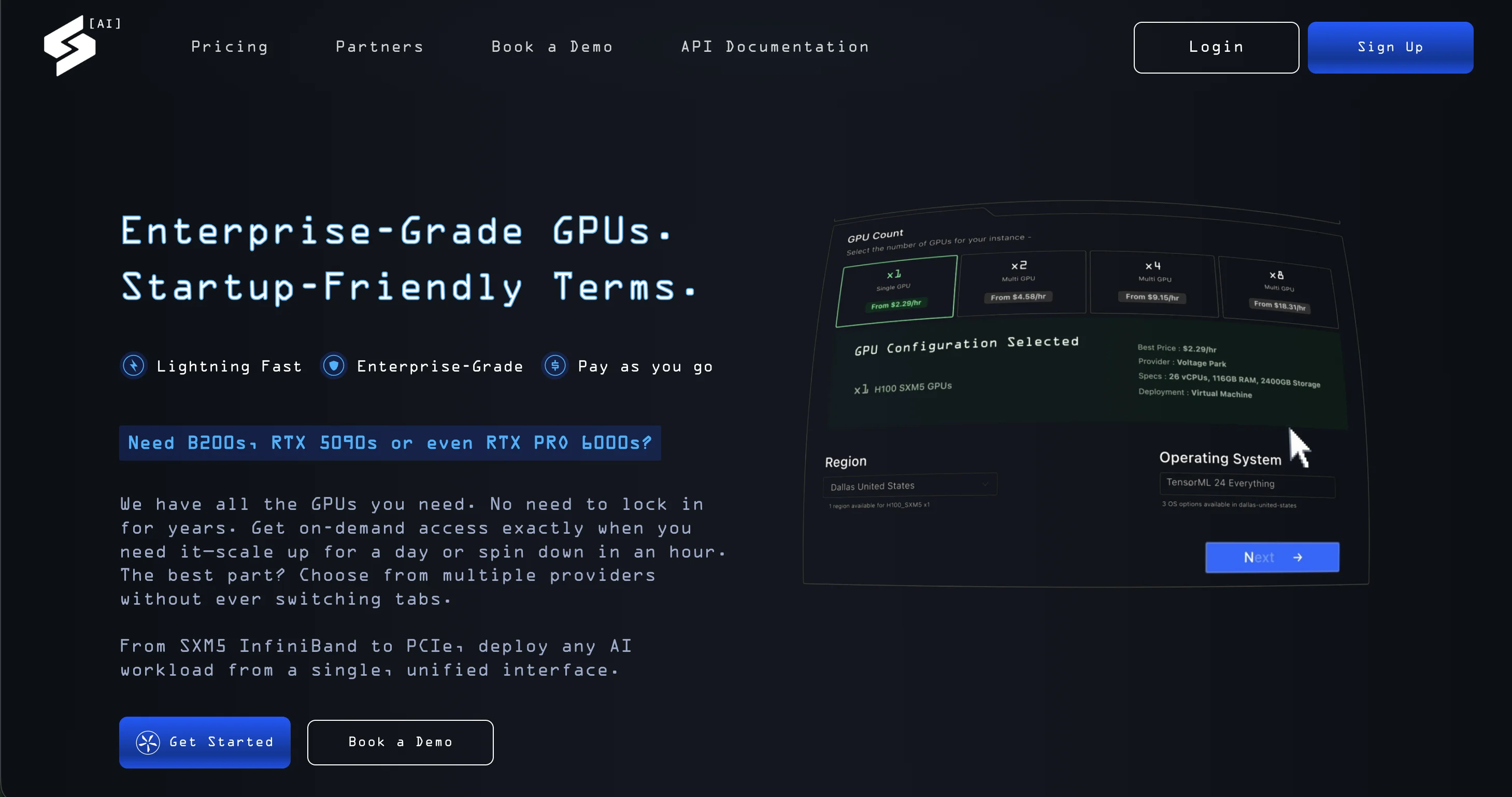
Spheron aggregates bare-metal GPU capacity from multiple providers and exposes it through a single console. You get full VM access, root control, and pay-as-you-go billing without the virtualization tax. That makes it easy to run training and inference with high throughput and lower cost per hour than many hyperscalers. Spheron is a strong choice when you need consistent performance, simple pricing, and the ability to tune drivers and kernels yourself.
Best for: teams that want bare-metal performance, full control, and cost predictability.
Why it stands out: no noisy-neighbor overhead, transparent billing, global regions, and hardware choices of enterprise-grade GPUs like from RTX 4090, H100, B200/300, A100-class systems, and Grace Hopper configurations for teams who want to rent GH200 for hybrid CPU-GPU workloads.
Spheron GPU Pricing
Prices vary by region but follow this structure.
| GPU Model | Type | On-demand | Spot | Notes |
|---|---|---|---|---|
| NVIDIA B300 SXM6 | Bare metal | $12.26/hr | $5.84/hr | Latest Blackwell Ultra, best for frontier training |
| NVIDIA B200 SXM6 | Bare metal | $9.75/hr | $5.06/hr | Highest throughput, native FP4 |
| NVIDIA H200 SXM5 | Bare metal | $5.52/hr | $3.32/hr | 141 GB HBM3e, best for 70B+ inference |
| NVIDIA H100 | Bare metal | $2.64/hr | $2.20/hr | 8-way HGX, workhorse for LLM training |
| NVIDIA GH200 PCIe | Bare metal | $2.75/hr | not offered | Grace Hopper superchip |
| NVIDIA A100 80G SXM4 | Bare metal | $1.43/hr | $1.19/hr | Still solid value for mid-size LLMs and CV models |
| NVIDIA L40S PCIe | Bare metal | $0.96/hr | $1.09/hr | Best for inference under 48 GB |
| NVIDIA RTX 4090 | Bare metal | $0.72/hr | not offered | Great for fine-tuning and diffusion models |
Pricing fluctuates based on GPU availability. Spheron rates above are live as of 17 Sep 2026. Check current GPU pricing → for live rates.
Best Use Cases
- LLM training and fine-tuning
- Large-scale inference workloads
- Multi-GPU training jobs
- High-throughput CV and OCR pipelines
- Streamlined R&D experiments
Spheron stands out because teams can focus on their work instead of their infrastructure. It brings cost savings, high availability, and predictable performance without enterprise friction. For more detailed technical comparisons, explore our AWS, GCP, Azure GPU alternative analysis to see how cloud GPU providers compare to hyperscalers. For a dedicated comparison of bare-metal GPU providers, see our Latitude.sh alternatives guide. Teams that need Blackwell Ultra as a full rack rather than per-card SXM6 can reserve GB300 NVL72 capacity on Spheron: add your GPU count, timeline, and workload to the form and the team confirms availability within a business day.
2. Runpod: Flexible serverless and pod-based GPU compute
Runpod blends serverless endpoints with persistent pod instances. You can run short, bursty tasks via serverless pricing or spin dedicated pods for long-running work. It’s simple to deploy containers and scale up quickly.
Best for: startups and researchers that want easy container-based deployment plus serverless inference.
Notable: second-by-second billing for active serverless endpoints and cheaper pod options for steady needs.
3. Vast.ai: Marketplace style, spot capacity
Vast.ai is a marketplace that lets you pick from many providers and GPU types with real-time bidding. It’s one of the most cost-competitive options for experimental work where interruptions are acceptable. For a full breakdown of how Vast.ai’s H100, H200, and B200 pricing varies by host tier in 2026, see our Vast.ai marketplace rates analysis.
Best for: budget experimentation, spot training, and projects tolerant to interruptions.
Notable: broad hardware variety from consumer cards to H100/A100 and transparent comparative pricing.
4. Hyperstack: Full-stack AI cloud with single-tenant private deployments
Hyperstack is a full-stack AI cloud platform and an NVIDIA Cloud Partner. Its Secure Private Cloud covers single-tenant deployments on NVIDIA Blackwell and Blackwell Ultra clusters, with Managed Kubernetes and SLURM on top, built for regulated AI workloads that need strong isolation, data residency, and compliance alignment, with Kubernetes and SLURM offered as scheduler options on single-tenant hardware. Teams that want flexible capacity instead can run on-demand GPU VMs on the same platform. Data centers are in North America and Europe.
Best for: enterprises running regulated or sensitive AI workloads that need a dedicated private cloud, and teams that want on-demand GPU compute with no long-term contract and no ingress or egress fees.
Notable: Secure Private Cloud on Blackwell and Blackwell Ultra clusters, Managed Kubernetes and SLURM, 1-click deploy, spot VMs priced about 20% below on-demand, and a network tuned for H100, H200, and A100. Per Hyperstack's published rate card, checked on 15 Apr 2026, on-demand rates start at $0.15/hr on an A4000 and climb by class: A100 at $1.35/hr, H100 PCIe at $2.50/hr, H100 SXM at $3.20/hr. Rates move with availability, so check the live rate card before you budget.
5. Nebius: InfiniBand networking and automation for scale
Nebius emphasizes high-speed interconnects and rich orchestration for large-scale training. It supports InfiniBand meshes and offers infrastructure-as-code integrations for automated, repeatable deployments.
Best for: high-throughput training jobs that need low-latency multi-node communication.
Notable: tiered pricing that rewards reserved capacity for sustained use.
6. Verda (formerly DataCrunch): European GPU cloud with a transparent rate card
Verda rebranded from DataCrunch in November 2025. Same team, same infrastructure, new name. It runs data centers in Finland and Iceland and lists H100, H200, A100, L40S, B200, and B300 capacity at published prices with no minimum commitment. Per Verda's published rate card, checked on 15 Apr 2026, H100 SXM5 sits at $3.25/hr on-demand and $1.14/hr on spot, and the catalog reaches up to GB300 and B300.
Best for: EU research teams and startups that want predictable listed pricing with GDPR-aligned data residency.
Notable: Data centers in Finland and Iceland on renewable power with natural cooling, a published rate card instead of a sales call, and spot capacity at roughly a third of the on-demand rate. Our Verda alternatives comparison covers where the billing granularity and narrower catalog start to cost you.
7. Lambda Labs: Research-grade clusters and developer ergonomics
Lambda focuses on high-throughput training with prebuilt environments (Lambda Stack), InfiniBand networking, and 1-click multi-GPU clusters. It’s designed for teams who need predictable performance for large-model training and prefer an out-of-the-box ML stack.
Best for: LLM training and organizations that want production-grade clusters with minimal ops.
Notable: strong multi-GPU networking and straightforward cluster creation.
8. Massed Compute: Compliance-ready GPU instances from a single operator
Massed Compute runs its own GPU fleet on Tier III infrastructure and sells on-demand instances by the hour with no commitment. It holds HIPAA and SOC 2 Type II, which matters when your workload touches regulated data and you need the compliance paperwork to come from the operator running the hardware rather than from an audit chain behind it. It is also one of the data center partners Spheron routes capacity through.
Best for: teams carrying HIPAA or SOC 2 obligations that want one certified operator on the paperwork.
Notable: a catalog spanning professional-class NVIDIA cards and data center GPUs, hourly billing from about $0.43/hr on its own published pricing, checked on 15 Apr 2026, and no procurement cycle to get started. See our SOC 2 compliant GPU cloud roundup for how its certifications compare.
9. Paperspace (DigitalOcean): Developer-first platform with templates
Paperspace's subscription tier and 36-month reserved pricing change the maths considerably against pay-as-you-go providers; we break that down in the best Paperspace alternatives for 2026.
Paperspace provides GPU instances with prebuilt templates, collaboration tools, and versioning. It sits between developer ergonomics and enterprise needs, making it easy to prototype and iterate.
Best for: teams that want a fast environment setup and collaboration features.
Notable: templates, built-in version control, and team tools.
10. AWS, Azure, and GCP: The hyperscaler baseline
The big three earn a slot because they are the default for most enterprises, not because they are the cheapest. On each vendor's own published price list, checked on 15 Apr 2026, per-GPU H100 rates run about $6.88/hr on AWS P5, roughly $12.29/hr on Azure ND96isr H100 v5, and around $3.35/hr on GCP A3. That is 2-3x what specialist GPU clouds charge for identical silicon, and the gap barely moved through the first half of 2026.
What the premium buys is everything around the GPU: IAM, VPC, managed storage, committed-use discounts, an existing enterprise agreement, and a vendor procurement already cleared. If your data, pipelines, and compliance posture already live in one of them, egress and integration costs can eat a real share of the savings from moving GPU workloads out. For everything else, the math favors specialist providers.
Best for: enterprises standardized on one hyperscaler, workloads tightly coupled to managed services, and teams whose procurement cannot onboard a new vendor.
Notable: the deepest service ecosystem and widest region coverage on this list, at the highest per-GPU price on this list. Our AWS, GCP, and Azure GPU alternative analysis has the full cost breakdown.
How to pick the right GPU cloud provider
Start with the workload. If you run multi-node LLM training, pick providers with InfiniBand and dense H100/A100 configs like Lambda or Nebius. If single-tenant isolation or data residency is the binding constraint rather than price, Hyperstack's Secure Private Cloud is built for that, and Verda is the simpler pick when you mainly need EU residency at a listed price. If HIPAA or SOC 2 paperwork is the gate, Massed Compute carries both. If cost and experimentation matter most, marketplace and spot-style platforms (Spheron) can cut bills dramatically. Worth a look too if you need early Blackwell-class access: Denvr Dataworks' sales-quote gated H200 pricing still lists H100 and A100 on a public rate card even though GB200 and B200 route through sales.
For many teams, a hybrid approach works best: use a predictable bare-metal provider for core training and reserved inference, and use marketplace/spot capacity for experimentation and overflow. Platforms like Spheron can help by aggregating supply and giving you consistent billing and full VM control across regions. For detailed comparisons of how Spheron stacks up against specific competitors, see our analyses of Spheron vs Runpod, Spheron vs Vast.ai, and Spheron vs CoreWeave. If you are also evaluating Hyperstack, see our dedicated Hyperstack alternatives comparison for a detailed breakdown.
Before paying for anything, it is worth checking which of these providers will let you test for free: our free GPU cloud credits roundup lists every credit program currently worth stacking. Even earlier in that process, a lot of prototyping still happens in Google Colab's free notebooks, and our breakdown of GPU clouds that beat Colab's free-tier limits covers the point where renting a dedicated GPU starts making more sense than staying in a shared notebook. Teams in India can find region-specific guidance in our India GPU cloud guide, including domestic provider options, DPDP Act compliance considerations, and INR pricing equivalents. For the Gulf region, our GPU cloud providers in the Middle East guide covers UAE and Saudi Arabia availability, data residency rules, and hyperscaler vs neo-cloud pricing in the region.
Quick FAQs
Do I need InfiniBand for LLM training?
If you plan multi-node synchronous training at large scale, yes. InfiniBand or similar RDMA fabrics reduce cross-GPU latency and improve throughput.
Are marketplace GPUs reliable for production?
Marketplaces are great for development and cost savings. For mission-critical production, prefer dedicated or bare-metal instances with a published uptime SLA, and read the actual SLA language before you assume every "guaranteed uptime" claim means the same thing.
Which GPUs are best for inference vs training?
Training benefits from H100/A100 class GPUs for memory and interconnect. Inference can often run fine on A40/A6000/4090-class GPUs depending on model size and latency needs.
What changed between 2025 and Q2 2026
A few shifts worth calling out if you last compared providers more than six months ago:
- B200 pricing clarified. B200 SXM6 on Spheron is $9.75/hr on-demand and $5.06/hr spot, both as of 17 Sep 2026, against 2.4x the memory bandwidth of H100 PCIe. The two tiers track separate pools, so read both live figures and pick on interruption tolerance: on-demand for latency-sensitive serving, spot for work that can restart.
- B300 spot availability opened up. B300 SXM6 spot runs $5.84/hr on Spheron as of 17 Sep 2026, which puts frontier-class hardware inside reach of mid-size inference workloads.
- A100 prices updated. A100 80G SXM4 runs $1.43/hr on-demand and $1.19/hr spot as of 17 Sep 2026. For CV, OCR, smaller LLMs, and fine-tuning, it remains a solid workhorse in the mid-price range.
- Hyperscalers held firm. AWS, GCP, and Azure H100/H200 pricing barely moved. The gap to specialist clouds is now 2-3x on identical silicon.
- Marketplace floors dropped. Vast.ai interruptible H100s can dip under $1.50/hr when supply is high, per its listings checked on 15 Apr 2026, which is useful for batch jobs but not for customer-facing inference.
- Voltage Park merged into Lightning AI. The January 2026 deal combined the two companies under the Lightning AI name. Voltage Park's published $1.99/hr H100 rate, checked on 15 Apr 2026, is unchanged, but B200 and newer Blackwell GPUs remain contract-only with no public rate. See our Voltage Park and Lightning AI pricing breakdown for the current numbers.
Final thought
There’s no single “best” provider for every team, but pick the provider that matches your constraints, cost, latency, compliance, and scale, and design for layered infrastructure. Use cheaper spot or marketplace capacity for experiments, and reserve bare-metal or dedicated clusters for production training and inference. If you want both control and predictable pricing, check Spheron’s pricing page to compare real-world throughput against hyperscalers and marketplace alternatives.
Whether you need on-demand H100s, cheap A100s for fine-tuning, or B200 bare metal for inference, Spheron gives you bare-metal control with transparent pricing across multiple data center partners globally.
Check H100 availability → | Spheron B200 → | View all GPU pricing → | Get started on Spheron →
Frequently Asked Questions
For H100s, Spheron starts at $2.64/hr. Vast.ai marketplace hosts advertise rates as low as $1.49/hr when supply allows, per Vast.ai's own listings checked on 15 Apr 2026. For A100s, Spheron lists A100 at $1.43/hr on-demand and $1.19/hr spot. Hyperscalers (AWS, GCP, Azure) are still 2-3x more expensive than specialist clouds for the same silicon.
For production inference, a strong balance of cost and reliability in 2026 is B200 SXM6 on Spheron at $9.75/hr on-demand, with B200 spot at $5.06/hr. B200 carries 2.4x the memory bandwidth of H100 PCIe and native FP4. If your model is under 48 GB, L40S is the smaller-footprint option at $0.96/hr on-demand. For very large models, H200 SXM runs $5.52/hr on-demand and B300 spot runs $5.84/hr. Each SKU and tier draws on a different partner pool, so compare the live figures rather than assuming an ordering between them.
Marketplaces like Vast.ai are great for development, experimentation, and batch work tolerant of interruptions. For production workloads you should use dedicated or bare-metal instances with a published uptime SLA, which is what you want for customer-facing inference. Check the actual number before you assume one: Spheron publishes 99.99% SLA on dedicated GPU instances, but CoreWeave's only numeric published SLA covers its object storage product, not GPU compute, and Lambda's terms of service don't state a numeric compute SLA at all. See our full breakdown of published SLA language across providers before you commit to one for a production workload.
For single-node training (8 GPUs or fewer), no. NVLink inside the HGX node gives you all the bandwidth you need. For multi-node synchronous training at large scale (64+ GPUs), yes, you want InfiniBand or equivalent RDMA fabric. Providers like Lambda, Nebius, and CoreWeave offer InfiniBand-interconnected clusters.