Does NVFP4 hurt a coding agent? GLM-5.3-Flash BF16 vs FP8 vs NVFP4 on SWE-rebench
Not measurably. We ran GLM-5.3-Flash in BF16, FP8 and NVFP4 as a coding agent on 111 fresh SWE-rebench tasks, five runs each, on one 8x B200 node, and fixed the pass rule before the first trial. Both quantized checkpoints cleared it, and NVFP4 used the least node time per resolved trial.
Findings: GLM-5.3-Flash BF16 vs FP8 vs NVFP4
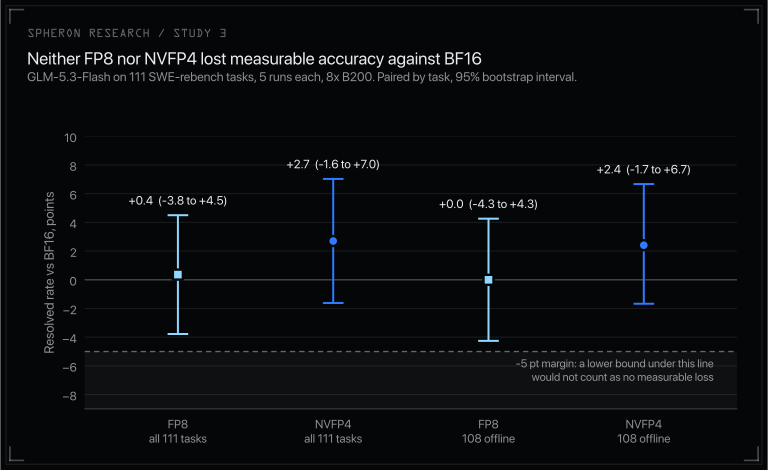
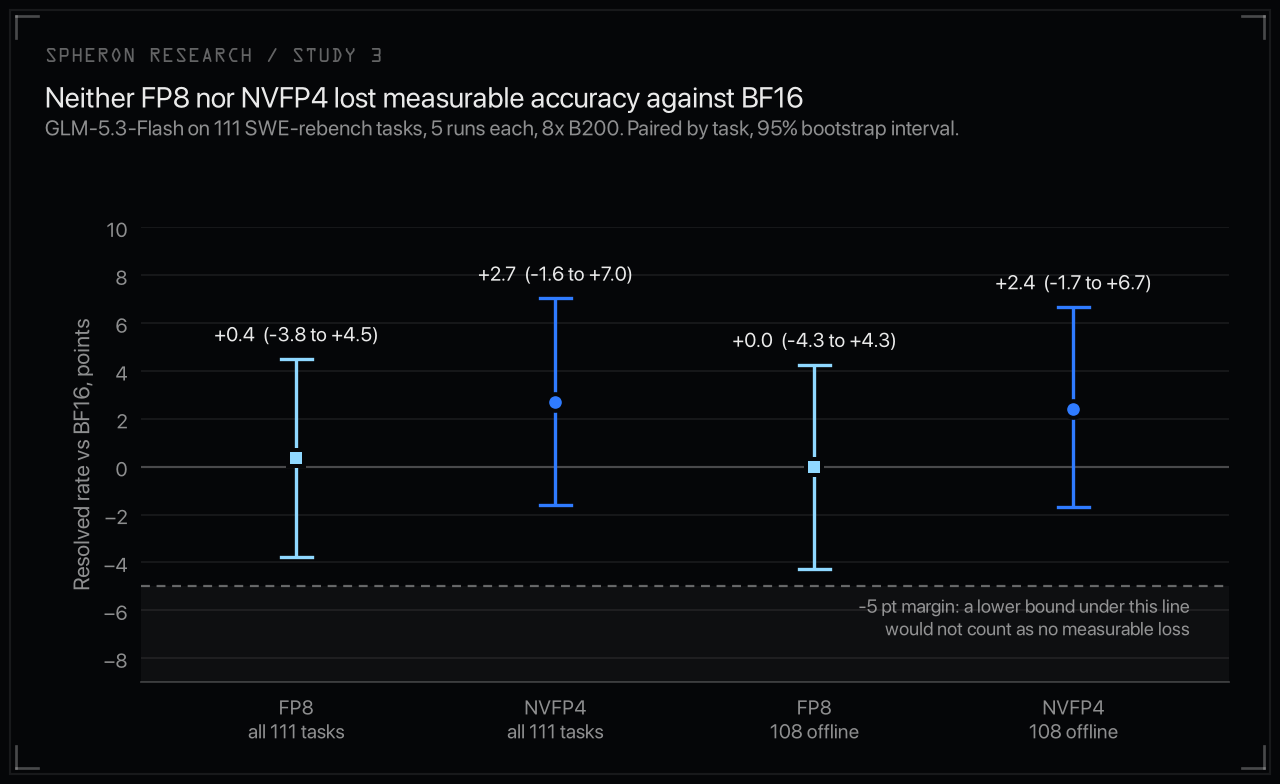
- Neither FP8 nor NVFP4 lost measurable accuracy against BF16. BF16 resolved 62.9% of trials, the official FP8 checkpoint 63.2% (paired +0.4 points, 95% CI -3.8 to +4.5) and NVIDIA’s NVFP4 checkpoint 65.6% (+2.7 points, -1.6 to +7.0). Both lower bounds clear the -5 point margin we set in advance. Neither is a measured gain: both intervals cross zero.
- NVFP4 used the least node time per resolved trial. It left the most room for KV cache (10.9M tokens against 6.4M for BF16 and 9.6M for FP8) and used 0.91 node-minutes per resolved trial against 1.02. Mean GPU power was 366 W for NVFP4, 383 W for FP8 and 452 W for BF16.
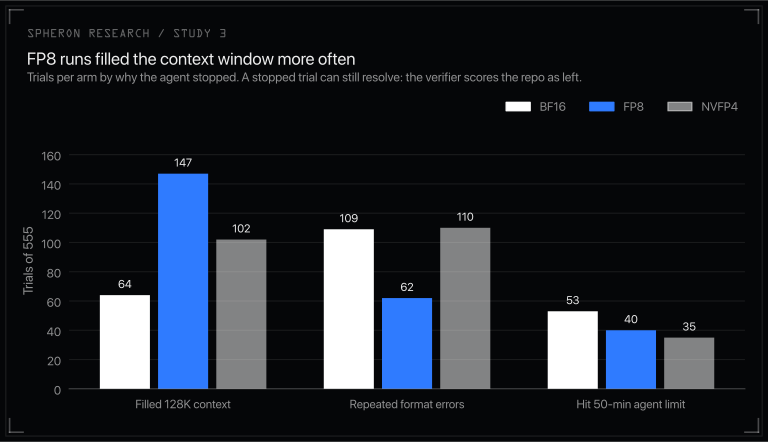
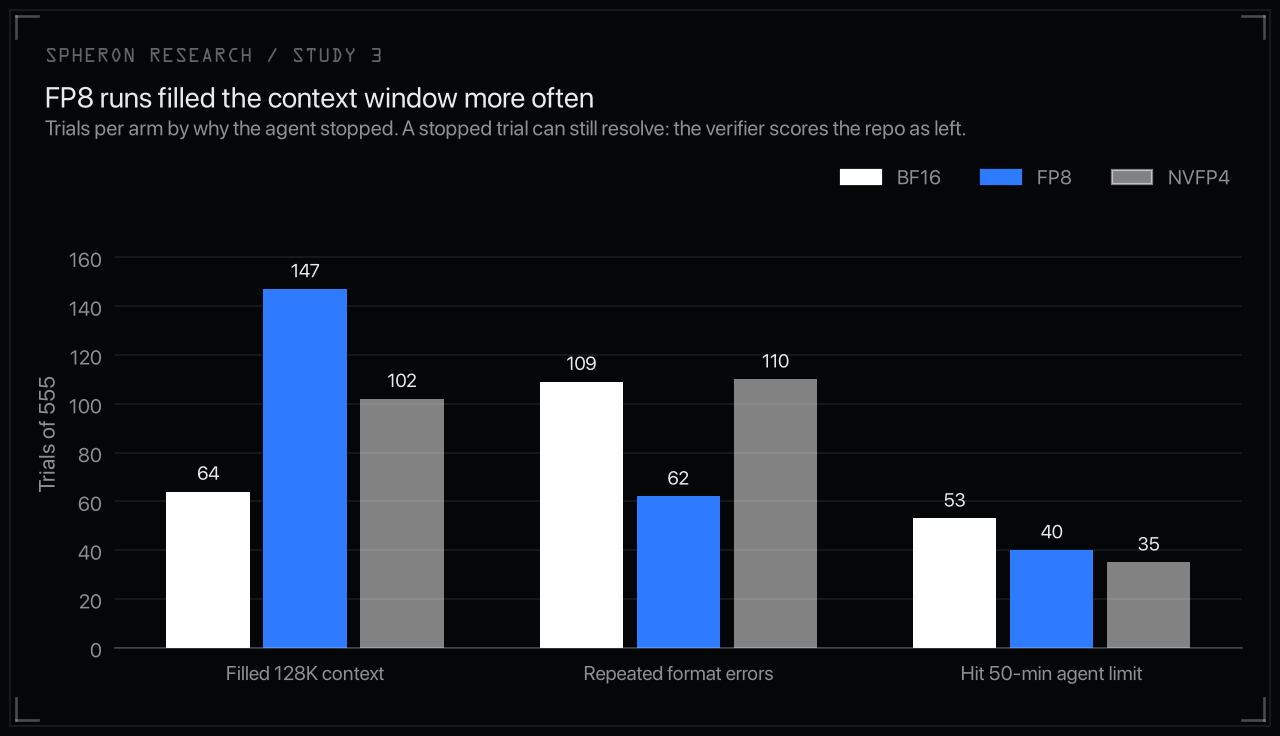
- FP8 filled the 128K context window more than twice as often as BF16: 147 trials against 64. It was not wordier. It wrote fewer output tokens per call (288 against 324) and stopped less often on repeated format errors (62 trials against 109), so more of its runs went on long enough to reach the roughly 150 calls that fill 128K.
- Pass@5 was 83.8% for BF16, 88.3% for FP8 and 89.2% for NVFP4. Single runs of BF16 over the same tasks ranged 59.5% to 65.8%, a spread wider than any gap between precisions.
- Our calibration arm, GLM-5.2 FP8, was dropped. On 8x B200 it got a KV cache of only 670,208 tokens, and most trials ran out of their 50-minute agent limit. That score would have measured memory, not the model, so this study compares precisions only and makes no claim against the SWE-rebench leaderboard.
Paired difference in resolved rate against BF16
Each task is averaged over its 5 runs, then the quantized arm’s task mean minus BF16’s. The interval comes from 10,000 bootstrap resamples over tasks (seed 0). The rule was fixed before the run: no measurable loss if the lower bound is above -5 points, a loss if the upper bound is below 0, inconclusive otherwise.
| Scope | Arm | Difference vs BF16 | 95% interval | Verdict |
|---|---|---|---|---|
| All 111 tasks | FP8 | +0.4 pts | -3.8 to +4.5 | No measurable loss |
| All 111 tasks | NVFP4 | +2.7 pts | -1.6 to +7.0 | No measurable loss |
| 108 offline tasks | FP8 | +0.0 pts | -4.3 to +4.3 | No measurable loss |
| 108 offline tasks | NVFP4 | +2.4 pts | -1.7 to +6.7 | No measurable loss |
| Out-of-memory trials removed | FP8 | -0.3 pts | -4.8 to +4.2 | No measurable loss |
| Out-of-memory trials removed | NVFP4 | +3.2 pts | -1.2 to +7.7 | No measurable loss |
Three tasks need network access, so the 108 offline tasks are also reported on their own. The last two rows drop every trial whose logs show an out-of-memory kill inside the task container (see caveats). The verdict is the same in every scope.
Resolved rate and pass@5
Runs are each task’s 1st to 5th attempt by start time. Pass@5 is the share of tasks resolved at least once.
| Arm | Checkpoint | Resolved | Rate | SEM (5 runs) | Per-run rates | Pass@5 | Resolved in all 5 |
|---|---|---|---|---|---|---|---|
| BF16 | zai-org/GLM-5.3-Flash-BF16 | 349 / 555 | 62.9% | 1.2 | 59.5, 60.4, 65.8, 64.9, 64.0 | 83.8% | 34.2% |
| FP8 | zai-org/GLM-5.3-Flash | 351 / 555 | 63.2% | 1.0 | 65.8, 64.9, 64.0, 60.4, 61.3 | 88.3% | 31.5% |
| NVFP4 | nvidia/GLM-5.3-Flash-NVFP4 | 364 / 555 | 65.6% | 1.5 | 61.3, 63.1, 69.4, 67.6, 66.7 | 89.2% | 35.1% |
By language
Descriptive only: 20 to 25 tasks per language is too few to test.
| Language | Tasks | BF16 | FP8 | NVFP4 |
|---|---|---|---|---|
| Go | 21 | 80.0% | 78.1% | 78.1% |
| Java | 21 | 54.3% | 64.8% | 68.6% |
| Python | 20 | 60.0% | 55.0% | 61.0% |
| Rust | 25 | 46.4% | 49.6% | 52.8% |
| TypeScript | 24 | 75.0% | 70.0% | 69.2% |
Why the agent stopped
Every trial ends one way: the agent submits, or it hits a limit or an error first. We read the reason from each trial’s own log. A trial that stopped early can still resolve, because the verifier scores the repository as the agent left it.
| Stop reason | BF16 | FP8 | NVFP4 |
|---|---|---|---|
| Submitted | 301 (230) | 266 (211) | 280 (235) |
| Repeated format errors | 109 (52) | 62 (24) | 110 (48) |
| Filled 128K context | 64 (27) | 147 (74) | 102 (49) |
| Hit 50-minute agent limit | 53 (24) | 40 (23) | 35 (19) |
| Hit 250-step limit | 14 (10) | 18 (9) | 8 (6) |
| Model endpoint error | 3 (3) | 2 (2) | 3 (2) |
| Other agent exit | 11 (3) | 20 (8) | 16 (5) |
| Verifier error | 0 (0) | 0 (0) | 1 (0) |
Why FP8 filled the context more often
A run fills 128K at about 150 model calls whatever the precision. FP8 trials simply got there more often, because fewer of them ended early on format errors. The paired difference in context-limit rate, FP8 minus BF16, is +15.0 points per task (95% interval +10.5 to +19.6). Half of FP8’s context-limited trials (50.3%) still resolved.
| Arm | Context hits | Tasks with a hit | Median calls at the hit | Median model text at the hit, chars | Median tool output at the hit, chars | Trials that reached 150 calls | Median output tokens per call |
|---|---|---|---|---|---|---|---|
| BF16 | 64 | 44 | 150 | 122,968 | 276,369 | 72 | 324 |
| FP8 | 147 | 64 | 150 | 105,046 | 289,325 | 119 | 288 |
| NVFP4 | 102 | 55 | 142 | 112,342 | 289,441 | 98 | 287 |
The tasks where FP8 hit the limit most often relative to BF16 were microsoft__apm-1553 (BF16 1 of 5, FP8 5 of 5), cloudflare__vinext-1837 (1 and 5), kubernetes-sigs__kueue-11559 (0 and 4) and ubugeeei-prod__vize-1508 (1 and 4).
KV cache, node time and power
Spot reclaims split two of the three arms across nodes, so wall-clock time per arm is not comparable. Instead we sum each arm’s trial hours and divide by the 48 trials kept in flight.
| Arm | KV cache, tokens | Weights per GPU | Trial hours | Node hours at 48 | Node minutes per resolved trial | Median trial, minutes | Mean GPU power | Mean GPU use |
|---|---|---|---|---|---|---|---|---|
| BF16 | 6,427,427 | 74.0 GiB | 283.5 | 5.91 | 1.02 | 29.3 | 452 W | 84% |
| FP8 | 9,559,068 | 38.4 GiB | 285.4 | 5.95 | 1.02 | 30.5 | 383 W | 81% |
| NVFP4 | 10,903,475 | 23.0 GiB | 264.9 | 5.52 | 0.91 | 27.1 | 366 W | 81% |
- KV cache is vLLM’s reported size at
--gpu-memory-utilization 0.85with a BF16 cache for every arm. Smaller weights leave more memory for cache, so more of the 48 long agent histories stay resident. - Power and use are per GPU, sampled every 5 s while each arm ran.
- NVFP4 ran start to finish on one node in 6.0 h of wall time.
- The workload is almost all prefill. In BF16’s last segment, on one node, the engine read 889.8M prompt tokens and generated 4.9M, about 180 to 1. No request was preempted in any arm.
Why GLM-5.2 FP8 is not in this study
The plan had a fourth arm, GLM-5.2 in FP8, to calibrate our scores against the closed models on the SWE-rebench leaderboard. vLLM gave it a KV cache of 670,208 tokens on 8x B200, about five 128K contexts, against 6,427,427 for BF16 GLM-5.3-Flash. Long agent histories were evicted and re-read over and over. At 48 trials in flight, 48 of its first 50 trials hit the 50-minute agent limit; at 16 in flight, 9 of its first 20 still did.
A resolved rate from that setup would measure GPU memory, not the model, so we dropped the arm. None of its trials is scored or published. Without it this study compares precisions only and makes no claim against leaderboard rows.
What we did
- GPU: 8x NVIDIA B200 (179 GiB each), 160 vCPU, 1,792 GB RAM, driver 580.196.07, CUDA 13.0, rented as B200 on Spheron, spot, at $41.80/h. A 4 TB network volume in the same region held the weights, task images and every trial’s results, so a reclaim lost only trials in flight.
- Engine: the
vllm/vllm-openaiimage pinned by digest, which reports0.28.1rc1.dev580+g385dce36b. Same flags for every arm, only the checkpoint changes: TP8 with expert parallel,--kv-cache-dtype bfloat16, 131,072 context, 64 max sequences, chunked prefill, prefix caching on, GPU memory 0.85,--seed 0, GLM tool-call and reasoning parsers. - Checkpoints, pinned by commit: BF16
zai-org/GLM-5.3-Flash-BF16f9fed3bbc822; FP8zai-org/GLM-5.3-Flash46a050bec130; NVFP4nvidia/GLM-5.3-Flash-NVFP41d00738646cb. The NVFP4 checkpoint is NVIDIA’s, the one its model card reports numbers for. A community repack (tattrongvu/GLM-5.3-Flash-NVFP4) has more downloads; we did not test it. - Tasks: the SWE-rebench July 2026 window through Harbor 0.27.0,
ibragim-badertdinov/swe-rebench-07-2026@2026-07-r4: 111 tasks (Go 21, Java 21, Python 20, Rust 25, TypeScript 24). Three need network access, so the 108 offline tasks are also reported on their own. - Agent: mini-swe-agent 2.4.6 through Harbor, with SWE-rebench’s own July 2026 system prompt adapted to mini-swe-agent’s commands. 128K context with no history compaction, as on the leaderboard. Step limit 250. Shell commands may run 600 s. Observations over 5,000 characters keep their first and last 2,500. Each task’s own 50-minute agent limit applies. Temperature 1.0 and top-p 0.95, the model card’s recommendation, for every arm.
- Runs: 5 attempts per task per arm (
harbor run -k 5), 48 trials in flight, 555 trials per arm. Arms ran in the order NVFP4, FP8, BF16. - Statistics: the pre-registered paired bootstrap above. Stop reasons, context-limit rate and format-error rate were pre-registered as secondary outcomes, reported per arm.
- Pilot: a 20-task pilot and two re-pilots on 2x B200 set the agent config and the concurrency.
What this does not show
- This is not the SWE-rebench leaderboard’s scaffold. The leaderboard runs its own agent, which is not public. Ours is mini-swe-agent with their prompt, so absolute resolved rates here are not comparable with leaderboard rows. The comparison between precisions is, because every arm ran the same agent, prompt, tasks and limits.
- Contamination. Every task in this window predates GLM-5.3-Flash’s release on 25 Aug 2026, so its absolute scores may be inflated. That affects all three arms alike and does not bias the precision comparison.
- The context limit caps every arm. 11.5% to 26.5% of trials filled 128K. Rust and TypeScript tasks account for 194 of the 313 hits across the three arms. The leaderboard’s own agent reads files through a 100-line window and overflows far less often (about 3% in the trajectories we checked). A scaffold that compacts history or reads files in smaller pieces could change both the absolute rates and the FP8 context-limit gap.
- “No measurable loss” means no loss larger than about 4 points. The intervals are about ±4 points wide. A real loss of 1 to 3 points would not show up at 111 tasks.
- NVFP4 scoring +2.7 points higher is not a finding. Its interval crosses zero, and single runs within one arm spread over 6 points. We report it, we do not claim it.
- Temperature 1.0. Runs differ by sampling, which is why there are 5 per task. Greedy decoding could rank the arms differently.
- Out-of-memory kills inside task containers. Each task container was capped at 16 GB. 52 to 66 trials per arm show a kill or allocation failure in their logs, Rust tasks most often (72 of 174). Removing those trials leaves the verdicts unchanged. The match is on log text, not the kernel log, which was not kept per trial.
- One GPU type. Every arm ran on Blackwell, which runs NVFP4 natively. On Hopper, which has no FP4 hardware, NVFP4 would be slower and its throughput advantage could shrink or reverse.
- Spot reclaims. Six reclaims interrupted the run. Trials cut by a reclaim were rerun, not scored (see deviations). Every scored trial has a normal verifier result.
What changed from the plan
We publish these so the numbers can be judged with them in mind.
- Arm D (GLM-5.2 FP8), the calibration arm, was dropped, and with it the comparison with closed models on the leaderboard (see above). Optional arm E (GLM-5.2 NVFP4) was not run.
- Agent config changed after the pilot. The plan said step limit 150, a 60-minute wall limit and mini-swe-agent’s defaults. The pilot found 40% of trials filling 128K and builds being polled around mini-swe-agent’s 30-second command limit, so the main run used SWE-rebench’s prompt, step limit 250, a 600-second command limit and 5,000-character observations. The wall limit is each task’s own 50 minutes. All arms used the same config.
- KV cache forced to BF16 for every arm. NVIDIA’s NVFP4 recipe casts the KV cache to FP8, and vLLM picks that by default. We kept one KV dtype so only the weights differ between arms.
- vLLM version. The plan assumed 0.29.0. The image that supports GLM-5.3-Flash reports
0.28.1rc1.dev580, pinned by digest for every arm.transformerswas upgraded to 5.16.1 or later inside the container at start, as the image required. - Seeds. The plan said seeds 0 to 4 per run. Harbor’s
-k 5does not set or record a per-attempt seed, so runs are numbered by start time. The vLLM server ran with--seed 0. - Spot reclaims and reruns. Nodes were reclaimed during NVFP4, FP8 (three times) and BF16, once during arm D, and one more before it finished booting. On the first node the work directory was on local disk, so NVFP4’s 162 finished trials were lost and the arm was run again in full on the second node. After that everything lived on the volume. Trials written up as failures in a node’s last seconds were set aside and rerun: 184 for FP8 over three reclaims and 62 for BF16.
- Task container memory set to 16 GB for every arm. The plan did not set it.
- A 4 TB volume, not 3 TB, to hold the weights and the saved task images.
- Four trials have no verifier reward and count as unresolved. Two filled the context window and then ended on an authentication error from the harness (
HKUDS__nanobot-4274, FP8;microsoft__apm-1553, NVFP4). Two are onubugeeei-prod__vize-774, NVFP4: one missing reward file and one non-zero agent exit.
Raw data and downloads
The tables and charts on this page are drawn from these files. Rates and differences are fractions from 0 to 1. Data is under CC BY 4.0, scripts under MIT.
- paired_vs_A.csvThe pre-registered test: FP8 and NVFP4 minus BF16, paired by task, with 95% bootstrap intervals and the verdict, for all 111 tasks and the 108 offline ones.
- paired_vs_A_without_oom.csvThe same comparison over all 111 tasks after removing every trial with an out-of-memory signal.
- arms.csvResolved trials, resolved rate, SEM over the 5 runs, each run's rate, pass@5 and the share resolved in all 5, per arm and scope.
- stop_reasons.csvTrials per arm by why the agent stopped, and how many of each still resolved.
- context_probe.csvWhat the trials that filled the 128K context looked like: model calls, tool output and model text at the hit, and output tokens per call.
- by_language.csvResolved rate per arm in each of the five task languages.
- throughput.csvTrial hours, node hours at 48 in flight, node minutes per resolved trial and the median trial time, per arm.
- oom_signal.csvTrials per arm whose logs show an out-of-memory kill, and how many of those resolved.
- trials_classified.csvOne row per scored trial (1,665): task, language, attempt, resolved, stop reason, model calls, tokens and minutes.
The harness, the full report, the plan, the pilot notes, the run log and the column guide for every CSV are in the study’s folder in the public research repo, with the per-trial results the CSVs above are built from.
How to cite this study
The URL will not change. Corrections bump the version and add a dated line under Changes, with the old numbers left visible.
Spheron Research (2026). Does NVFP4 hurt a coding agent? GLM-5.3-Flash BF16 vs FP8 vs NVFP4 on SWE-rebench. Measured 26-27 Nov 2026, published 28 Nov 2026, version 1.
https://www.spheron.network/research/glm53-flash-bf16-vs-fp8-vs-nvfp4-swe-rebench/
Raw data: https://github.com/spheronai/research/tree/main/2026-11-26-swe-rebench-glm-quantization@misc{spheron2026glm53quant,
author = {{Spheron Research}},
title = {Does NVFP4 hurt a coding agent? GLM-5.3-Flash BF16 vs FP8 vs NVFP4 on SWE-rebench},
year = {2026},
note = {Measured 26-27 Nov 2026, published 28 Nov 2026, version 1},
howpublished = {\url{https://www.spheron.network/research/glm53-flash-bf16-vs-fp8-vs-nvfp4-swe-rebench/}}
}Changes to this study
- 28 Nov 2026: version 1.
Related reading: deploying GLM-5.3 on GPU cloud, NVFP4 vs MXFP4 and benchmarking AI agents with SWE-bench and GAIA. Study 1 asked the same question for chat and math: FP8 vs NVFP4 vs AWQ on Qwen3.8-27B.
Run your own agent evals on B200
Rent the same 8x B200 node by the minute, serve three checkpoints side by side, and pay only for the hours you use.
