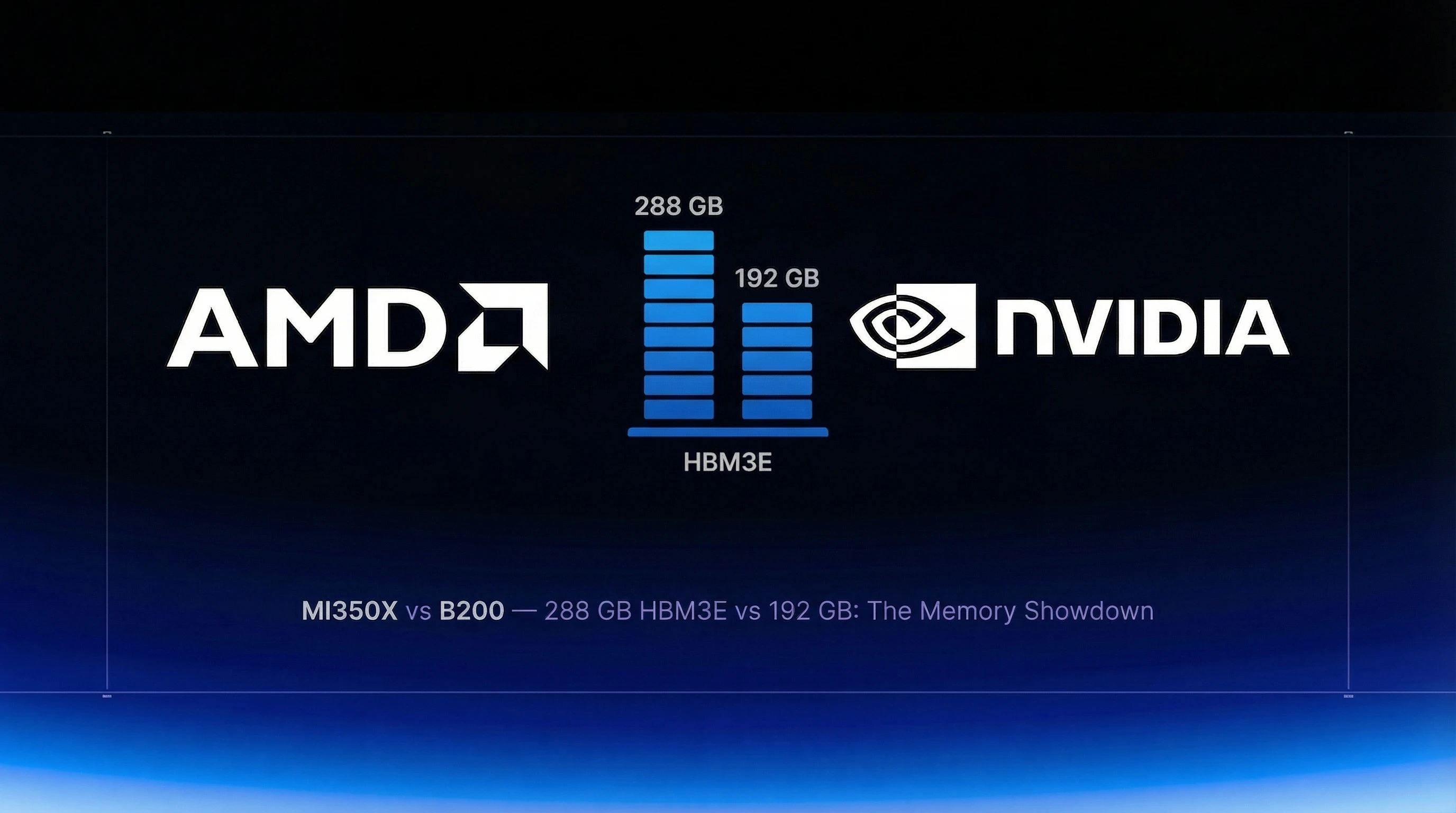
AMD's MI350X ships with 288 GB HBM3E, compared to the B200 SXM's 192 GB HBM3e. That single number defines when each GPU makes sense, and it shapes every other decision in this comparison.
The B200 is NVIDIA's latest Blackwell GPU, available today with a mature software stack, native FP4 support, and strong benchmark data. The MI350X is AMD's CDNA 4 answer: more memory, comparable bandwidth, and a ROCm software stack that has improved substantially but still trails CUDA in ecosystem depth. For how AMD's previous generation stacked up against NVIDIA, see our AMD MI300X vs NVIDIA H200 comparison.
This post gives you the concrete comparison: architecture, specs, inference projections, software compatibility, and pricing, so you can make the right choice for your workload.
MI350X vs B200 at a Glance
| Spec | AMD MI350X | NVIDIA B200 SXM |
|---|---|---|
| Architecture | CDNA 4 | Blackwell (GB202) |
| Memory | 288 GB HBM3E | 192 GB HBM3e |
| Memory Bandwidth | ~8 TB/s (estimated) | 8 TB/s |
| Peak FP16 (dense) | 2,307 TFLOPS | 2,250 TFLOPS |
| Peak FP8 (dense) | 4,614 TFLOPS | 4,500 TFLOPS |
| Peak FP4 | Supported (announced) | 9,000 TFLOPS |
| TDP | ~1,000W (air-cooled) | 1,000W |
| Interconnect | Infinity Fabric | NVLink 5 (1.8 TB/s) |
| Software Stack | ROCm 7.x | CUDA 13.x / TensorRT-LLM |
| Spheron Spot Price | Not currently listed | From $2.01/hr per GPU |
MI350X memory bandwidth (~8 TB/s) is estimated based on AMD's published statements and publicly available information as of March 2026.
Architecture Deep Dive: CDNA 4 vs Blackwell
AMD CDNA 4: What Changed from CDNA 3
The MI350X is built on AMD's CDNA 4 architecture, the successor to the CDNA 3 that powered the MI300X. The packaging approach is familiar: chiplet design combining GPU compute dies with high-bandwidth memory stacks and I/O dies on a single package. What changed is the memory subsystem and compute density.
288 GB HBM3E is the headline number. That is 50% more than the MI300X's 192 GB, and AMD achieved it by moving to higher-density HBM3E stacks. Memory bandwidth increases to an estimated 8 TB/s, up from 5.3 TB/s on MI300X. For memory-bound inference workloads, these are meaningful gains.
AMD's marketing materials reference a "35x inference improvement" for the MI355X (the liquid-cooled, 1,400W variant running Llama 3.1-405B at FP4 vs. MI300X at FP8, under different batch/concurrency conditions). That claim does not apply to the MI350X directly. The general MI350 series claim is "up to 4x AI compute performance" over MI300X. Based on CDNA 4 architecture specs, the FP8 dense throughput improvement over MI300X is approximately 3-4x. Treat any vendor-supplied comparison as workload-specific marketing, not a general engineering benchmark. For CDNA 3 architecture background, see our AMD MI300X vs H200 guide.
CDNA 4 also adds native FP4 and FP6 precision support, a capability CDNA 3 lacked. This matters for quantized inference, where FP4 can roughly double effective throughput over FP8 for models that tolerate the precision reduction.
NVIDIA Blackwell: GB202 Architecture
The B200 is NVIDIA's current-generation data center GPU, built on the GB202 die. It ships with 192 GB HBM3e at 8 TB/s, and its 5th-generation Tensor Cores add native FP4 support at 9,000 TFLOPS dense.
The FP4 story is where Blackwell differentiates most clearly. For models using FP4 quantization, the B200 delivers roughly 2x the effective throughput of FP8 on the same hardware. That is a real-world advantage, not just a spec sheet number, and inference frameworks like TensorRT-LLM and vLLM now support it. See the NVIDIA B200 complete guide for full Blackwell specs and benchmark data.
NVLink 5 at 1.8 TB/s connects B200 GPUs in multi-GPU configurations. This is roughly 2x the bandwidth of NVLink 4 (used on H100/H200), and it matters for models that require tensor parallelism across multiple GPUs. The MI350X relies on AMD's Infinity Fabric for multi-GPU scaling. Infinity Fabric is competitive but lacks the raw bandwidth of NVLink 5 in dense multi-GPU configurations.
For a broader view of where B200 fits in NVIDIA's architecture roadmap, see our Hopper vs Blackwell vs Rubin guide.
Inference Benchmarks: LLM Performance Projections
Independent MI350X inference benchmarks are limited as of March 2026, because the GPU is newly shipping and the inference community has not yet published third-party results at scale. The numbers below combine AMD's published claims, MI300X benchmark data from public sources, and bandwidth-scaling projections. They are clearly labeled by source.
The closest available data point for MI350X inference comes from MI300X benchmarks. See our MI300X vs H200 guide for those numbers. MI350X has 50% more memory and roughly 3-4x higher FP8 compute throughput vs MI300X. However, memory-bandwidth-bound inference workloads scale more closely with bandwidth gains (~1.5x). The projections below use a conservative bandwidth-scaling factor for memory-bound workloads and a higher factor for compute-bound ones. Treat these as rough estimates until independent benchmarks are published.
| Model | Batch | MI350X est. tok/s | B200 tok/s | Source |
|---|---|---|---|---|
| Llama 4 Scout (109B) FP8 | 1 | ~2,400 (est.) | ~1,800 | B200: bandwidth scaling from MI300X reference; MI350X: bandwidth-scaling projection (~1.5x MI300X) |
| Llama 4 Maverick (400B) FP8 | 1 | ~280 (est., 2-GPU) | N/A (multi-GPU required) | MI350X requires 2 GPUs (576 GB); B200 requires 3 GPUs (576 GB) |
| Qwen 3.5 72B FP8 | 32 | ~3,200 (est.) | ~4,800 | B200: vLLM community benchmarks; MI350X: bandwidth-scaling projection (~1.5x MI300X) |
| DeepSeek R1 671B FP8 | 1 | ~280 (est., 3-GPU) | ~350 (4-GPU) | Both require multi-GPU; MI350X advantages from fewer GPUs needed |
These are projections, not measured results. "Est." figures are derived from AMD's published TFLOPS gains over MI300X applied to available MI300X benchmarks, not from direct MI350X testing. Real performance depends on ROCm kernel optimization, driver version, and framework-specific implementation quality.
The memory advantage is not speculative. A 400B+ parameter model at FP16 requires approximately 800 GB. That fits on three MI350X GPUs (3 x 288 GB = 864 GB) but needs five B200s (5 x 192 GB = 960 GB). Fewer GPUs means less inter-GPU communication overhead and simpler deployment.
Training Performance: Multi-Node Scaling
For training workloads, the software maturity gap between ROCm and CUDA is the dominant factor, not raw hardware specs.
MI350X supports PyTorch, JAX, and model-parallel training through ROCm 7.x. The ROCm experience for training has improved significantly from 2024 to 2026. Teams running MI300X clusters report that PyTorch workloads now run without the extensive custom configuration that was required in 2023-2024. However, getting to H100/H200-equivalent training throughput on MI300X historically required AMD engineering involvement. Expect a similar dynamic with MI350X until the ecosystem matures further. For practical guidance on fine-tuning LLMs on GPU cloud infrastructure, see our LLM fine-tuning guide.
NVLink 5 at 1.8 TB/s gives B200 a scaling advantage in dense multi-GPU training. Infinity Fabric is competitive for 2-4 GPU configurations, but for 8-GPU nodes and multi-node clusters, NVLink's bandwidth and topology consistency give NVIDIA an edge. For teams building multi-node training infrastructure, see our multi-node GPU training guide.
Software Ecosystem: ROCm 7.x vs CUDA 13.x
This is where the two platforms diverge most clearly.
CUDA 13.x is mature. TensorRT-LLM, FlashAttention 3, NCCL for multi-GPU communication, and every major AI framework work out of the box. Pre-built containers from NVIDIA and major cloud providers eliminate most setup friction. If you have existing H100 or H200 workloads, moving to B200 is a straightforward swap.
ROCm 7.x has improved substantially. PyTorch first-class support means most training and inference scripts run on MI350X without modification. vLLM, SGLang, and DeepSpeed all support ROCm. The gap is in specialized libraries: TensorRT-LLM is NVIDIA-only, some FlashAttention 3 features are unavailable on ROCm, and custom CUDA kernels require porting via AMD's HIP compatibility layer.
HIP lets teams port CUDA code to AMD hardware with relatively low friction for standard operations. Complex, performance-tuned kernels (custom attention implementations, fused operations) require more work. For teams starting fresh or already using framework-standard inference pipelines, HIP compatibility is not a major blocker. For teams with deep custom CUDA optimization, plan for porting effort.
Framework Compatibility Matrix
| Framework | MI350X (ROCm 7.x) | B200 (CUDA 13.x) | Notes |
|---|---|---|---|
| vLLM | Supported | Supported | ROCm backend available; CUDA has more optimizations |
| SGLang | Supported | Supported | ROCm support available in recent releases |
| TensorRT-LLM | Not supported | Full support | NVIDIA-only; B200 advantage for production inference |
| FlashAttention 3 | Limited | Full (FP4) | AMD backend maturing; FP4 features NVIDIA-only |
| DeepSpeed | Supported | Supported | Both platforms work well |
| Megatron-LM | Partial | Full | NVIDIA-tuned for H100/B200 |
| Triton | Partial | Full | AMD Triton backend maturing; CUDA is more stable |
"Supported" for ROCm frameworks means you can run inference and training, not that performance is identical to CUDA. Expect 5-20% additional engineering time for ROCm deployments on non-standard configurations.
Cloud Pricing: MI350X vs B200
B200 on Spheron: The live API shows B200 SXM6 spot pricing at $16.08/hr for an 8-GPU node ($2.01/hr per GPU). Check current GPU pricing for up-to-date rates.
MI350X on Spheron: MI350X is not currently listed on Spheron as of March 2026. This reflects the GPU's recent availability; cloud providers are still onboarding MI350X capacity. For AMD GPU options, check current GPU pricing for the latest availability.
For context on where MI350X is appearing in other clouds, early listings are appearing on specialized GPU cloud providers, typically in the $14-18/hr per-GPU range for on-demand access. These figures will compress as availability grows. Specific competitor pricing is not listed here given how quickly rates change.
Cost-per-token advantage for large models: The MI350X's memory advantage creates a real economic case for 405B+ models. A Llama 4 Maverick deployment on MI350X needs 3 GPUs (at FP16); on B200 it needs 5 GPUs (at FP16). At comparable per-GPU rates, that is a 40% lower hardware cost per token at this model size for FP16 workloads, before factoring in any per-GPU rate differences between AMD and NVIDIA clouds. For FP8 deployments (the more common production scenario), MI350X requires 2 GPUs versus B200's 3, yielding approximately 33% lower hardware cost per token.
Pricing fluctuates based on GPU availability. The prices above are based on 03 Apr 2026 and may have changed. Check current GPU pricing → for live rates.
When to Choose AMD MI350X
- Models in the 96B-144B parameter range at FP16. The MI350X's 288 GB fits models up to approximately 144B parameters at FP16 on a single GPU, where the B200 (192 GB) cannot. For any model in this range, MI350X is the single-GPU option while B200 requires two. For larger models like Llama 4 Maverick (400B+), both GPUs require multiple units: MI350X needs 3 (at FP16) versus B200's 5 (at FP16), or 2 versus 3 at FP8.
- Memory-bound inference at scale. The larger per-GPU memory means fewer GPUs per model instance, which means lower inter-GPU communication overhead and simpler infrastructure.
- HPC and scientific workloads. CDNA 4 maintains AMD's strong FP64 throughput advantage, making MI350X compelling for computational fluid dynamics, molecular dynamics, and other double-precision workloads.
- Teams with existing ROCm investment. If your team already runs MI300X deployments and has ROCm-compatible pipelines, MI350X is a natural upgrade path with minimal software changes.
- Cost-sensitive large-model inference. AMD's cloud pricing has historically undercut NVIDIA on equivalent compute. As MI350X availability grows, this pattern will likely repeat.
When to Choose NVIDIA B200
- Native FP4 quantization. B200's FP4 Tensor Cores have no direct AMD equivalent for production inference. For Blackwell-optimized models, FP4 roughly doubles throughput over FP8 on the same GPU.
- Mature production inference stack. TensorRT-LLM, FlashAttention 3, and NCCL work out of the box. For teams prioritizing time-to-production over hardware cost, B200 has lower setup friction.
- Models under 192 GB at production scale. For 7B-70B models, the B200's NVLink 5 scaling and FP4 support give it a strong per-token cost advantage.
- Existing CUDA infrastructure. H100 and H200 Docker containers, kernel libraries, and optimization tooling all run on B200 without modification.
- Available now. B200 has wider cloud availability than MI350X as of Q1 2026. If you need GPU capacity in the next few weeks rather than months, B200 is the accessible option.
MI355X and MI400: AMD's CDNA Roadmap for 2027
AMD's roadmap does not stop at MI350X. The MI355X is not a later refresh of the MI350X, they launched simultaneously. It is a higher-power, liquid-cooled (1,400W) variant of the same CDNA 4 die, targeting workloads that can absorb the additional power draw for more compute headroom.
The MI400 series, based on AMD's next CDNA generation, is planned for 2026-2027. AMD has framed it as a rack-scale answer to NVIDIA's NVL72 strategy, with their "Helios" infrastructure supporting up to 72 GPUs in a tightly coupled scale-up domain. Infinity Fabric at rack scale is AMD's bet: if they can match NVLink's bandwidth topology at the system level, the per-GPU cost advantage becomes a compelling argument for large AI infrastructure teams.
For teams making 2-year infrastructure decisions, the MI400 vs NVIDIA's Rubin R100 matchup will be the next major comparison. See our NVIDIA Rubin R100 guide for the NVIDIA side of that roadmap.
Full Specs Comparison
| Specification | AMD MI350X | NVIDIA B200 SXM |
|---|---|---|
| Architecture | CDNA 4 | Blackwell (GB202) |
| Process Node | ~3 nm (TSMC, announced) | 4 nm (TSMC) |
| Memory Type | HBM3E | HBM3e |
| Memory Capacity | 288 GB | 192 GB |
| Memory Bandwidth | ~8 TB/s (estimated) | 8 TB/s |
| Peak FP16 (dense) | 2,307 TFLOPS | 2,250 TFLOPS |
| Peak FP8 (dense) | 4,614 TFLOPS | 4,500 TFLOPS |
| Peak FP4 (dense) | Supported (figures pending) | 9,000 TFLOPS |
| Interconnect | Infinity Fabric | NVLink 5 (1.8 TB/s) |
| TDP | ~1,000W (air-cooled) | 1,000W |
| Software Stack | ROCm 7.x | CUDA 13.x |
| Spheron Pricing | Not currently listed | From $2.01/hr per GPU (spot, 8-GPU node) |
The B200 is available on Spheron today with spot pricing starting at $2.01/hr per GPU ($16.08/hr for an 8-GPU node), no long-term contracts, no minimum commitments. If you are evaluating next-gen GPU infrastructure for inference or training, compare current GPU pricing or rent a B200 directly.