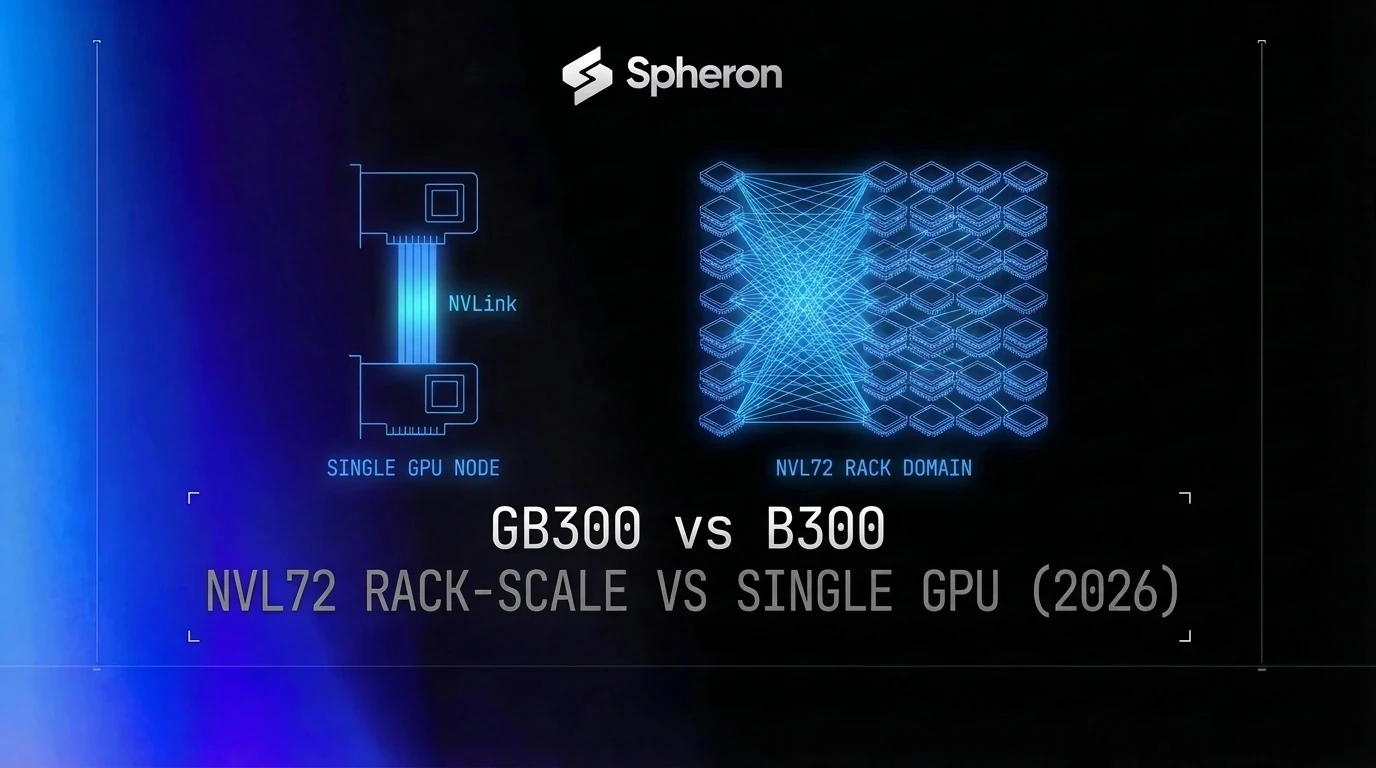
GB300 vs B300 is really a question about NVLink domain size, not which spec sheet wins. A standalone B300, rented inside a 2026 cloud catalog, sits on an 8-GPU node where every GPU reaches seven others over one NVLink hop. GB300 NVL72 fixes that ceiling at 72 GPUs in a single rack-scale domain. That gap, not the extra memory or the FLOPS totals most comparisons lead with, is what actually forces a workload off single-node rental and onto a reserved rack.
TL;DR: GB300 vs B300, Rack-Scale or Single GPU?
GB300 NVL72 and standalone B300 run the same Blackwell Ultra silicon, but they answer different sizing questions: GB300 NVL72 is a rack's 72-GPU NVLink domain, and B300 is the GPU you can book today inside an 8-GPU node.
| Question | Answer |
|---|---|
| NVLink domain | B300 tops out at 8 GPUs per node; GB300 NVL72 is one 72-GPU domain, 9x larger. |
| Memory pool | 2.3TB total across an 8-GPU B300 node vs 20TB across the GB300 NVL72 rack. |
| Who needs the rack | Trillion-parameter MoE training and pretraining at scale; Reflection AI trained its 501B-parameter Beam model on 6,144 GB300 NVL72 GPUs. |
| Who needs one node | Dense models and agent fleets that fit inside 2.3TB, including most serving workloads under 200B parameters. |
| Access | Spheron rents standalone B300 on-demand and spot now; GB300 NVL72 reservations are quoted within one business day. |
GB300 vs B300 NVL72: What Actually Changes (Package Count, NVLink Domain, Memory Pool)
Both products are built from the same Blackwell Ultra die, packaged as a B300 SXM6 GPU. What changes between them is how many of those GPUs sit inside one NVLink domain, and how much memory that domain can pool.
| Spec | Standalone B300 (8-GPU node) | GB300 NVL72 (rack) |
|---|---|---|
| GPU packages | 8 | 72 |
| NVLink domain size | 8 GPUs | 72 GPUs |
| NVLink generation | NVLink 5 | NVLink 5 |
| NVLink GPU-to-GPU bandwidth | 1.8 TB/s | 1.8 TB/s |
| Total NVLink switch bandwidth | 14.4 TB/s | 130 TB/s |
| Total GPU memory pool | 2.3 TB | 20 TB |
| FP4 Tensor Core (dense) | 120 PFLOPS | 1,080 PFLOPS |
The FP4 row is the one worth reading carefully. At 1,080 PFLOPS of dense FP4, GB300 NVL72's rack-level throughput is exactly 9x the node's 120 PFLOPS, matching the 9x jump in GPU count one for one. What that multiplier doesn't capture is the part that actually changes how a workload gets written: inside the rack, all 72 GPUs exchange activations and expert weights in a single NVLink hop. Spread across nine separate 8-GPU nodes instead, the same exchange has to cross InfiniBand or Ethernet, at a fraction of the bandwidth and several times the latency, on every step. That's the real reason to reserve a rack instead of renting nine nodes and calling it equivalent: the FLOPS total scales the same either way, but the communication pattern doesn't.
This fixed-at-72 domain size isn't new to GB300. Our NVL72 HBM capacity comparison tracks the same 72-GPU domain through GB200, GB300, and Vera Rubin NVL72, with only memory, HBM type, and NVLink generation changing underneath it. NVIDIA's own GB200 NVL72 announcement describes the rack as connecting "72 Blackwell GPUs in a single NVLink domain," and the domain size hasn't grown since GB200; it's the same number GB300 NVL72 ships with today. The actual jump in domain size happened one generation earlier, going from Hopper's 8-GPU NVLink 4 domain to Blackwell's 72-GPU NVLink 5 domain, which is also why a B300 vs B200 comparison never needs to talk about domain size at all: every Hopper and Blackwell single-node product tops out at 8 GPUs, full stop.
When a Single B300 Node Is Enough
Most inference workloads never touch the 8-GPU ceiling, let alone need to cross it. If a model's weights, KV cache, and framework overhead fit inside a B300 node's 2.3TB pool with headroom for concurrent requests, a rack reservation buys NVLink bandwidth you have no way to use. Our multi-GPU vs single-GPU sizing framework works the VRAM math in more detail; the short version is that dense models up to roughly 200B parameters, and MoE models with a few hundred billion total parameters, routinely clear that bar on one node.
We ran GLM-5.3 on both an 8xB200 node and an 8xB300 node in October 2026, under SGLang with NVFP4 quantization at a 256K context window, to see how far a single B300 node actually stretches under concurrent agentic load. On the 8xB200 node, run as one 8-GPU copy on 14-15 Oct 2026, a single user got 324 tokens/sec, dropping to 158 at 8 concurrent users, 142 at 16, and 117 at 32, with a 0.90-second time to first token; at 32 sessions that copy read 109,488 prompt tokens/sec and wrote 1,356 output tokens/sec. On the 8xB300 node, run as two separate 4-GPU copies on 12 Oct 2026, a single user got 254 tokens/sec, dropping to 135 at 8, 107 at 16, and 86 at 32, with a faster 0.48-second time to first token; each 4-GPU copy read 65,500 prompt tokens/sec and wrote 840 output tokens/sec, and the full node handled 64 agent sessions across both copies, twice what the single 8xB200 copy served.
That's the actual trade on a single B300 node: splitting it into two 4-GPU copies costs per-user speed (254 vs 324 tokens/sec for one user) but doubles how many concurrent agent sessions the node serves (64 vs 32), because it's running two independent model copies instead of one. None of that needed a 72-GPU domain. It's a concurrency-and-latency tuning decision inside one 8-GPU box, and it's the decision most teams asking "GB300 vs B300" are actually facing before they ever need to think about a rack.
When Only the Rack Works: Trillion-Parameter MoE and Agentic Serving at Scale
Some workloads genuinely can't be split across separate 8-GPU islands without a real cost. Mixture-of-experts models route each token to a handful of experts out of dozens or hundreds, and training them means constantly exchanging activations and gradients between whichever GPUs hold the experts a given batch needs. Keep those GPUs inside one 72-GPU NVLink domain and that exchange stays a single hop at full NVLink bandwidth. Spread them across nine separate 8-GPU nodes connected by InfiniBand instead, and the same exchange crosses a fabric with a fraction of the bandwidth and several times the latency, on every expert-routing step, for the entire run.
NVIDIA's GB200 NVL72 announcement is explicit about what that domain buys in practice: it delivers "a 30x speedup for resource-intensive applications like the 1.8T parameter GPT-MoE compared to the previous H100 generation," and "4X faster training performance with 32k GB200 NVL72 for large language models like GPT-MoE-1.8T compared to the same number of NVIDIA H100 GPUs." GB300 NVL72 runs the identical 72-GPU domain architecture on Blackwell Ultra silicon, so that communication advantage carries over directly; what GB300 adds on top is the Blackwell Ultra compute upgrade inside that same domain, not a bigger one.
Reflection AI's Beam is the most concrete real-world proof of what a full rack of GB300 NVL72 domains does at frontier scale. That's roughly 85 full 72-GPU racks of hardware stitched together for a single pretraining job, each rack still operating as its own 72-GPU NVLink domain underneath the larger cluster fabric. Our deployment guide for Beam covers the model's architecture and the VRAM math for serving it once weights ship. No team outside frontier-lab scale needs that many racks, but the same logic applies at a tenth the size: once an MoE model's expert-parallel group genuinely needs to span more than 8 GPUs to fit memory or throughput targets, one larger NVLink domain beats stitching nodes together over a slower fabric, and the rack is the only product that offers a domain bigger than 8 GPUs today.
Agentic serving fleets hit the same wall from a different direction. A single agent session can fan out into dozens of parallel tool calls and sub-agent invocations, each one a separate LLM call hitting the same model. Once total active KV cache across every one of those concurrent sessions, for a model already too large for one node, outgrows what 8 GPUs can hold, the choice isn't adding a ninth GPU, it's moving the whole deployment onto a domain big enough to hold it. That's a rack-sized decision, not a node-sized one.
Reserving GB300 NVL72 vs Renting B300 On-Demand: Pricing and Access Compared
The two products aren't sold the same way, and that's arguably a bigger practical difference than the spec sheet. As of 30 Oct 2026, B300 runs $12.42/hr on-demand and $5.84/hr spot per GPU on Spheron. Rent B300 on-demand if your workload clears the single-node bar from the section above.
That's a real limitation worth stating plainly: a buyer who wants an instant, self-serve rack price today won't find one anywhere in the market right now. What the reservation model does offer is the ability to size the request from one node up, so a team that needs rack-level NVLink but not a full 72-GPU rack isn't forced into a whole-rack minimum, plus a same-business-day quote instead of an open-ended sales cycle. It's also worth saying where the rack is the wrong call: a dense training job or inference workload comfortably under 200B parameters is usually cheaper and faster to provision on a standalone B300 or B200 node than on reserved rack capacity it won't fill.
Our GB300 NVL72 vs GB200 NVL72 pricing comparison goes deeper on what a full rack actually costs and why analyst estimates for it still disagree by millions of dollars. If a desk-side single-GPU box is a better fit than either cloud option, our DGX Station GB300 break-even guide works out when buying outright beats renting by the hour.
Pricing fluctuates based on GPU availability. Spheron rates above are live as of 30 Oct 2026; other providers reflect their most recent published rates and may have changed. Check current GPU pricing → for live rates.
Decision Checklist: Rack or Single GPU?
Work through these in order; the first one that applies to your workload is usually the deciding factor.
- Does your model's weights plus KV cache fit inside 2.3TB with 20-30% headroom? If yes, stop here. Rent a standalone B300 node, or step down to B200 or H200 if you don't need Blackwell Ultra's FP4 throughput specifically. Our GB200 vs H200 vs B200 decision guide works through that adjacent fork for the previous rack-vs-node generation.
- Is your bottleneck concurrent agent sessions rather than raw memory? Splitting one 8xB300 node into smaller copies, the way the GLM-5.3 run above did, often clears a concurrency target without touching a rack at all.
- Does a single MoE model's expert-parallel group need to span more than 8 GPUs to hit your memory or throughput target? That's the line where a 72-GPU NVLink domain stops being a nice-to-have and starts being the only way to avoid an InfiniBand bottleneck on every routing step.
- Are you training, not just serving, at 200B+ total parameters? Pretraining runs at that scale are the clearest rack-only case; Reflection AI's Beam run is the public example of what that looks like at full scale.
- Can you tolerate a same-business-day quote instead of an instant price? If not, and your workload genuinely needs rack-scale NVLink, that's a real constraint on GB300 NVL72 access everywhere right now, not just on Spheron.
Whether your workload clears the single-node bar or needs a full 72-GPU domain, Spheron prices B300 by the minute and reserves GB300 NVL72 from one node up.
Frequently Asked Questions
On raw specs, yes, across the board. An 8-GPU B300 node ships 120 PFLOPS of dense FP4 against an 8-GPU B200 node's 72 PFLOPS, about 1.67x, and higher FP64 throughput per GPU (60 TFLOPS vs 40 TFLOPS). B300 is a straightforward upgrade over B200 at the node level; the real fork in this comparison is standalone B300 against GB300 NVL72, which is what the rest of this post works through.
There's no published per-chip or per-rack price. Spheron, like every other provider we checked, prices GB300 NVL72 by reservation, sized from a single 8-GPU node up to a full 72-GPU rack, with the quote depending on quantity, commitment length, region, and networking, and confirmed within one business day rather than shown instantly on a page.
Vera Rubin. NVIDIA's next GPU generation after Blackwell Ultra (B300) is Rubin, shipping in the Vera Rubin NVL72 rack. It keeps the same 72-GPU NVLink domain size as GB300 NVL72 but moves to HBM4 memory and NVLink 6, roughly double NVLink 5's per-GPU bandwidth. NVIDIA hasn't detailed a standalone single-GPU Rubin product to match standalone B300; NVL72 is the configuration specified so far.
9x. A standalone B300 node tops out at an 8-GPU NVLink domain, the same ceiling every Blackwell and Blackwell Ultra single-node product shares. GB300 NVL72 is one 72-GPU NVLink domain, meaning any 72 of its GPUs reach each other in a single NVLink hop instead of crossing onto InfiniBand or Ethernet between separate 8-GPU nodes.
Not on Spheron, and not anywhere else checked as of October 2026. GB300 NVL72 is reservation-only capacity everywhere, confirmed within a business day rather than priced instantly. Standalone B300 is the hourly option: it books on-demand and spot with per-minute billing right now, with no reservation cycle.