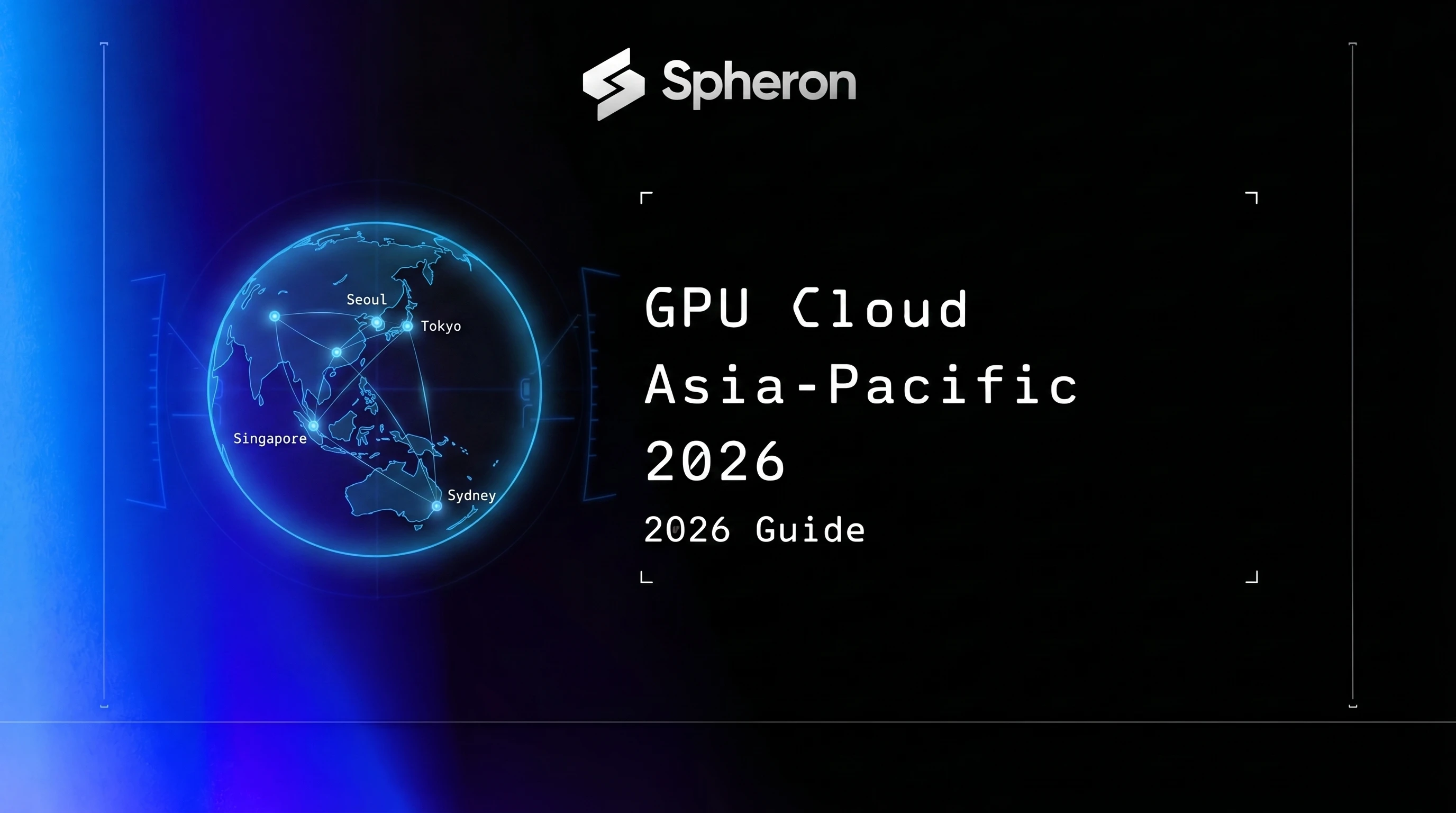
GPU compute demand across Asia-Pacific is growing faster than hyperscalers can expand regional capacity. AI investment in the region spans Japanese language model research, Singapore's financial AI sector, Australian enterprise deployments, and South Korea's government-backed compute buildout. For a focused look at Korea specifically, see our South Korea GPU cloud guide and our GPU cloud pricing comparison covering 15+ providers globally.
The challenge for APAC teams is not just price. It is the intersection of three distinct problems: latency for end-user-facing inference APIs, data residency obligations that vary by country, and GPU availability that concentrates in US-East and EU-West. For the equivalent analysis covering Europe's sovereign AI requirements, GDPR, and the CLOUD Act, see our GPU cloud providers in Europe 2026 guide. For the Middle East, where Saudi Arabia's HUMAIN and the UAE-US AI Campus are building sovereign GPU capacity at scale, see our Middle East GPU cloud guide 2026. This post works through all three, with a provider availability matrix, latency benchmarks, per-country data residency summaries, and live pricing from the Spheron API.
Why Region Matters for APAC AI Teams
Latency Penalty
For batch training workloads, where your code runs matters less than how fast the GPU is. But for production inference APIs serving real users, the geographic distance between your server and your users is a hard floor on response latency.
Round-trip time from US-East (us-east-1) to APAC destinations runs approximately:
- Singapore: 190-220ms
- Tokyo: 170-200ms
- Sydney: 220-260ms
- Seoul: 180-210ms
For a streaming text generation API using vLLM or TGI, time-to-first-token (TTFT) is roughly the inference engine's prefill latency plus the network RTT to the user. If prefill takes 50ms for a 1,000-token context, a US-East deployment adds 200-250ms of network overhead on top for a Singapore user. In-region deployment in ap-southeast-1 brings that overhead down to 5-10ms. For short, interactive completions, that is a 150-250ms per-request win.
This matters less for batched embeddings, fine-tuning jobs, and long-horizon training runs where network RTT is not in the critical path.
Data Residency Laws
Three major data protection regimes govern APAC GPU cloud decisions:
Singapore (PDPA, 2012, amended 2020): The Personal Data Protection Act requires organizations to ensure comparable protection when transferring personal data outside Singapore. Cross-border transfers must be covered by contractual arrangements, such as a data processing agreement, or sent to a country with an approved adequacy framework. For AI workloads, this is relevant when training data or inference inputs contain identifiable information about Singapore residents.
Japan (APPI, 2003, revised 2022): The Act on the Protection of Personal Information was revised in 2022 with significant changes, including extraterritorial application to foreign businesses handling data of Japanese residents. The third-party provision rules require that data transfers to foreign recipients be disclosed to the data subject or covered by a processing agreement. The 2022 revision added mandatory reporting for data breaches affecting more than 100 individuals, with a 72-hour initial notification timeline.
Australia (Privacy Act 1988, APP 8): Australian Privacy Principle 8 governs cross-border disclosure of personal information. Before sending personal data overseas, an entity must either take reasonable steps to ensure the overseas recipient handles it in compliance with the APPs, or obtain explicit consent from the individual. Crucially, the disclosing entity remains accountable if the overseas recipient breaches the APPs. This makes contractual protections with overseas GPU cloud providers relevant for Australian organizations handling regulated data.
Egress Cost
Hyperscaler egress pricing matters more than most teams account for. Moving large model checkpoints or training datasets in and out of a cloud region carries a per-GB charge:
- AWS internet egress (from US-East to a non-AWS APAC destination): approximately $0.08-0.09/GB
- GCP inter-region egress: similar rates
- Azure inter-region: similar rates
In-region egress is typically $0.08/GB for AWS and free or discounted for smaller volumes on GCP and Azure. For a 70B model checkpoint (140GB with float16 weights), a full round-trip transfer between US-East and ap-southeast-1 costs around $22-25 at list prices. If you run multiple training iterations with frequent checkpointing, this accumulates. Neo-cloud providers generally do not charge egress fees or cap them at a lower rate, which changes the math for data-intensive workloads. Azure's H200 tier is priced in this Azure H200 breakdown.
GPU Availability by Region: Provider Matrix
The table below shows which GPU models each provider offers in the four major APAC compute regions. "None" means the provider has no presence in that location. Hyperscaler entries reflect publicly listed instance families as of mid-2026.
| Provider | Singapore | Tokyo | Sydney | Seoul |
|---|---|---|---|---|
| AWS | H100 SXM (P5, ap-southeast-1) | H100 SXM (P5, ap-northeast-1), A100 (P4d, ap-northeast-1) | H100 SXM (P5, ap-southeast-2) | H100 SXM (P5, ap-northeast-2) |
| GCP | H100 SXM (a3-highgpu, asia-southeast1) | H100 SXM (a3-highgpu, asia-northeast1) | H100 SXM (a3-highgpu, australia-southeast1) | Limited, L4 only (asia-northeast3) |
| Azure | H100 SXM (ND H100 v4, southeastasia) | H100 SXM (ND H100 v4, japaneast) | H100 SXM (ND H100 v4, australiaeast) | H100 SXM (ND H100 v4, koreacentral) |
| Lambda Labs | None | None | None | None |
| Runpod | None | None | None | None |
| Spheron | H100, H200, B200 via 5+ providers (global marketplace) | H100, H200, B200 via 5+ providers (global marketplace) | H100, H200, B200 via 5+ providers (global marketplace) | H100, H200, B200 via 5+ providers (global marketplace) |
A few notes on this table: AWS P5 H100 instances are not available in all APAC sub-regions and availability is subject to capacity constraints. GCP's A3 Ultra (H200) and B200 instances have limited APAC coverage as of mid-2026. Azure's ND H100 v4 family is the primary APAC H100 offering; H200 instances (ND H200 v5) are not yet generally available in all APAC regions. For Neo-clouds like Lambda Labs and Runpod, global coverage is primarily US and EU, with no dedicated APAC presence. Spheron operates as a marketplace, giving APAC teams access to global GPU capacity at neo-cloud pricing without in-region placement. What GCP charges for those B200 instances is broken down in Google Cloud A4 B200 pricing.
Latency Impact on Inference Workloads
The table below shows approximate round-trip latency from US-East-1 (AWS Virginia) to each APAC region, along with estimated TTFT impact for a streaming chat API. TTFT values assume a 50ms in-server prefill latency for a 1K-token prompt and 20-token completion.
| Destination | Approx. RTT from US-East | TTFT Impact (streaming) | Suitable for production inference? |
|---|---|---|---|
| Singapore | ~200ms | +200ms per request | Borderline; CDN edge helps |
| Tokyo | ~180ms | +180ms per request | Borderline; CDN edge helps |
| Sydney | ~240ms | +240ms per request | High latency; in-region preferred |
| Seoul | ~190ms | +190ms per request | Borderline; in-region preferred |
These figures are approximations based on typical ISP routing and vary with provider infrastructure. They are not benchmarked results from a specific measurement setup.
A key point: frameworks like vLLM and TensorRT-LLM use continuous batching to improve GPU utilization, but they do not reduce network RTT. If your API endpoint is in US-East, continuous batching does not make a Singapore user's request arrive any faster.
For latency-sensitive use cases, such as customer-facing chat, real-time translation, or interactive coding assistants, the recommendation is in-region deployment or a proxy architecture where a lightweight gateway in-region forwards to your GPU cluster with keep-alive connections. For training, fine-tuning, and batch inference pipelines, US or EU GPU clusters remain cost-effective even for APAC teams.
GPU Pricing Comparison Across APAC
Hyperscaler APAC pricing for GPU instances generally tracks their global list prices with minor regional variations. The table below uses on-demand list prices for H100 and H200 in APAC-relevant regions. For Spheron, prices come from the live Spheron API.
| Provider | Region | H100 SXM (on-demand, per GPU/hr) | H200 SXM (on-demand, per GPU/hr) |
|---|---|---|---|
| AWS | ap-southeast-1, ap-northeast-1, ap-southeast-2 | ~$12.30/hr (P5.48xlarge / 8) | Not widely available in APAC |
| GCP | asia-southeast1, asia-northeast1, australia-southeast1 | ~$12.49/hr (A3 High) | ~$14.40/hr (A3 Ultra, limited) |
| Azure | southeastasia, japaneast, australiaeast, koreacentral | ~$14.00/hr (ND H100 v4 / 8) | Not widely available in APAC |
| Lambda Labs | Global (no APAC) | $2.49/hr | Not available |
| Runpod | Global (no APAC) | From $1.50/hr | From $2.49/hr |
| Spheron | Global marketplace | $2.98/hr (on-demand), $2.20/hr (spot) | $5.51/hr (on-demand), $3.18/hr (spot) |
Pricing fluctuates based on GPU availability. Spheron rates above are live as of 08 Oct 2026; other providers reflect their most recent published rates and may have changed. Check current GPU pricing → for live rates.
The hyperscaler premium over neo-clouds is significant: 6-8x on H100 on-demand pricing. Most of this gap comes from the managed services, SLAs, and enterprise procurement infrastructure built into hyperscaler pricing. Teams that do not need those services and can tolerate the operational tradeoffs of bare-metal GPU access can realize substantial savings on training and batch workloads.
Singapore: Southeast Asia's GPU Hub
Singapore is the default choice for GPU cloud in Southeast Asia. The city-state has the highest concentration of MAS-regulated financial AI workloads in the region, dense startup activity, and well-established data center infrastructure. All three major hyperscalers run full-service regions here (AWS ap-southeast-1, GCP asia-southeast1, Azure southeastasia).
PDPA and Cross-Border Transfer
The PDPA's Section 26 obligation requires organizations to ensure that recipients of personal data outside Singapore protect it to a standard comparable to the PDPA. In practice, this means your GPU cloud contract needs a data processing agreement (DPA) or you need to use a recipient country on Singapore's approved list. For most financial AI workloads, this is solvable contractually. The PDPA also requires that organizations assess adequacy of protection, not just obtain a paper agreement.
For AI model training: if your training data contains identifiable information about Singapore residents, the PDPA governs where it can be sent. Model weights themselves are generally not personal data under the PDPA, so training a model and hosting it outside Singapore is typically allowed, even if some training data came from Singapore. Inference queries that pass personal data to a model hosted overseas trigger the cross-border transfer obligations.
GPU Cloud Options in Singapore
AWS ap-southeast-1 provides the widest managed GPU service stack in Singapore. P5 instances (8x H100 SXM) are available on-demand. The AWS ecosystem integration (S3, Bedrock, SageMaker) makes this the default for Singapore enterprise teams with existing AWS commitments.
GCP asia-southeast1 provides A3 High instances with H100 SXM. Google's TPU-based offerings are not competitive with H100 for LLM workloads, but A3 fills the gap.
Azure southeastasia provides ND H100 v4 instances. Teams using Azure OpenAI Service for managed inference often colocate fine-tuning compute in the same region for simplicity.
Spheron for Singapore teams: Spheron does not operate its own Singapore data center. What it provides instead is H100 rental on Spheron at neo-cloud pricing, with per-minute billing and no reservation requirements. For Singapore teams running training jobs where the compute itself does not touch personal data, this is cost-effective. Checkpoint data stored on S3-compatible storage controlled by the team remains within their jurisdictional control regardless of where the GPU runs.
Tokyo: APAC's Largest GPU Capacity
Tokyo (ap-northeast-1 / asia-northeast1 / japaneast) is the largest hyperscaler region in APAC by overall compute capacity. It is the first APAC region many hyperscalers expand GPU availability to, and it carries the most diverse instance type support. For the full domestic picture, including SoftBank's GB200-based neocloud, Sakura Internet's live H100/H200 pricing, and the METI subsidy program driving Japan's sovereign AI buildout, see our GPU cloud guide for Japan.
APPI and Extraterritorial Scope
Japan's revised APPI (2022 revision, effective April 2022) added extraterritorial applicability for foreign businesses handling data of Japanese residents. The key provision for GPU cloud is Article 24, which governs third-party provision to foreign recipients. If your model training pipeline processes personal information of Japanese residents and sends it to a foreign GPU cloud, you need to either obtain consent or establish an alternative legal basis for the transfer. The alternative bases include: the recipient country being subject to equivalent personal data protection rules, or having a data processing contract meeting specified standards.
The 2022 revision also added the 72-hour breach notification requirement for incidents affecting more than 100 individuals, with notification to both the PPC (Personal Information Protection Commission) and the affected individuals. This is relevant for APAC organizations that self-host models: a breach of a training dataset stored on a cloud provider triggers this obligation.
For most AI training workloads on anonymized or synthetic datasets, APPI cross-border obligations are not triggered. The law focuses on identifiable personal information, not model weights or aggregated statistics.
GPU Cloud Options in Tokyo
AWS ap-northeast-1 is the most mature APAC hyperscaler region. P5 instances (H100 SXM) and P4d instances (A100 80GB) are both available. AWS also runs P3 (V100) instances here for legacy workloads. Reserved and spot capacity are available, with spot availability generally lower than US-East.
GCP asia-northeast1 provides A3 High instances. Google has expanded APAC A3 availability since 2025 as part of its Japan AI partnership commitments.
Azure japaneast provides ND H100 v4 instances. Microsoft's Japan region also has relatively deep Copilot and Azure OpenAI Service availability, which matters for enterprise teams combining managed inference with custom training.
Cost comparison: AWS P5.48xlarge in ap-northeast-1 runs approximately $98.32/hr on-demand for 8x H100 SXM (about $12.30/hr per GPU), matching US-East list prices. Spheron's H200 on Spheron runs $5.51/hr on-demand or $3.18/hr on spot. As a worked example at the 24 May 2026 H200 spot rate of $2.00/hr, a 100-GPU-hour training job cost about $200 on Spheron against roughly $1,230 at $12.30/hr per GPU in AWS Tokyo, a difference of about $1,000.
The catch: Spheron jobs run on global GPU capacity, not in-region Tokyo compute. For training on non-personal-data datasets, this is fine. For workloads where Tokyo placement is required (financial data, APPI-regulated training sets), the hyperscaler is the right call despite the cost.
Sydney: ANZ Data Residency
Australian teams face one of the stricter cross-border data transfer regimes in APAC under the Privacy Act's APP 8. This shapes where Australian enterprises can send regulated workloads and influences GPU cloud decisions more than latency for many ANZ teams. For the full breakdown, including the Australia-US CLOUD Act Agreement that took effect in January 2026 and the new sovereign Sydney capacity from SCX.ai and Sharon AI, see our dedicated GPU cloud Australia guide.
Privacy Act APP 8
Australian Privacy Principle 8 requires that before an entity discloses personal information to an overseas recipient, it must take reasonable steps to ensure the overseas recipient handles the data consistently with the APPs, or obtain explicit consent from the individual. The critical point: the Australian entity does not shed liability when data leaves the country. If the overseas GPU cloud provider fails to secure the data, the Australian entity is still accountable under the Privacy Act.
In practice, this means Australian organizations need data processing agreements with their GPU cloud providers and need to satisfy themselves that the provider has adequate security practices. It does not automatically prohibit sending data overseas, but it creates compliance overhead that makes in-region options attractive for regulated financial services, healthcare, and government workloads.
GPU Cloud Options in Sydney
AWS ap-southeast-2 provides P5 H100 instances in Sydney. This is the primary hyperscaler GPU option for Australian teams requiring local data residency. S3 in ap-southeast-2 stays in Australia, making it easy to satisfy APP 8 obligations for data-at-rest.
GCP australia-southeast1 provides A3 High H100 instances. Google has expanded APAC A3 availability to Sydney, making it a viable option for GCP-committed teams.
Azure australiaeast provides ND H100 v4 instances. Microsoft's Australia region has deep enterprise adoption in financial services and government, making it a common choice for regulated workloads.
B200 availability in Sydney: B200 instances are not widely available in Sydney as of mid-2026. AWS's P6 instances (B200-based) have been announced but are not yet generally available in ap-southeast-2. GCP's B200 Ultra instances are similarly limited in APAC. For teams needing B200-class compute, B200 GPU rental via Spheron provides access to global B200 capacity at neo-cloud pricing. For workloads where B200 is purely for compute speed (not data residency), this is often the only near-term option in the region.
Spheron for ANZ Teams
Teams building on Spheron for non-regulated training work gain access to B200 SXM6 at $8.98/hr on-demand or $5.25/hr on spot. This is a significant cost advantage over any hyperscaler for workloads that do not require Sydney placement. Storing training data and checkpoints in Australia-hosted object storage (S3 ap-southeast-2 or equivalent) and running GPU compute elsewhere is a common architecture that satisfies many APP 8 obligations, provided the personal data itself does not leave Australian storage.
Seoul: Connected to Korea's AI Investment
Seoul's GPU cloud landscape is covered in depth in our guide covering Korean provider pricing tables and PIPA detail, with the full Korean AI investment context. This section summarizes the key infrastructure points.
AWS ap-northeast-2 (Seoul) runs P5 H100 instances. This is the primary hyperscaler GPU option for Korean teams. Azure koreacentral provides ND H100 v4 instances. GCP's presence in South Korea is more limited: Seoul does not currently host A3 H100 instances, with L4 GPU instances available in asia-northeast3 (Seoul).
PIPA (Personal Information Protection Act): South Korea's data protection law governs cross-border data transfers similarly to GDPR and APPI. Transfers of personal information overseas require: adequate protection in the receiving country, or explicit consent. The amended 2023 PIPA version increased extraterritorial scope and aligned more closely with GDPR principles.
For Korean teams considering Spheron, the same pattern as other APAC regions applies: training on non-personal-data or anonymized datasets at global GPU pricing, with regulated data staying in Korean-controlled storage.
Data Residency Cheatsheet by Country
| Country | Law | Cross-Border Transfer Rule | GPU Cloud Implication |
|---|---|---|---|
| Singapore | PDPA (2012, amended 2020) | Must ensure comparable protection via contract or adequacy finding | DPA required with cloud provider; model weights are generally not personal data |
| Japan | APPI (2003, revised 2022) | Third-party provision to foreign recipients requires consent or processing agreement; extraterritorial scope | Anonymized training data avoids APPI obligations; identifiable data needs contract coverage |
| Australia | Privacy Act 1988 (APP 8) | Disclosing entity remains liable for overseas recipient's compliance; must take reasonable steps | Strong incentive for in-region placement for regulated data; contract-based solutions require active due diligence |
| South Korea | PIPA (amended 2023) | Cross-border transfers require adequacy finding, consent, or processing agreement; extraterritorial scope expanded | Similar to GDPR-aligned regime; anonymized datasets and model weights generally out of scope |
This table is a technical summary, not legal advice. Requirements vary by industry (financial services, healthcare, and government face sector-specific overlays) and the sensitivity of the specific data. Teams with regulated workloads should verify requirements with legal counsel.
Spot Capacity and Reservation for APAC Regions
Hyperscaler spot GPU availability in APAC is consistently tighter than US-East and EU-West. AWS EC2 Spot for P5 instances in ap-southeast-1 and ap-northeast-1 sees higher interruption rates and lower availability windows than Virginia or Oregon. GCP Spot VMs for A3 instances similarly have constrained availability in APAC.
For teams that prioritize spot economics for batch training, this is a real constraint. The options are:
- Run spot on hyperscaler US-East or EU-West regions and accept the egress cost and latency for data transfer.
- Use on-demand hyperscaler APAC capacity and pay list price.
- Use a marketplace like Spheron, where spot GPU pricing is available globally and is not subject to the same APAC capacity bottleneck that hyperscalers face in their owned infrastructure.
The table below shows spot availability and typical discounts across providers for APAC-oriented workloads:
| Provider | Spot Available | APAC Region Spot Discount | Min Duration |
|---|---|---|---|
| AWS | Yes (P5, limited APAC) | ~70% off on-demand | None (interruptible) |
| GCP | Yes (A3 Spot, limited APAC) | ~60-70% off on-demand | None (interruptible) |
| Azure | Yes (Spot, limited APAC) | ~60-80% off on-demand | None (evictable) |
| Spheron | Yes (global capacity) | 40-80% off on-demand (H100, H200, B200) | None (interruptible) |
| Runpod | Yes (US/EU only) | Variable | 1 hour |
| Lambda Labs | No | N/A | N/A |
For training workloads running more than a few hours, checkpoint-to-object-storage discipline is required on any spot instance. A good pattern is writing checkpoints every 30-60 minutes to S3-compatible storage, so interruption means at most one checkpoint interval of lost compute.
Decision Tree: Which Region for Which Workload
Choosing the right GPU cloud setup for an APAC team depends on the type of workload, regulatory exposure, and latency tolerance.
If You Need Strict Data Residency
Use in-region hyperscaler compute. AWS, GCP, and Azure all provide H100 instances in Singapore, Tokyo, Sydney, and Seoul. Data stays in-region, and the providers offer DPAs, compliance certifications, and audit support that satisfy PDPA, APPI, APP 8, and PIPA requirements. The premium is real (6-8x neo-cloud pricing) but so is the compliance certainty.
For some organizations, on-premises or co-location is the only option. If your legal team requires data sovereignty guarantees beyond what public cloud contracts provide, bare-metal in local data centers is the correct architecture, regardless of cost.
If You Need Lowest Price With APAC Users
Use Spheron or another neo-cloud for GPU compute, combined with a CDN or edge proxy for API serving. The pattern: run your vLLM or TGI inference server on Spheron H100 or H200 spot capacity ($2.20/hr and $3.18/hr respectively), and put a lightweight API proxy in-region (a small VM in ap-southeast-1 or ap-northeast-1) that accepts user requests and forwards them to your GPU server. This reduces the observed latency for short prompts while keeping GPU costs at neo-cloud rates.
The savings on a sustained training run often cover months of CDN/proxy costs. At the 24 May 2026 H100 spot rate of $0.80/hr, a 100-GPU-hour training job on Spheron cost roughly $80. The same job on AWS ap-southeast-1 P5 on-demand runs $1,400-1,600. For training, the geo-placement question is usually a non-issue.
If You Need Production Inference In-Region
Use hyperscaler in-region capacity, reserved if you can commit to a term, or on-demand with auto-scaling. AWS, GCP, and Azure all support production-grade SLAs in APAC regions. For customer-facing inference at scale, the operational overhead of self-managed GPU clusters becomes a real concern, and the hyperscaler managed services (SageMaker endpoints, Vertex AI, Azure ML) provide useful abstractions.
Teams with tighter budgets can consider a hybrid: run fine-tuning and batch jobs on neo-cloud spot compute, and deploy the fine-tuned model to a reserved hyperscaler inference endpoint in-region.
If You Need to Train Large Models on a Budget
Use Spheron spot H100 or H200. B200 SXM6 spot is available at $5.25/hr per GPU, making it one of the most cost-effective options for large model training globally. Store training data and checkpoints in object storage that you control, write checkpoints frequently, and design your training loop to recover from interruption. Multi-node distributed training is supported with NVLink-connected instance configurations available through the Spheron platform.
Pricing fluctuates based on GPU availability. Spheron rates above are live as of 08 Oct 2026; other providers reflect their most recent published rates and may have changed. Check current GPU pricing → for live rates.
For 70B+ models, the memory advantage of H200 (141GB HBM3e vs H100's 80GB HBM3) reduces the number of GPU nodes needed. An H200 spot cluster is often cheaper than a larger H100 cluster for the same effective batch size.
GPU compute in Asia-Pacific is not one problem. It is three separate ones: where the data can legally go, where the latency budget allows your GPU to sit, and what your budget can support. Each APAC region has different answers, and the right architecture depends on which of these constraints is binding for your specific workload.
APAC AI teams pay hyperscaler premiums for in-region GPUs or accept the latency cost of US-East serving. Spheron gives you a third option: H100, H200, and B200 access from 5+ providers at a fraction of hyperscaler $/hr, with no egress fees and per-minute billing. The savings on a sustained training run often exceed the cost of a CDN layer for inference.
Spheron H100 instances → | Compare B200 pricing → | View all GPU pricing →
Frequently Asked Questions
AWS (ap-southeast-1), GCP (asia-southeast1), and Azure (southeastasia) all operate H100 instances in Singapore. Neo-cloud providers like Spheron give Singapore-based teams access to global H100, H200, and B200 capacity at lower per-GPU hourly rates, though without a dedicated Singapore data center.
Yes. Round-trip latency from US-East to APAC is approximately 180-240ms depending on the destination. For streaming inference APIs serving end users in Singapore, Tokyo, or Sydney, this adds 150-250ms of observable latency per request above what in-region deployment would provide. For batch training workloads, latency to the GPU cluster is not a concern.
Singapore's PDPA requires a processing agreement or adequate protection standard for cross-border personal data transfers. Japan's APPI (revised 2022) applies extraterritorially and requires third-party provision agreements for data transfers to foreign recipients. Australia's Privacy Act APP 8 requires disclosure conditions for cross-border transfers and holds the original entity accountable for overseas recipients' compliance.
Hyperscalers charge $12-15/hr per H100 GPU in APAC regions for on-demand instances. Spheron provides H100 SXM5 at $2.98/hr on-demand and H200 at $5.51/hr on-demand, with spot rates of $2.20/hr (H100 SXM5) and $3.18/hr (H200). The tradeoff is that Spheron is a global marketplace without a dedicated APAC data center, while hyperscalers offer in-region compute with direct access to managed services like S3, BigQuery, and Azure Blob.
Yes. Spheron aggregates GPU capacity from 5+ providers globally and provides on-demand and spot access to H100, H200, and B200 instances. APAC teams use Spheron for training and batch inference workloads where in-region placement is not a strict regulatory requirement. For production inference APIs serving APAC end users with latency constraints, pairing Spheron training runs with a CDN or edge proxy layer is the recommended pattern.