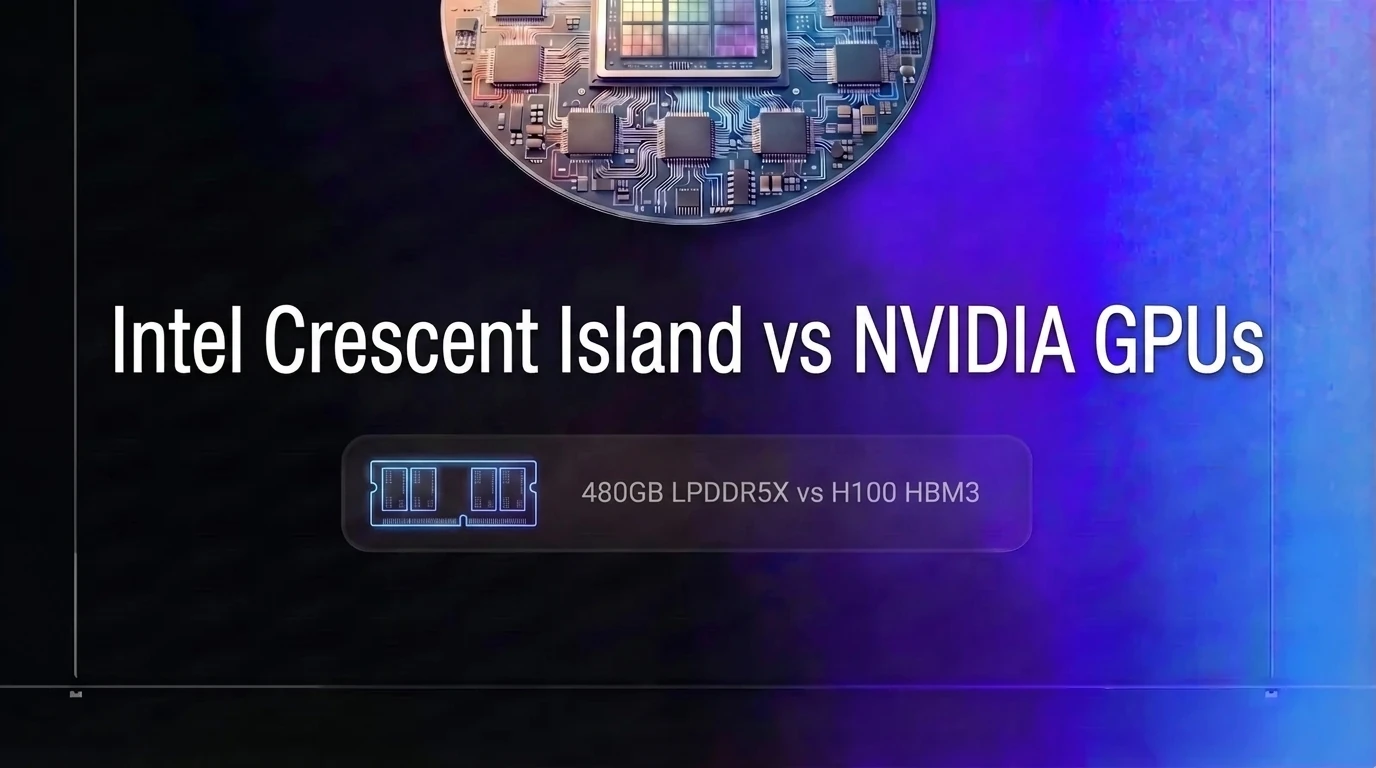
Intel used Hot Chips 2026, the week of 24 August 2026 in Palo Alto, to detail Crescent Island's full spec sheet: 32 Xe3P cores, 256 third-generation XMX engines, 32MB of unified L2 cache, PCIe Gen5 x16 connectivity, and a 350W air-cooled TDP, according to ServeTheHome's coverage. That's a different kind of announcement than most challenger-chip news this blog covers. Intel didn't show a roadmap slide with a launch-year promise. It showed core counts, cache sizes, and a real Intel Crescent Island GPU specs sheet, the kind of detail that normally arrives with shipping silicon, not a chip that's still a year from general availability.
The catch is what's missing from that sheet. Intel published cores, cache, and TDP, then declined to confirm memory bandwidth or FLOPS. There's no public price, and nothing about Crescent Island is available to rent before 2027 at the earliest. This isn't Intel's first run at inference silicon either; see how the Gaudi 3 accelerator stacks up against NVIDIA's H200 and B200 for how the company's last attempt played out against a shipping NVIDIA lineup. We'll walk you through what Crescent Island actually is, how its published (and unpublished) numbers stack up against H100, H200, and B200, and what that means for the buying decision you have to make this quarter, not in 2027.
TL;DR: How Do Intel Crescent Island GPU Specs Compare to NVIDIA H100 and H200?
- Specs: Intel detailed Crescent Island's full spec sheet at Hot Chips 2026 (week of 24 Aug 2026): 32 Xe3P cores, 256 XMX engines, 350W air-cooled TDP.
- Memory: The reference card ships with 160GB of LPDDR5X; ODM variants scale to 480GB, more than 3x an H200 SXM5's 141GB of HBM3e.
- Bandwidth: Crescent Island's memory bandwidth is unconfirmed (chipsandcheese estimates ~1.5TB/s), against H100 SXM5's 3.35TB/s and H200 SXM5's 4.8TB/s of HBM.
- Availability: Sampling begins H2 2026, general availability targets 2027. Spheron rents an H100 SXM5 instance at $2.64/hr on-demand today, as of 17 Sep 2026.
- Verdict: nothing to actually rent until 2027, so this quarter's decision stays H100, H200, or B200.
What Crescent Island Actually Is: Xe3P, LPDDR5X, No HBM
Crescent Island is built on Intel's Xe3P architecture, and the die itself carries 32 Xe3P cores paired with 256 third-generation XMX engines, the matrix units that do the actual tensor math for inference. Each core has 1MB of register file and 512KB of L1/SLM, backed by 32MB of unified L2 cache across the chip, and the card connects over PCIe Gen5 x16 rather than NVLink, according to ServeTheHome. The whole package draws 350W and runs air-cooled.
The memory story is the part that actually differentiates Crescent Island. Intel's reference card ships with 160GB of LPDDR5X, but the design supports ODM variants scaling all the way to 480GB, which Tom's Hardware calls the highest per-card memory capacity of any AI accelerator announced to date. There's no HBM anywhere in the design, and that's deliberate. Intel is using commodity LPDDR5X, the same memory family that ships in phones and laptops, instead of the stacked HBM3 or HBM3e that NVIDIA and AMD put on their data center parts.
It's the same memory-capacity-over-bandwidth bet Qualcomm made with the AI200, which also trades HBM for a large pool of cheaper, denser LPDDR5X. Neither company is pretending this is a training chip. Crescent Island is inference-only, and the architecture is built around holding a large model in memory on a single card rather than pushing peak FLOPS.
Intel's Data Center GPU Bet on Agentic AI
Crescent Island's specs only make sense against what Intel is actually building it for: serving inference at a lower cost per card than an HBM-equipped GPU, aimed squarely at the agentic AI workloads driving most of 2026's new GPU demand. An agent doesn't make one LLM call per user turn. It makes a chain of them, tool calls, retrieval steps, retries, subagent invocations, each one holding a slice of context in memory while it runs. That pattern rewards a card that can hold a large model and a lot of concurrent context locally, over one that's fastest per token but constrained to a smaller memory pool.
That's the argument for a 350W, air-cooled, PCIe Gen5 card with up to 480GB of memory: it's cheaper to build, cheaper to cool, and cheaper to rack than an HBM-based GPU, at the cost of raw throughput per card. Whether that tradeoff actually wins on cost per agent interaction depends entirely on bandwidth and real-world throughput numbers Intel hasn't published yet, which is exactly the gap covered further down. It's a strategy Intel has tried before with mixed results in the market. Crescent Island joins a growing list of 2026 challenger chips built around the same non-GPU inference bet, alongside d-Matrix's Corsair accelerator, which takes an in-memory-compute approach to the same problem instead of a memory-capacity one.
Crescent Island Specs vs NVIDIA H100, H200, and B200
Here's the full picture, published specs where Intel has released them, and the gaps where it hasn't.
| Spec | Intel Crescent Island | NVIDIA H100 SXM5 | NVIDIA H200 SXM5 | NVIDIA B200 (DGX, per GPU) |
|---|---|---|---|---|
| Architecture | Xe3P, 32 cores, 256 XMX engines (3rd-gen) | Hopper | Hopper | Blackwell |
| Memory | 160GB LPDDR5X (reference card); ODM variants to 480GB | 80GB HBM3 | 141GB HBM3e | 180GB HBM3e (1,440GB total across an 8-GPU DGX system) |
| Memory bandwidth | Not published; chipsandcheese estimates ~1.5TB/s | 3.35TB/s | 4.8TB/s | 8TB/s (64TB/s total across an 8-GPU DGX system) |
| Peak compute | Not confirmed; chipsandcheese estimates ~1.3 PFLOP/s FP8, ~2.6 PFLOP/s FP4 (XMX) at 2.5GHz | Not covered in this comparison | Not covered in this comparison | ~9,000 TFLOPS FP8, ~9,000-18,000 TFLOPS FP4 (dense/sparse) |
| TDP | 350W, air-cooled | Up to 700W | Up to 700W (configurable) | Not individually published (DGX B200 system draws ~14.3kW across 8 GPUs) |
| Interconnect | PCIe Gen5 x16 | NVLink + PCIe | NVLink + PCIe | NVLink + PCIe |
| Availability | Sampling H2 2026, general availability 2027 | Available now | Available now | Available now |
| Spheron pricing | Not applicable, not shipping | $2.64/hr on-demand | $4.80/hr on-demand | $5.37/hr spot |
Pricing fluctuates based on GPU availability. Spheron rates above are live as of 17 Sep 2026; other providers reflect their most recent published rates and may have changed. Check current GPU pricing → for live rates.
Two things jump out. Crescent Island's memory capacity beats every NVIDIA part on the table, by a wide margin once you get to the 480GB ODM variants. And Crescent Island's TDP is dramatically lower, 350W against an H100's up to 700W, according to ServeTheHome. That's a real rack-density argument if the rest of the numbers hold up. The problem is that "if" is doing a lot of work, and the next two sections are where it breaks down.
The Bandwidth Tradeoff: Why 480GB of Cheap Memory Isn't Free
A 40-word answer first: LPDDR5X is cheaper and denser per dollar than HBM, which is why Intel can put up to 480GB on a card where NVIDIA tops out at 192GB. The cost is bandwidth, LPDDR5X estimates run near 1.5TB/s against 3.35-8TB/s for the HBM parts in the table above, and bandwidth, not capacity, is what decides decode-phase inference speed.
For scale, ServeTheHome's Hot Chips 2026 coverage puts AMD's MI350P at 3.6-4TB/s and NVIDIA's RTX PRO 6000 Blackwell at 1.6-1.79TB/s, both above Crescent Island's roughly 1.5TB/s estimate. That estimate isn't Intel's own figure; Intel hasn't published one. It's the outside industry's best guess at what LPDDR5X delivers in this configuration.
That gap matters because LLM inference splits into two phases with different bottlenecks. Prefill, processing the input prompt, is compute-bound: more FLOPS finishes it faster. Decode, generating each output token one at a time, is memory-bandwidth-bound: the GPU has to read the entire set of model weights and the KV cache from memory for every single token it produces, so the ceiling on tokens-per-second is set by how fast memory can deliver those bytes, not by how many matrix units the chip has sitting idle in between reads. LPDDR5X vs HBM is exactly this tradeoff. A card with 480GB of LPDDR5X can hold a much bigger model, or far more concurrent context, than an 80-192GB HBM card. But if decode throughput matters, a lower-bandwidth memory pool caps how fast that huge model actually generates tokens, no matter how much of it fits.
Teams mapping out a multi-vendor hardware plan for 2026 and 2027 are tracking a similar list of bets on this same tradeoff, from Huawei's Ascend 950 to Qualcomm's AI200 to Crescent Island itself, each betting that capacity wins more workloads than bandwidth does. None of them have shipped enough independent benchmark data yet to settle which workloads that's actually true for.
What Intel Hasn't Published: Bandwidth, FLOPS Confirmation, Pricing, Independent Benchmarks
Intel's spec sheet stops well short of a complete picture. Intel hasn't published FLOPS figures for the chip either, chipsandcheese reports.
In the absence of official numbers, chipsandcheese built its own clock-scaled estimates, assuming a 2.5GHz clock: roughly 10.2 TFLOP/s FP64, 20.5 TFLOP/s FP32, 41 TFLOP/s FP16, 1.3 PFLOP/s FP8 on the XMX units, and 2.6 PFLOP/s FP4/MXFP4 on the XMX units. By chipsandcheese's same estimate, Crescent Island beats an NVIDIA RTX PRO 6000 Blackwell by roughly 30% in matrix (XMX/tensor) compute and 5x in FP64, while the RTX PRO 6000 exceeds Crescent Island by about 6x in FP32 vector and 3x in FP16 vector throughput. Those are third-party estimates built from a clock-speed assumption, not confirmed Intel figures, and Crescent Island hasn't run a single independently published benchmark against H100 or H200 yet.
Pricing is the other open question. Intel hasn't said what a Crescent Island card, or an ODM 480GB variant, will actually cost. Without a price, there's no way to compute cost-per-token against a rented H100 or H200, which is the number that ultimately decides whether 480GB of cheap memory beats a smaller, faster HBM pool for a given workload.
Where This Fits Against Rented H100/H200 Today
Customer sampling for Crescent Island is expected in the second half of 2026, per Intel's original October 2025 guidance, with general availability targeted for 2027, according to Phoronix. That timeline matters more than the spec sheet does for anyone making a rental decision this quarter, because it means Crescent Island isn't actually competing against the H100, H200, and B200 instances available to rent right now. It's competing against whatever ships next.
Phoronix frames Crescent Island's eventual competitive set as AMD's Instinct MI450 series and NVIDIA's Vera Rubin generation, not today's Hopper and Blackwell lineup, because those are the generations that will actually be shipping by the time Crescent Island launches in 2027. See how AMD's MI400/MI450 series stacks up against NVIDIA's B300 for the generation-matched comparison that's the more relevant one for a 2027 buying decision. Evaluating Crescent Island against an H100 you can rent today tells you where the market stood at Hot Chips 2026. It doesn't tell you what a team choosing hardware in 2027 will actually be picking between.
Intel Crescent Island vs NVIDIA: Decision Framework
| If you need... | Choose |
|---|---|
| Inference or training capacity to deploy this quarter | NVIDIA H100 or H200, rentable today, for example on Spheron at $2.64/hr and $4.80/hr on-demand |
| A single card to hold a 400B+ parameter model without sharding | Crescent Island's up to 480GB LPDDR5X ODM variants, once they ship, not before 2027 |
| FLOPS-heavy training or compute-bound prefill | NVIDIA H100, H200, or B200; Crescent Island is inference-only and hasn't confirmed FLOPS |
| A vendor-diversified 2026-2027 hardware roadmap | Track Crescent Island, AMD's MI450 series, and Huawei's Ascend 950 through their own vendor channels alongside NVIDIA capacity |
| Independent, benchmarked numbers before committing budget | Wait for Crescent Island's H2 2026 sampling results and any reviews that follow its 2027 launch |
What This Means for Teams Renting GPUs Today
Nothing about this quarter's GPU rental decision changes because of a Hot Chips spec sheet. Crescent Island has no confirmed bandwidth, no confirmed FLOPS, no public price, and nothing to rent before 2027. If you need to serve a model with a large context window or a lot of concurrent agent sessions this quarter, you still solve that with memory capacity that's actually shipping today, an H200 SXM5's 141GB of HBM3e or a B200's larger pool, on a stack (CUDA, vLLM, TensorRT-LLM) that doesn't require waiting on unproven inference software.
That's also where Spheron's own limits are worth being honest about. Spheron's docs describe renting enterprise NVIDIA GPUs, H100, A100, B200, and B300, with bare-metal performance and no long-term contract, and Spheron's pricing aggregates rates across 5+ providers with per-minute billing. There's no Crescent Island capacity there, and there won't be until Intel actually ships it, so a team specifically evaluating Crescent Island's economics firsthand has to do that through Intel's own channels. Spheron is also NVIDIA-only, so a genuinely vendor-diversified 2026-2027 plan that includes Crescent Island, AMD, or Huawei silicon needs to track those separately. What per-minute billing and no lock-in do offer is the ability to rent H100 or H200 capacity now and re-evaluate the moment Crescent Island gets independent benchmarks, without having committed to hardware in the meantime.
Crescent Island might change the memory-capacity math for inference once it ships in 2027, but H100 and H200 capacity is bookable today with per-minute billing and no long-term contract.
Frequently Asked Questions
Crescent Island is Intel's Xe3P-based, inference-focused data center GPU. Intel detailed its full spec sheet at Hot Chips 2026 in Palo Alto, the week of 24 August 2026: 32 Xe3P cores, 256 third-generation XMX engines, 32MB of unified L2 cache, PCIe Gen5 x16 connectivity, and a 350W air-cooled TDP. The reference card ships with 160GB of LPDDR5X memory, and ODM variants scale up to 480GB.
Crescent Island's reference card carries 160GB of LPDDR5X, roughly double an H100 SXM5's 80GB of HBM3, and ODM variants scale to 480GB, more than three times an H200 SXM5's 141GB of HBM3e. The tradeoff is bandwidth: LPDDR5X is estimated near 1.5TB/s, against the H100's 3.35TB/s and the H200's 4.8TB/s of HBM.
Intel hasn't confirmed Crescent Island's memory bandwidth, telling chipsandcheese it was 'not disclosing that information at this time' when asked at Hot Chips 2026, and Intel has not published FLOPS figures for the chip either. chipsandcheese's own clock-scaled estimates put Crescent Island around 1.3 PFLOP/s FP8 and 2.6 PFLOP/s FP4 at 2.5GHz, roughly 30% ahead of an NVIDIA RTX PRO 6000 Blackwell in matrix compute but behind it in FP32 and FP16 vector throughput. There's no independently benchmarked comparison against H100 or H200 yet.
No. Crescent Island is expected to sample with customers in the second half of 2026, with general availability targeted for 2027, and Intel hasn't published a price. Teams that need inference or training capacity this quarter are still choosing among NVIDIA GPUs such as H100 and H200, available to rent today on platforms like Spheron at $2.64/hr and $4.80/hr on-demand, as of 17 Sep 2026.
By the time Crescent Island reaches general availability in 2027, Phoronix frames its real competitive set as AMD's Instinct MI450 series and NVIDIA's Vera Rubin generation, not the H100, H200, or B200 shipping today. Comparing it against today's hardware only shows where the market stood at Hot Chips 2026, not what it will compete against on launch day.