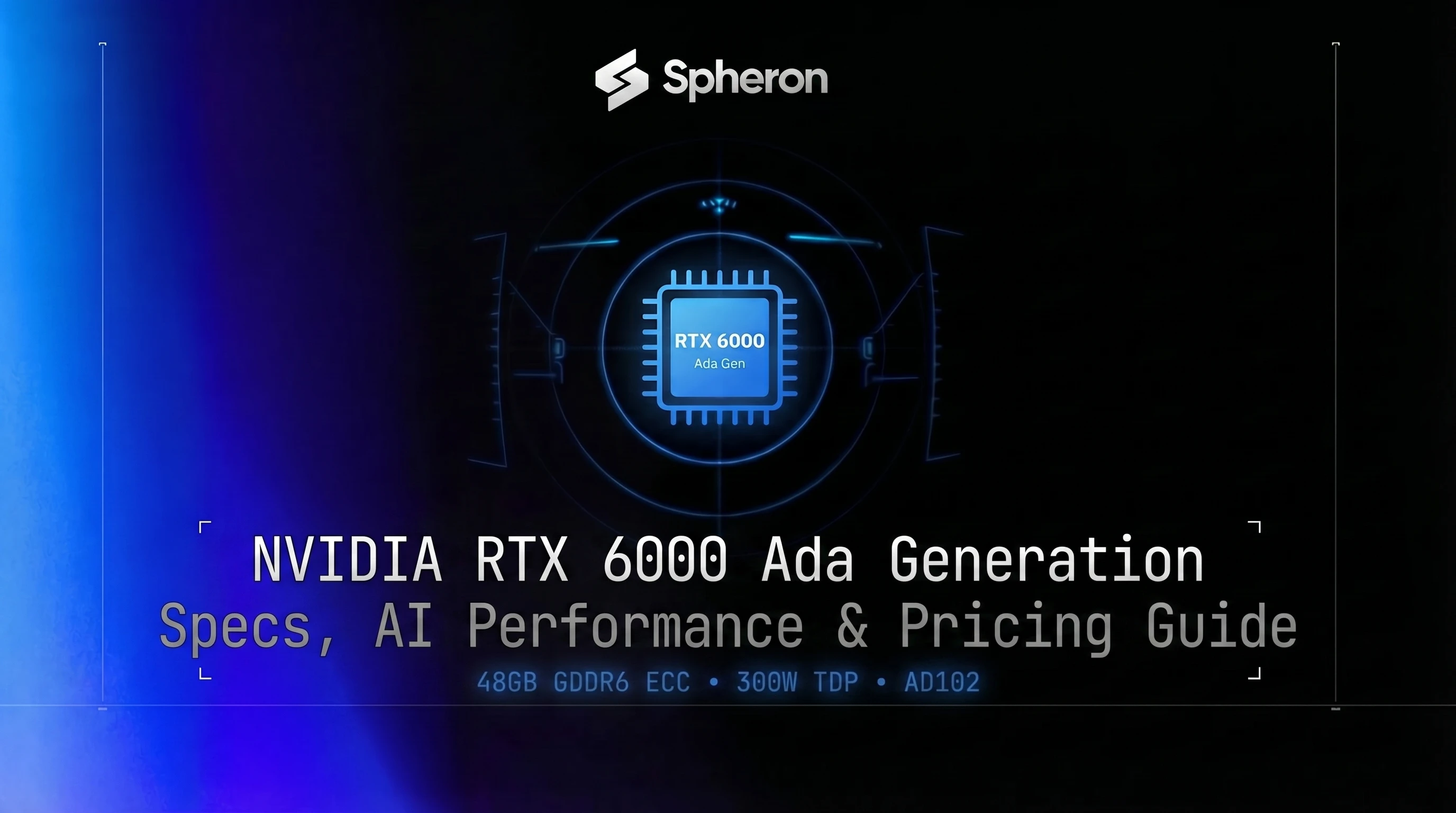
If you searched for "RTX 6000 Ada" and ended up reading about the RTX PRO 6000 Blackwell instead, you are not alone. NVIDIA's naming is confusing here. These are different GPUs, on different architectures, with different VRAM capacities. The RTX 6000 Ada Generation is the 2022-era Ada Lovelace workstation GPU with 48 GB of GDDR6 ECC memory. The RTX PRO 6000 Blackwell is its 2025 successor with 96 GB of GDDR7 ECC.
This guide covers the RTX 6000 Ada specifically: its architecture, what LLMs fit in 48 GB, real-world inference benchmarks, fine-tuning capacity, and how it stacks up against the RTX 4090, L40S, and RTX PRO 6000 Blackwell. For a broader GPU selection framework, see our GPU selection guide for LLMs.
The 48 GB GDDR6 ECC is the defining feature. It doubles the RTX 4090's 24 GB GDDR6X and matches the L40S at the same VRAM tier, while adding workstation ISV certification and professional driver support that neither the RTX 4090 nor the L40S provides.
TL;DR: RTX 6000 Ada vs RTX PRO 6000
- They are different GPUs. RTX 6000 Ada is Ada Lovelace with 48GB GDDR6 ECC. RTX PRO 6000 is Blackwell with 96GB GDDR7. The names collide; the hardware does not.
- Price: Spheron lists RTX 6000 Ada at $0.78/hr on-demand and $0.68/hr spot, against $2.23/hr on-demand for the RTX PRO 6000. Figures as of 12 Sep 2026.
- What 48GB fits: a 70B model at INT4, or a 32B at FP16, on a single card with ECC memory.
- Pick RTX 6000 Ada for cost-sensitive fine-tuning and inference where 48GB is enough and ECC matters.
- Pick RTX PRO 6000 when you need 96GB on one card or Blackwell FP4. Compare live rates
RTX 6000 Ada Generation: Architecture and Specs
The RTX 6000 Ada, RTX 4090, and L40S all use the same physical AD102 die. What differs is the configuration. NVIDIA enables more CUDA cores on the RTX 6000 Ada (18,176 vs 16,384 on the RTX 4090), pairs it with 48 GB GDDR6 ECC instead of 24 GB GDDR6X, and ships it with workstation drivers and ISV certifications instead of GeForce gaming drivers.
| Spec | RTX 6000 Ada | RTX 4090 | L40S | RTX PRO 6000 Blackwell |
|---|---|---|---|---|
| Architecture | Ada Lovelace | Ada Lovelace | Ada Lovelace | Blackwell |
| GPU Die | AD102 | AD102 | AD102 | GB202 |
| CUDA Cores | 18,176 | 16,384 | 18,176 | TBC |
| Tensor Cores (4th Gen) | 568 | 512 | 568 | Yes (5th Gen) |
| RT Cores (3rd Gen) | 142 | 128 | 142 | Yes (4th Gen) |
| VRAM | 48 GB GDDR6 ECC | 24 GB GDDR6X | 48 GB GDDR6 | 96 GB GDDR7 ECC |
| Memory Bandwidth | 960 GB/s | 1,008 GB/s | 864 GB/s | 1,792 GB/s |
| FP32 (TFLOPS) | ~91.1 | 82.6 | 91.6 | N/A (FP8/FP4 era) |
| FP8 support | Yes | Yes | Yes | Yes |
| FP4 support | No | No | No | Yes |
| ECC memory | Yes | No | Yes | Yes |
| NVLink | No | No | No | No |
| PCIe | Gen 4 | Gen 4 | Gen 4 | Gen 5 |
| TDP | 300W | 450W | 350W | ~300W |
| Form factor | Workstation | Consumer | Data center | Workstation |
Three things stand out. First, the RTX 6000 Ada's 960 GB/s memory bandwidth actually beats the L40S at 864 GB/s, which matters for memory-bound inference workloads. Second, the 300W TDP is lower than both the RTX 4090 (450W) and L40S (350W), which helps in power-constrained workstations. Third, ECC memory differentiates both the RTX 6000 Ada and L40S from the RTX 4090 for applications where silent data corruption is unacceptable.
The form factor distinction matters more than it looks. The L40S targets data center inference racks with certified inference stack support. The RTX 6000 Ada targets workstations running ISV-certified applications (Autodesk, Siemens NX, PTC Creo). Running the RTX 6000 Ada with NVIDIA's professional driver enables certifications that GeForce or data center drivers do not provide. For more on how L40S performs in pure inference workloads, see our L40S inference benchmarks.
What Models Fit in 48 GB VRAM
The 48 GB capacity covers single-GPU inference from small 8B models through 70B parameter models at Q4 quantization. At FP8 precision, 70B models exceed 48 GB and require a larger GPU.
| Model | Size | Precision | Fits on RTX 6000 Ada? | Notes |
|---|---|---|---|---|
| Llama 3.1 8B | 8B | FP16 | Yes | ~16 GB |
| Qwen 3 14B | 14B | FP16 | Yes | ~28 GB |
| Qwen 3 32B | 32B | Q4 | Yes | ~16 GB (tight on KV cache) |
| Llama 3.1 70B | 70B | Q4 (AWQ) | Yes | ~35-40 GB weights, ~8-13 GB KV cache headroom |
| Llama 3.1 70B | 70B | FP8 | No | ~70 GB needed, exceeds 48 GB |
| Llama 3.1 70B | 70B | FP16 | No | ~140 GB needed |
| FLUX.1 (dev) | ~25B | BF16 | Yes | ~12 GB for inference |
The key boundary is 70B Q4 fitting versus 70B FP8 not fitting. If your workload centers on 70B FP8 precision, you need either the RTX PRO 6000 Blackwell (96 GB) or a data center GPU. For everything up to 70B Q4, the RTX 6000 Ada's 48 GB is enough. For a complete VRAM sizing reference across all major 2026 models, see our guide to VRAM requirements for large models.
AI Inference Benchmarks
The RTX 6000 Ada covers four practical AI workload categories on a single GPU: LLM inference up to 70B Q4, image generation with FLUX.1 dev in BF16, automatic speech recognition with Whisper large-v3, and QLoRA fine-tuning up to 70B parameters. The throughput figures below come from published community benchmarks on Ada Lovelace GPUs at 48 GB VRAM using llama.cpp and vLLM. Where RTX 6000 Ada-specific results are unavailable, the numbers reflect what an AD102-based card with 960 GB/s bandwidth and 18,176 CUDA cores delivers in practice, matching the L40S Tensor Core configuration.
| Workload | Model | Precision | Tokens/sec | Notes |
|---|---|---|---|---|
| LLM inference | Llama 3.1 70B | Q4_K_M | 18-28 tok/s | llama.cpp, single GPU |
| LLM inference | Qwen 3 32B | Q4_K_M | 40-55 tok/s | llama.cpp, single GPU |
| Image generation | FLUX.1 dev | BF16 | ~2-3 img/min | 1024x1024 |
| ASR | Whisper large-v3 | FP16 | ~70x real-time | faster-whisper |
At roughly 250W average load during inference on Llama 70B Q4, the RTX 6000 Ada produces approximately 18-28 tokens per second. That works out to around 9,000-14,000 watts per 1,000 tokens per second throughput, comparable to the L40S running similar workloads at a higher 350W TDP. The RTX 6000 Ada's lower TDP makes it attractive for workstation deployments where power budgets are fixed.
Fine-Tuning on RTX 6000 Ada
The biggest practical difference between the RTX 6000 Ada and the RTX 4090 is fine-tuning capacity. Doubling VRAM from 24 GB to 48 GB doubles the parameter ceiling for every training method.
| Workload | RTX 4090 (24 GB) | RTX 6000 Ada (48 GB) |
|---|---|---|
| QLoRA fine-tuning | Up to ~20B params | Up to ~70B params Q4 |
| LoRA FP16 | Up to ~13B params | Up to ~34B params |
| Full fine-tune | Up to ~3B params | Up to ~7B params |
| Batch size at 70B Q4 | Not applicable | bs=1-2 |
A team fine-tuning Llama 3.1 70B on custom instruction data previously needed an A100 80GB or H100. With the RTX 6000 Ada, QLoRA fine-tuning at Q4 fits within 48 GB. Single-card economics change significantly when you can fine-tune 70B models on a workstation-class GPU instead of a data center card. For details on how the RTX 4090's 24 GB handles the same tasks, see our notes on the RTX 4090 fine-tuning ceiling.
RTX 6000 Ada vs RTX 4090 vs L40S vs RTX PRO 6000: Decision Matrix
Four GPUs with clear use cases. The AD102 architecture ties three of them together, but form factor, memory, and driver stack create real differentiation.
| GPU | Best for | Avoid if |
|---|---|---|
| RTX 4090 (24 GB) | Budget LLM dev, sub-20B fine-tuning | Models over 24 GB, production inference |
| RTX 6000 Ada (48 GB ECC) | ISV workflows, 30-70B Q4 inference, workstation reliability | Pure throughput maximization, FP8/FP4 heavy workloads |
| L40S (48 GB, data center) | Managed inference serving, data center deployment | Workstation-certified ISV software |
| RTX PRO 6000 Blackwell (96 GB ECC) | 70B FP8 single-card, FP4 quantization, upgrade from Ada | Budget-constrained workloads |
The RTX 6000 Ada and L40S are close in AI performance because they share the same AD102 die with 18,176 CUDA cores and 568 Tensor Cores. The RTX 6000 Ada's 960 GB/s bandwidth edge over the L40S (864 GB/s) gives it a slight throughput advantage in memory-bound inference. The L40S wins on data center driver support and certified inference stack compatibility. For workstation professional software with ISV certification, the RTX 6000 Ada is the only option of the four. That bandwidth edge doesn't always translate into the cheaper rental, though; our L40S vs RTX 6000 Ada pricing comparison checks live rates on Spheron and Runpod and works out the cost-per-million-tokens difference between the two. For how the L40S compares to the lower-tier L40 that shares its silicon, see our L40 vs L40S comparison.
The step to Blackwell is larger than the lateral move between Ada cards. For details on what RTX PRO 6000 Blackwell actually delivers in benchmarks, see our RTX PRO 6000 Blackwell benchmarks. For a framework on evaluating which GPU tier fits your workload and budget, see our AI GPU buyers guide.
Cloud Pricing for RTX 6000 Ada
Spheron offers RTX 6000 Ada at $0.78/hr on-demand per GPU, with spot capacity appearing intermittently at $0.68/hr when listed. The table below sets that against the other 48 GB ECC options; the third-party rates move on their own schedule, so compare the live figure against them rather than assuming a fixed ranking. For a broader look at how GPU rental pricing compares across providers, see our GPU marketplace comparison.
| Provider | On-Demand ($/hr) | Spot ($/hr) | VRAM | Notes |
|---|---|---|---|---|
| Spheron (RTX 6000 Ada) | $0.78/hr | $0.68/hr | 48 GB GDDR6 ECC | Bare metal, per-minute billing |
| Runpod | ~$0.80-1.20 | N/A | 48 GB ECC | Community cloud, published rate checked 02 May 2026 |
| Vast.ai | ~$0.50-1.00 | N/A | 48 GB ECC | Peer-to-peer host listings checked 02 May 2026 |
| Lambda | ~$1.25-1.75 | N/A | 48 GB ECC | Reserved plans, published rate checked 02 May 2026 |
Pricing fluctuates based on GPU availability. Spheron rates above are live as of 12 Sep 2026; other providers reflect their most recent published rates and may have changed. Check current GPU pricing → for live rates.
A 10-hour QLoRA fine-tuning run on a 70B model costs ten times the hourly rate per card. At $0.78/hr on-demand as of 12 Sep 2026, multiply that out to get your own figure; the per-card economics stay competitive with far smaller GPUs on other platforms.
When to Pick RTX 6000 Ada vs Upgrading to Blackwell
Three decision paths based on your actual requirements.
Stay on RTX 6000 Ada when ISV certification matters (Autodesk, Siemens NX, PTC), ECC memory is required for compliance, the budget does not justify the Blackwell premium, or your workload fits in 48 GB with Q4 quantization. The RTX 6000 Ada handles the full 30B-to-70B Q4 range on a single workstation GPU. If the workload fits, there is no reason to pay for Blackwell.
Upgrade to RTX PRO 6000 Blackwell when 70B FP8 inference is required (70 GB does not fit in 48 GB), FP4 quantization gains matter, or you need 2x bandwidth for throughput-sensitive serving. The Blackwell card's 1.792 TB/s versus 960 GB/s is a meaningful gap at high concurrency. If you are running production inference with dozens of concurrent users, Blackwell's bandwidth advantage becomes material. If you want Blackwell's FP4 support without doubling your VRAM budget, the 48GB and 72GB RTX PRO 5000 lands between the two, see our RTX PRO 5000 vs RTX PRO 6000 rental pricing breakdown for how its street price actually compares.
Move to a data center GPU (L40S, A100, H100) when managed serving with SLA, NVLink tensor parallelism, or MIG multi-tenancy is required. Workstation GPUs, including both Ada and Blackwell variants, lack MIG partitioning and NVLink. If your serving infrastructure requires those features, the workstation tier cannot meet the requirement regardless of VRAM.
How to Rent RTX 6000 Ada on Spheron
Spheron offers RTX 6000 Ada at $0.78/hr on-demand, with spot at $0.68/hr when capacity is listed. Choose the tier that matches your interruption tolerance.
Inference: On-demand instances are better for production serving where uptime matters. Spot pricing works for batch offline inference jobs where cost reduction is the priority and occasional interruption is acceptable.
Fine-tuning: Spot pricing suits LoRA and QLoRA jobs well, since modern fine-tuning pipelines checkpoint frequently and can resume from the last save point if interrupted. See the Spheron instance types docs for the full breakdown of spot vs. dedicated pricing and interruption policies.
Once connected via SSH to a 48 GB Ada workstation GPU, launching a vLLM inference server for Llama 3.1 70B AWQ on RTX 6000 Ada looks like this:
# Install vLLM
pip install vllm

# Serve Llama 3.1 70B AWQ on RTX 6000 Ada (48 GB)
# Uses hugging-quants/Meta-Llama-3.1-70B-Instruct-AWQ-INT4 (pre-quantized AWQ weights)
vllm serve hugging-quants/Meta-Llama-3.1-70B-Instruct-AWQ-INT4 \
  --quantization awq \
  --max-model-len 8192 \
  --gpu-memory-utilization 0.85
The --gpu-memory-utilization 0.85 leaves approximately 7 GB of the 48 GB for framework overhead and KV cache growth at moderate context lengths. For 70B Q4 weights (~35-40 GB), this keeps total memory usage within the 48 GB ceiling.
To rent RTX 6000 Ada on Spheron at $0.78/hr on-demand, go directly to the Spheron app.
The RTX 6000 Ada's 48 GB ECC VRAM covers the full 30B-to-70B Q4 inference range on a single workstation-class GPU, without the Blackwell premium. Spheron offers bare-metal access with SSH root, per-minute billing, and no contract minimums.
Rent RTX 6000 Ada on Spheron → | View RTX PRO 6000 Blackwell → | Compare all GPU pricing →
Frequently Asked Questions
The RTX 6000 Ada Generation is NVIDIA's professional workstation GPU built on the Ada Lovelace architecture (AD102 die). It has 48 GB of GDDR6 ECC memory, 18,176 CUDA cores, 568 fourth-generation Tensor Cores, and a 300W TDP. It is not the same GPU as the newer RTX PRO 6000 Blackwell, which uses the Blackwell architecture and has 96 GB of GDDR7 ECC memory.
RTX 6000 Ada uses Ada Lovelace architecture (2022-era), has 48 GB GDDR6 ECC, 960 GB/s bandwidth, no FP4 support, and a 300W TDP. RTX PRO 6000 Blackwell uses Blackwell architecture (2025-era), has 96 GB GDDR7 ECC, 1.79 TB/s bandwidth, FP4 support, and a higher TDP. The RTX 6000 Ada is the prior generation; the PRO 6000 Blackwell is its replacement.
Yes, in 4-bit (Q4) quantization. A Llama 3.1 70B Q4_K_M model weighs approximately 35-40 GB, which fits within the RTX 6000 Ada's 48 GB VRAM with 8-13 GB of headroom for KV cache. For FP8 precision (approximately 70 GB), the model does not fit on a single RTX 6000 Ada and would require multi-GPU or a GPU with more VRAM such as the RTX PRO 6000 Blackwell.
RTX 6000 Ada cloud pricing varies by provider. Check spheron.network/pricing/ for current Spheron rates. Pricing fluctuates based on availability. Compared to the RTX 4090 (24 GB GDDR6X), the RTX 6000 Ada typically costs more per hour but provides double the VRAM and ECC memory for production reliability.
Yes. The 48 GB GDDR6 ECC makes the RTX 6000 Ada one of the best single-GPU choices for QLoRA fine-tuning of models in the 30B to 70B parameter range. The RTX 4090's 24 GB VRAM limits QLoRA fine-tuning to approximately 20B parameters; the RTX 6000 Ada's extra 24 GB doubles the model size ceiling for single-card fine-tuning jobs.
Both are Ada Lovelace GPUs with 48 GB VRAM. The L40S is optimized for data center inference, with PCIe connectivity and certified inference stack support. The RTX 6000 Ada's 960 GB/s memory bandwidth edges the L40S at 864 GB/s, which gives a slight advantage in memory-bound inference workloads. The RTX 6000 Ada is a workstation GPU certified for ISV professional applications. For pure LLM inference throughput, they are broadly comparable; for 3D/rendering workloads alongside inference, the RTX 6000 Ada's workstation drivers matter.
If you need ISV-certified workstation drivers, ECC memory, and Ada-validated professional software today, the RTX 6000 Ada is the right choice. If you primarily need LLM inference or fine-tuning at the best performance per dollar, the RTX PRO 6000 Blackwell offers 2x VRAM, FP4 throughput, and higher memory bandwidth at a higher price. The RTX 6000 Ada is the better fit when workstation certification matters; Blackwell is the better fit when raw AI throughput is the priority.