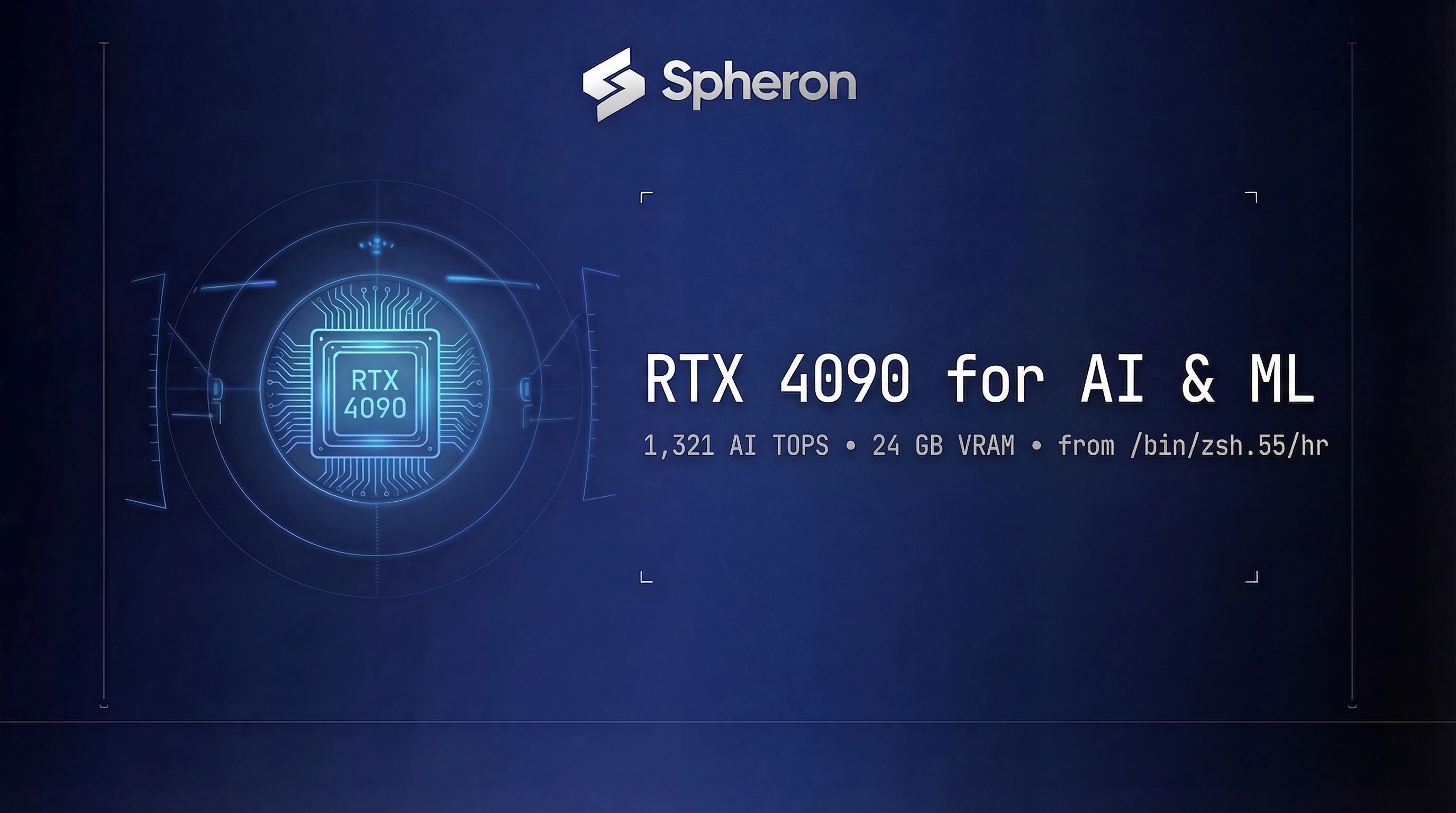
The NVIDIA RTX 4090 for AI workloads leads with 24 GB GDDR6X: enough to run 7B-13B models at FP16 and 32B models at Q4 quantization without CPU offload. At under $2,000, it delivers AI performance rivaling data center cards costing 5 to 10x more. For researchers, indie developers, and startups that need real GPU compute without enterprise budgets, the RTX 4090 is the most capable consumer option available. Upgraders weighing the current Blackwell generation should read the RTX 5090 vs RTX PRO 6000 comparison.
With 16,384 CUDA cores, 512 fourth-generation Tensor Cores, and 24 GB of GDDR6X memory, the RTX 4090 handles LLM inference at 10 to 30+ tokens per second on 13B parameter models, generates Stable Diffusion images in about 1.2 seconds, and supports fine-tuning of models up to 20B parameters with LoRA/QLoRA. For guidance on which GPU is best for your LLM workload, see our complete ranking of NVIDIA GPUs for LLMs.
This guide covers the RTX 4090's architecture, real-world AI benchmarks, model capacity, how it compares to data center GPUs, and when it makes sense for your workload.
Technical Specifications
| Specification | RTX 4090 | RTX 3090 (comparison) |
|---|---|---|
| Architecture | Ada Lovelace (TSMC 4N) | Ampere (Samsung 8nm) |
| CUDA Cores | 16,384 | 10,496 |
| Tensor Cores | 512 (4th Gen) | 328 (3rd Gen) |
| VRAM | 24 GB GDDR6X | 24 GB GDDR6X |
| Memory Bandwidth | 1,008 GB/s | 936 GB/s |
| Memory Bus | 384-bit | 384-bit |
| FP32 (TFLOPS) | 82.6 | 35.6 |
| FP16 Tensor (TFLOPS) | 165.2 | 71 |
| AI TOPS (FP8/INT8) | 1,321 | N/A |
| RT Cores | 3rd Gen (128) | 2nd Gen (82) |
| Base Clock | 2,235 MHz | 1,395 MHz |
| Boost Clock | 2,520 MHz | 1,695 MHz |
| TDP | 450W | 350W |
| PCIe | Gen 4 x16 | Gen 4 x16 |
| MSRP | $1,599 | $1,499 |
| CUDA Compute | 8.9 | 8.6 |
The RTX 4090's fourth-generation Tensor Cores support FP8, FP16, BF16, TF32, and INT8 precision formats, covering every data type used in modern AI training and inference. The 1,321 AI TOPS figure represents peak INT8/FP8 throughput, making the RTX 4090 exceptionally fast for quantized model inference.
AI Benchmark Performance
LLM Inference
The RTX 4090 is the fastest consumer GPU for local LLM inference. Using quantized models with llama.cpp or Ollama:
| Model | Quantization | Tokens per Second | Fits in 24 GB? |
|---|---|---|---|
| Llama 3.3 8B | Q4_K_M | 80-120 tok/s | Yes |
| Qwen 3 8B | Q4_K_M | 75-115 tok/s | Yes |
| Mistral 7B | Q4_K_M | 85-130 tok/s | Yes |
| Llama 3.3 13B | Q4_K_M | 40-60 tok/s | Yes |
| Qwen 3 32B | Q4_K_M | 12-20 tok/s | Yes (tight at ~16 GB) |
| Mixtral 8x7B | Q4_K_M | 20-35 tok/s | Yes (tight) |
| Llama 3.3 70B | Q4_K_M | 8-12 tok/s | No (needs 2 GPU or CPU offload) |
| Phi-4 14B | FP16 | 40-60 tok/s | Yes |
For models up to 13B parameters, the RTX 4090 delivers interactive speeds well above the 20 tok/s threshold needed for real-time chat. Even Mixtral 8x7B (47B total parameters, 12B active) runs at usable speeds with 4-bit quantization.
Stable Diffusion and Image Generation
| Workload | RTX 4090 | RTX 3090 |
|---|---|---|
| SD 1.5 (512x512, 20 steps) | ~1.2 seconds | ~3.5 seconds |
| SDXL (1024x1024, 30 steps) | ~4.5 seconds | ~12 seconds |
| Flux.1 (1024x1024) | ~6 seconds | ~18 seconds |
| Batch of 8 images (SD 1.5) | ~4 seconds | ~15 seconds |
The RTX 4090 is roughly 2.5 to 3x faster than the RTX 3090 for image generation workloads. The fourth-generation Tensor Cores and higher memory bandwidth make a significant difference for diffusion model inference.
Training and Fine-Tuning
The RTX 4090's 24 GB VRAM supports training and fine-tuning for models up to approximately 20B parameters using parameter-efficient methods:
| Training Method | Max Model Size | Notes |
|---|---|---|
| Full fine-tuning (FP16) | ~3B parameters | Limited by optimizer state memory |
| LoRA (FP16) | ~13B parameters | Trains adapter layers only |
| QLoRA (4-bit base) | ~20B parameters | Quantized base + FP16 adapters |
| Full training (small models) | ~1B parameters | ResNet, BERT-Base, small transformers |
For academic researchers and startup teams, QLoRA on the RTX 4090 enables fine-tuning of 13B-20B parameter models that would otherwise require A100-class hardware. For the workstation-class 48 GB Ada Lovelace option with ECC memory, see the RTX 6000 Ada Generation guide for a full comparison of what the extra VRAM unlocks for 70B fine-tuning.
RTX 4090 vs Data Center GPUs for AI
How does a $1,599 consumer card compare to enterprise accelerators?
| Specification | RTX 4090 | A100 80GB | H100 SXM |
|---|---|---|---|
| VRAM | 24 GB GDDR6X | 80 GB HBM2e | 80 GB HBM3 |
| Memory Bandwidth | 1,008 GB/s | 2,039 GB/s | 3,350 GB/s |
| FP16 Tensor TFLOPS (dense) | 165.2 | 312 | ~989 |
| INT8 (TOPS) | 1,321 | 624 | 3,958 |
| NVLink | No | Yes (600 GB/s) | Yes (900 GB/s) |
| MIG | No | Yes (7 instances) | Yes (7 instances) |
| TDP | 450W | 400W | 700W |
| Cloud Price (Spheron) | From $0.48/hr | From $1.19/hr | From $2.20/hr |
| Purchase Price | ~$1,599 | ~$15,000 | ~$30,000+ |
FP16 Tensor Core values are dense (non-sparse). With NVIDIA structured sparsity (2:4): RTX 4090 ~330, A100 ~624, H100 SXM ~1,979 TFLOPS.
Pricing fluctuates based on GPU availability. Spheron rates above are live as of 16 Oct 2026; other providers reflect their most recent published rates and may have changed. Check current GPU pricing → for live rates.
The RTX 4090 is surprisingly competitive in raw INT8/FP8 throughput (1,321 TOPS versus A100's 624 TOPS), but its 24 GB VRAM is the primary limitation for AI workloads. Data center GPUs win on memory capacity, memory bandwidth, multi-GPU interconnects, and ECC reliability.
Where RTX 4090 Wins
Cost per TOPS: At $1,599, the RTX 4090 delivers 1,321 AI TOPS, better INT8 throughput per dollar than an A100. For inference on quantized models that fit in 24 GB, it's the most cost-effective option.
Local development: No cloud costs, no network latency, no data privacy concerns. Researchers can iterate on models 24/7 without watching a billing dashboard.
Image generation: Stable Diffusion, Flux, and other diffusion models run fastest on the RTX 4090 among consumer GPUs. The combination of Tensor Core throughput and memory bandwidth makes it ideal for batch image generation.
Where RTX 4090 Loses
Large model training: 24 GB cannot hold models larger than ~3B for full fine-tuning or ~20B with QLoRA. Serious pre-training or SFT on 70B+ models requires data center GPUs.
Multi-GPU scaling: No NVLink means multi-GPU communication bottlenecks on PCIe. Data center GPUs scale to 8-GPU clusters with full-bandwidth interconnects.
Production inference: No MIG, no ECC memory, and consumer-grade reliability make the RTX 4090 unsuitable for production serving with SLA requirements. Data center GPUs provide hardware isolation and error correction that production systems need.
For a direct comparison with the H100 including cost-per-million-token math and a worked example of the hybrid 4090-dev/H100-training workflow, see the H100 vs RTX 4090 comparison.
Ada Lovelace Architecture for AI
The RTX 4090's Ada Lovelace architecture brings several AI-relevant improvements over the previous Ampere generation:
Fourth-Generation Tensor Cores: Support FP8 precision for the first time in consumer GPUs. FP8 enables 2x the throughput of FP16 for inference, which is why the RTX 4090's AI TOPS figure (1,321) is so high relative to its FP16 TFLOPS (82.6). To understand how memory affects GPU performance at different quantization levels, see our guide to GPU memory requirements for LLMs.
DLSS 3 and Frame Generation: While primarily a gaming feature, DLSS demonstrates NVIDIA's neural network inference capabilities on consumer hardware. The same Tensor Core architecture accelerates AI workloads.
Shader Execution Reordering: Improves GPU utilization by dynamically reordering work across streaming multiprocessors. This benefits compute workloads by reducing idle time during irregular memory access patterns common in AI inference.
L2 Cache: 72 MB L2 cache (vs 6 MB on RTX 3090) significantly improves data reuse for AI workloads, reducing memory bandwidth pressure and improving throughput for models with repetitive access patterns like transformer attention.
Optimal Use Cases
Local LLM inference: Running Ollama, llama.cpp, or vLLM locally with 7B-13B parameter models at interactive speeds. The RTX 4090 is the fastest consumer option for this use case. For a guide to running LLMs locally, see our run LLMs locally with Ollama guide.
Stable Diffusion and image generation: Generating images, training LoRA adapters for Stable Diffusion, and running ComfyUI/Automatic1111 workflows. The RTX 4090 produces images 2.5-3x faster than RTX 3090.
Research prototyping: Testing model architectures, running ablation studies, and training small models before scaling to cloud GPUs. The zero-cost iteration cycle (no per-hour billing) accelerates research.
Fine-tuning with QLoRA/LoRA: Adapting 7B-20B parameter models on custom datasets. QLoRA makes the RTX 4090 viable for fine-tuning work that previously required A100-class hardware.
Computer vision: Training and evaluating CNNs, vision transformers, and object detection models. Models like ResNet-152, ViT-Large, and YOLO train comfortably within 24 GB.
The RTX 4090 is also the primary hardware for SmolVLM multimodal inference and SmolVLA robotics deployments, where the 24 GB VRAM fits multiple concurrent small vision-language model instances that a data center card would be economically wasted on.
RTX 4090 AI Workstation Builds
Sizing an RTX 4090 workstation for AI comes down to two decisions: which model sizes you need to run, and whether you need more than one GPU.
VRAM headroom by task: 7B-13B parameter models in Q4 quantization run comfortably inside 24 GB. Qwen 3 32B fits but uses around 16 GB, leaving little buffer for long context windows. Llama 3.3 70B in Q4 doesn't fit on one card; running it requires a second RTX 4090 via PCIe or partial CPU offloading, both of which slow generation significantly. For fine-tuning, QLoRA accommodates base models up to 20B parameters; standard LoRA tops out around 13B; full fine-tuning is constrained to roughly 3B.
Multi-GPU PCIe limits: Two RTX 4090s connect at 32 GB/s of bandwidth per direction on PCIe Gen 4. That ceiling is adequate for data parallelism on small models but insufficient for tensor parallelism on large ones, where NVLink interconnects in data center GPUs provide the sustained bandwidth that per-step weight sharing requires.
Deploy RTX 4090 on Spheron
For teams that need RTX 4090 GPU access without purchasing hardware, Spheron offers cloud RTX 4090 instances; the live rate starts at $0.48/hr as of 16 Oct 2026, moving with marketplace availability. This is ideal for:
- Burst workloads that don't justify hardware purchase
- Teams that need multiple RTX 4090s simultaneously
- Remote development environments with GPU access
- Scaling beyond a single local GPU
Deploy with full root access, pre-configured CUDA environments, and pay-per-second billing. No long-term contracts required.
If you need more VRAM or want Blackwell's native FP4 support and 78% higher memory bandwidth, see our RTX 5090 rental guide. Spheron offers it from $0.78/hr, with lower cost-per-token for small model inference. For a full side-by-side benchmark across both cards including cost-per-token math, see our RTX 5090 vs RTX 4090 AI comparison. Before committing to the newer generation, it's worth checking which Blackwell consumer card actually rents cheaper for AI work, since the 5080's lower sticker price doesn't always translate into a lower cost per token once VRAM limits force smaller batch sizes. If your inference workload is small enough that even a 4090 feels like overkill, our NVIDIA L4 vs L40S pricing comparison covers two data-center cards built specifically for that budget tier. And if you're weighing the 4090's successor against full datacenter hardware rather than just its own product line, the RTX 5090 vs H100 vs B200 breakdown lays out where the consumer-to-datacenter tradeoff actually lands.
RTX 4090s are available on Spheron from $0.48/hr with full root access and pre-configured CUDA environments. Need more VRAM? The RTX 5090 (32 GB) starts at $0.78/hr. Per-minute billing, no contracts.
Frequently Asked Questions
Not comfortably on a single GPU. Llama 70B in Q4 quantization requires approximately 35 GB of VRAM, which exceeds the RTX 4090's 24 GB. You can run it with partial CPU offloading (slow) or across two RTX 4090s via PCIe (bandwidth-limited). For 70B models, an A100 80GB or H200 is the practical choice.
The RTX 4090 is roughly 2-3x faster for most AI workloads. It has 56% more CUDA cores, 56% more Tensor Cores, fourth-generation Tensor Core architecture with FP8 support, and a 72 MB L2 cache (vs 6 MB). Both have 24 GB VRAM, so model capacity is similar, but the RTX 4090 processes everything significantly faster.
For development and testing, yes. For production with SLA requirements, no. The RTX 4090 lacks ECC memory, MIG partitioning, and NVLink, features that production inference systems need for reliability and multi-tenancy. Use data center GPUs (A100, H100, L4) for production serving.
With QLoRA (4-bit quantized base model + FP16 adapter layers), you can fine-tune models up to approximately 20B parameters. With standard LoRA in FP16, the limit is around 13B parameters. Full fine-tuning is limited to ~3B parameter models due to optimizer state memory requirements.
If you need GPU access daily for development and local inference, buying is more cost-effective, the $1,599 investment pays for itself once your rental hours pass $1,599 divided by the hourly cloud rate ($0.48/hr for an RTX 4090 on Spheron). If you need burst capacity, multi-GPU clusters, or data center GPUs for larger models, cloud rental on Spheron is the better option.
Technically yes via PCIe, but performance is limited. Without NVLink, multi-GPU communication bottlenecks on PCIe Gen 4 bandwidth (32 GB/s per direction). This is adequate for data parallelism on small models but insufficient for tensor parallelism on large models. For serious multi-GPU training, data center GPUs with NVLink are recommended.