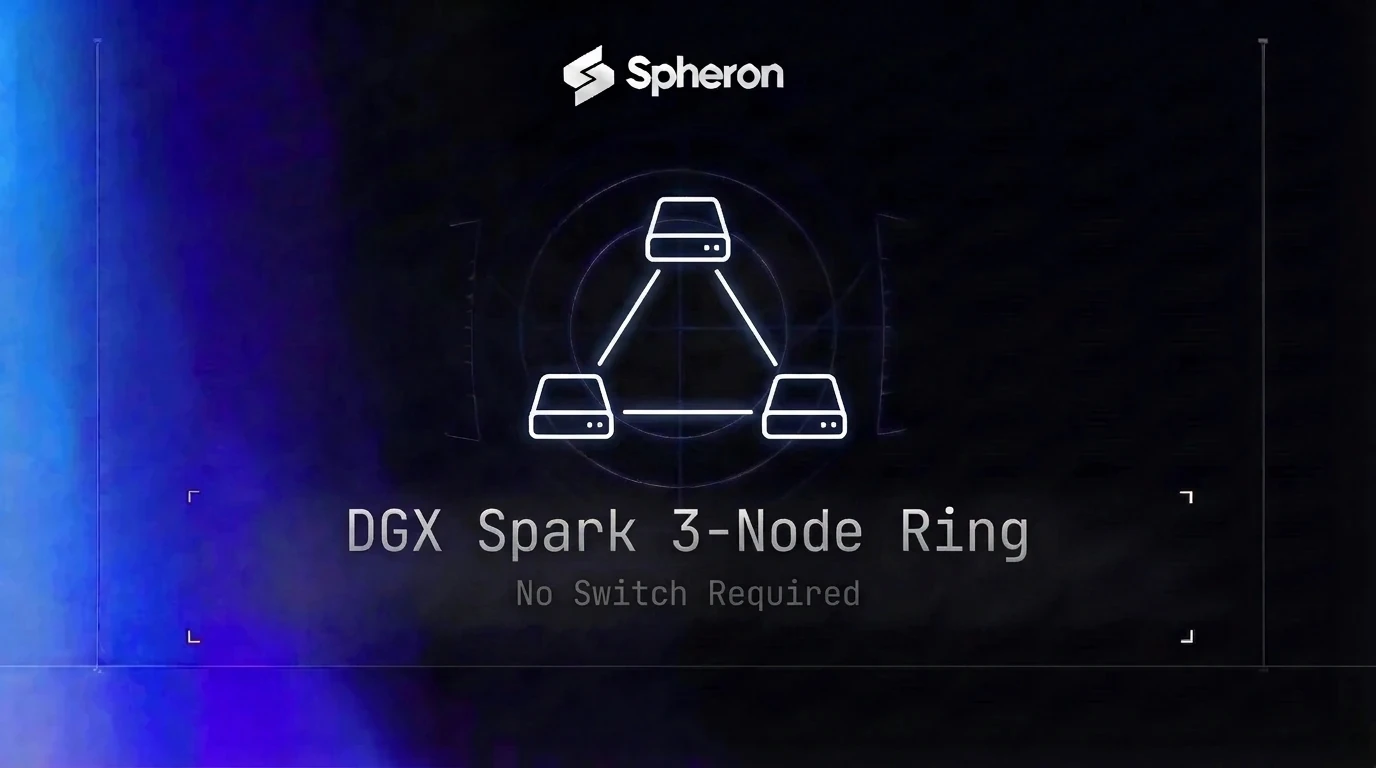
NVIDIA's own documentation confirms a DGX Spark multi-node setup with no switch works for exactly three units, cabled directly to each other in a triangle. Four nodes is where NVIDIA's supported, switchless path stops. What most writeups skip is the real payoff: cabling three DGX Spark units in a ring doesn't save you a cable over a switched build, you need three QSFP links either way. It saves you the switch itself, the rack space, and the hour of setup that comes with it. The community tool sparkrun makes the NCCL side of that ring workable. Here's how to cable it, configure it, what it measures, and the two places it falls apart.
TL;DR: DGX Spark Multi-Node Setup No Switch
- Topology: NVIDIA's Sync Cluster Assistant officially supports a 3-node DGX Spark ring with zero switch ports; four nodes officially needs a switch, per NVIDIA's own documentation (as of Nov 2026).
- Cabling: three ConnectX-7 QSFP links, cross-connected Port 0 to Port 1 around the triangle, using NVIDIA-approved cables such as the Amphenol NJAAKK0006.
- Software: the sparkrun tool sets NCCL_NET_PLUGIN=none, NCCL_IB_SUBNET_AWARE_ROUTING=1, and NCCL_IB_MERGE_NICS=0 for a detected ring.
- Throughput: nccl-tests on a stock 3-node ring measured roughly 24 GB/s average bus bandwidth; one inference benchmark logged token generation as low as 12.01 tok/s.
- Where it breaks: training across the ring has failed with ibv_modify_qp timeout errors for at least one user, and Spheron's B200 on-demand instances cover the concurrency and model sizes the ring structurally can't reach. Compare live GPU pricing.
DGX Spark Multi-Node Setup No Switch: Cost for Two vs Three Nodes
NVIDIA's own clustering documentation draws the line at exactly three units. NVIDIA Sync Cluster Assistant officially supports up to three DGX Spark systems connected directly through cables, and reserves four systems for a switched build. That detail is what makes the switchless ring worth building rather than worth skipping past entirely: it isn't a workaround or an unsupported hack, it's the documented path for this exact node count.
The three-node ring doesn't save you a cable. A three-node cluster needs three QSFP links whether they run node-to-node around a triangle or node-to-switch into a hub; the cable count is identical either way. What you skip is the switch hardware itself and the time spent racking, powering, and configuring a device that didn't need to exist for three nodes specifically. Four nodes is a different story, and the last section of this post covers why.
DGX Spark's own price has only moved up since launch, which makes avoiding an unnecessary switch purchase more than a rounding error. ServeTheHome Editor-in-Chief Patrick Kennedy pinned the cause of that trend directly to memory sourcing: "we are paying $2000 for 64GB ECC RDIMMs, so pricing logically must increase." A small QSFP switch costs far less than a DGX Spark unit on its own, but on a three-unit build where every line item is already competing with rising hardware prices, the switchless path is the one line item you can remove entirely rather than shop around for.
Three broad paths get you multi-GPU capacity for the model sizes this hardware targets:
- Buy a small QSFP switch and cable up to four DGX Spark units into it, the officially supported route past three nodes.
- Cable three units directly into a ring, skip the switch purchase entirely, and work within the ring's own limits, covered below.
- Skip owning the hardware and rent multi-GPU capacity by the hour instead. Spheron's B200 instances run on-demand, billed per minute with no commitment, with spot capacity that can be reclaimed without notice and reserved capacity available by quote.
That third option doesn't make sense if you already own three DGX Spark units and just want them talking to each other for free, which is the actual intent behind a "no switch" search. It starts to matter once you hit the ring's ceiling, which the last section of this post covers in detail. The simpler two-node version of this same trade-off, pairing two units over a single QSFP cable to reach 128GB and 546 GB/s of combined bandwidth, is also switchless by definition, since there's only one cable to run; our DGX Spark 64GB Sync Clustering guide covers that pairing in full.
Cabling the Ring: Three ConnectX-7 Links, Zero Switch Ports
Each DGX Spark carries exactly two QSFP ports on its ConnectX-7 NIC, each capable of up to 200 Gb/s; a cable rated faster than 200 Gb/s gives no benefit, because the port itself is the ceiling. NVIDIA names two approved cables for this direct connection: the Amphenol NJAAKK0006 and the Luxshare LMTQF022-SD-R.
Wiring the triangle is where the one detail that trips people up actually lives. The three-node ring cables Port 0 on one Spark to Port 1 on the next, all the way around the triangle, never port 0 to port 0 on both ends. NVIDIA Developer Forums user eugr summed up the fix plainly: "it's important to 'cross-connect' between port0-port1."
| Link | From | To |
|---|---|---|
| Link 1 | Node A, Port 0 | Node B, Port 1 |
| Link 2 | Node B, Port 0 | Node C, Port 1 |
| Link 3 | Node C, Port 0 | Node A, Port 1 |
Pairing port 0 to port 0 on adjacent nodes looks symmetric and is the wrong move; the ring only resolves cleanly when every hop crosses from one port number to the other.
The subnet math behind that cabling is worth knowing before you start troubleshooting routes. Each of the three direct QSFP links carries two L3 subnets, so the full three-node mesh runs across six subnets total. None of those six subnets can carry general coordination traffic between the nodes, so all three nodes also need to share a common Ethernet network for out-of-band coordination, since the QSFP ports can't do that job in a ring. In practice that means a standard switch or router for SSH and orchestration traffic stays in the picture; what the ring removes is the dedicated, high-speed QSFP switch, not every piece of networking gear on the bench.
Configuring NCCL for a Ring Instead of a Star Topology
A switched cluster hands NCCL a star: every node talks to a central hub, and NCCL's default routing assumptions line up with that shape out of the box. A ring has no hub, so NCCL needs to be told explicitly that its neighbors are each other, not a switch.
The community tool sparkrun handles most of that detection for you. Its setup wizard auto-detects ConnectX-7 topology, assigns static IPs via netplan at MTU 9000, and saves "topology: ring" to the cluster definition. Once it recognizes a ring, it injects three NCCL environment variables specifically for that topology:
NCCL_NET_PLUGIN=none
NCCL_IB_SUBNET_AWARE_ROUTING=1
NCCL_IB_MERGE_NICS=0
NCCL_NET_PLUGIN=none keeps NCCL off a plugin written for switch-fabric assumptions it doesn't need here. NCCL_IB_SUBNET_AWARE_ROUTING=1 is the piece that actually deals with the six-subnet mesh from the cabling section above, telling NCCL to route traffic based on which of those subnets a destination actually sits on instead of assuming one flat fabric. NCCL_IB_MERGE_NICS=0 stops NCCL from treating the two ConnectX-7 ports on a single node as one merged interface, which matters because each port in a ring is talking to a different neighbor, not sharing one link.
The software side of this got meaningfully easier over the course of 2026. Early three-node ring setups needed a special, ring-patched NCCL build to work at all.
Measured Throughput vs a Switched Cluster, and What a Ring Is Actually Good For
Raw bandwidth on a stock three-node ring holds up reasonably well for a switchless setup. nccl-tests on a stock three-node DGX Spark ring measured roughly 24 GB/s average bus bandwidth before anything else about that particular run went wrong (more on that in the next section). Real-world LLM throughput tells a more mixed story, and the numbers vary by who ran the benchmark:
| Setup | Benchmark | Result |
|---|---|---|
| 3-node ring, nccl-tests | average bus bandwidth | ~24 GB/s |
| 3-node ring, llama-benchy 0.3.5 (31 Mar 2026) | prompt processing (pp2048) | 901.27 ± 75.84 tok/s |
| 3-node ring, llama-benchy 0.3.5 (31 Mar 2026) | token generation (tg32) | 17.86 ± 0.16 tok/s, dropping to 17.63 tok/s at 8192-token context depth |
| 3-node ring, later report | prompt processing (pp2048) | 912.55 ± 218.84 tok/s |
| 3-node ring, later report | token generation (tg32) | 12.01 ± 3.30 tok/s |
| 3-node ring, another later report | token generation (tg100) | 16.4 tok/s single-stream, ~169.6 tok/s aggregate at 32 concurrent requests |
Prompt processing holds steady across reports; token generation is where the spread shows up, and that later tg32 figure is actually lower than a two-node setup's generation throughput on the same kind of workload. The explanation is structural rather than a bad cable: pipeline-parallel inference across three nodes is generally slower than running on a single Spark, because of pipeline overhead. Three nodes mainly help in two situations: letting a model fit at all that wouldn't fit on one unit, or adding data parallelism once a model already fits on a single Spark and you want more concurrent throughput rather than more capacity. That's also why a published pipeline-parallel recipe for a ~397B MoE model uses pipeline_parallel: 3, tensor_parallel: 1: tensor parallelism generally needs a power-of-2 node count, and three nodes structurally can't run TP=3.
Set those tok/s figures against what a purpose-built multi-GPU cloud node does at the same job. On an 8xB200 node running Kimi K2.7 Code with vLLM in NVFP4 as one 8-GPU copy (14 Oct 2026), we measured 178 tok/s for a single user and 93 tok/s at 32 concurrent users, with a 1.90-second time to first token and 95,033 prompt tokens/sec plus 1,179 output tokens/sec under agent load. That's not a fair apples-to-apples comparison, eight B200s with NVLink inside the node is a different class of hardware from three desk-side GB10 chips bridged over ConnectX-7, but it's the honest scale a ring is up against once concurrency, not just capacity, is the requirement.
Running three units at sustained, multi-hour load also raises the same clock and power questions that apply to a single DGX Spark, just across three chassis instead of one. Our DGX Spark thermal throttling and power draw measurements cover what clock decay and sustained temperature look like on one unit; it's worth reading before you assume a ring's throughput numbers will hold steady for hours at a stretch.
Where the Ring Breaks: Training, the Firmware Gotcha, and the Four-Node Wall
Inference is the use case the ring is actually documented for. Training is where the same hardware starts failing in ways the nccl-tests benchmark doesn't predict. One user training across a 3-node ring found that nccl-tests passed at roughly 24 GB/s average bus bandwidth, but accelerate-launch training initialization failed with ibv_modify_qp "Connection timed out" errors, until switching to a NCCL build with explicit three-node mesh support compiled for the GB10 (sm_121) architecture. A ring over ConnectX-7 is itself a flavor of the non-InfiniBand multi-node setups our guide to multi-node GPU training without InfiniBand covers at rack scale; the same general lesson applies here at desk scale: a passing raw-bandwidth test is not the same thing as a passing distributed-training job.
Firmware is the second gotcha, and it's a real regression, not a one-off. After upgrading every node's ConnectX-7 firmware to version 1.108.20, two directly-linked DGX Spark units reached about 111 Gbit/s in a 30-second iperf test. Moving to a three-node ring on the same firmware then regressed throughput to about 10 Gbps, with a fatal AER (PCIe Advanced Error Reporting) error showing up in dmesg. The only fix that worked was fully unplugging power and QSFP cables, draining residual power, and rebooting, after which throughput returned to roughly 100 Gbps and held for about seven hours. A soft reboot alone did not clear it. If your ring suddenly tanks to a fraction of its expected bandwidth after a firmware update, a full power drain before you start debugging NCCL settings can save a lot of wasted time.
The four-node wall is structural, not a bug NVIDIA might patch away. NVIDIA's Cluster Assistant documentation confirms direct cabling covers two- and three-device clusters only; it does not support four devices directly, only via a switch, and NVIDIA's own developer blog lists the same three supported topologies: a two-node direct connection over one cable, a three-node ring using three QSFP cables with both ports active on every node, and a two-to-four-node fabric through a QSFP switch. The reason shows up the moment you go past three nodes: in a triangle, every node is directly adjacent to both of the others, so there's no missing path. Add a fourth node and that stops being true; a report on an even larger six-node DGX Spark ring found that non-adjacent node pairs have no direct cable and must route through an intermediate node, and routed RDMA between those pairs caused NCCL failures, exactly the structural problem a complete three-node triangle doesn't have. If a model needs to go past what three nodes hold, the next step up is officially a switch, not a fourth cable; our DGX Spark 4-node cluster guide covers that build, the 512GB ceiling it buys, and why the fourth node breaks the ring's clean geometry.
Both failure modes above land on whoever owns the hardware: a training job that won't initialize, a link that needs a full power drain to come back. Renting shifts that risk to the provider's side of the line. In live failure tests under load on our four-node 8xB200 inference fleet through the production gateway (16 Oct 2026), we killed a spot node mid-stream and the streams finished on the other copy after about 7 seconds, with 0 failed; we killed a node while 16 requests were writing tool calls and 16 of 16 still ended with one complete, valid tool call; an engine crash restarted on the same node in 3 minutes; and gateway and control plane restarts dropped 0 of 832 requests during a gateway hand-over. None of that erases the ring's cost advantage for a team that already owns three Spark units, but it's the other half of the tradeoff: a cable topology puts node failures on your desk, a rented fleet is built to absorb them.
If the real goal is multi-node training rather than inference, debugging a desk-side ring may not be the right place to chase it. As of 10-11 Nov 2026, we trained a 1.38B-parameter GPT-2-class model from scratch with nanochat's speedrun recipe on a single 8x H100 SXM5 spot node (Spheron ES, EU North 1, $22.14/hr live spot): pretraining took 99.2 minutes across 5,568 steps and 5.84B tokens, about 980K tokens/second, for a total GPU bill of $72.17. That's one node with NVLink inside it, not three desk units bridged over ConnectX-7, and it sidesteps the ibv_modify_qp failure mode above entirely. If you're weighing whether to own this hardware at all rather than rent around its limits, our DGX Spark break-even hours analysis runs that math against live H100, H200, and B200 on-demand rates.
Pricing fluctuates based on GPU availability. Spheron rates above are live as of 24 Nov 2026; the $22.14/hr spot rate and $72.17 total reflect a specific run captured on 10-11 Nov 2026 and may have changed since. Check current GPU pricing → for live rates.
None of this makes the switchless ring a bad build. For the job it's documented for, running an inference workload that needs three Spark units' combined memory but not training-grade reliability, it's the cheapest path to that capacity and it works. It's a worse fit the moment the job needs training stability, four or more nodes, or concurrency a GB10 ring was never built to serve.
A three-node ring gets inference-grade capacity onto a desk with no switch. For the jobs that need more concurrency, more memory, or multi-node training that just works, renting the GPU instead skips the cabling and the firmware debugging entirely.
Frequently Asked Questions
Yes, up to three. NVIDIA's Sync Cluster Assistant officially supports connecting three DGX Spark systems directly through ConnectX-7 cables in a ring, with no switch required. Four systems is where NVIDIA's documented path switches to a QSFP switch instead, because a four-node ring leaves two non-adjacent node pairs with no direct cable between them.
The community sparkrun tool sets three on a detected ring: NCCL_NET_PLUGIN=none, NCCL_IB_SUBNET_AWARE_ROUTING=1, and NCCL_IB_MERGE_NICS=0.
NVIDIA names two approved cables for direct ConnectX-7 connections: the Amphenol NJAAKK0006 and the Luxshare LMTQF022-SD-R. Each ConnectX-7 QSFP port tops out at 200 Gb/s, so a cable rated faster than that adds nothing.
Not reliably out of the box. One user whose nccl-tests passed at roughly 24 GB/s average bus bandwidth still hit accelerate-launch initialization failures with ibv_modify_qp 'Connection timed out' errors, and only got past them with a NCCL build compiled with explicit three-node mesh support for the GB10 architecture. Inference is the better-documented use case for this topology; training is the rougher edge.
Not for raw throughput. Reported token generation on a 3-node ring has run as low as 12.01 tok/s in one benchmark, while Spheron's $11.12/hr on-demand B200 instances are built for multi-GPU concurrency a ring can't reach at all. The ring's advantage is cost and ownership for a team that already has three Spark units sitting idle, not raw speed.