Oracle is deploying NVIDIA's Vera CPU on its cloud platform. That's a real rollout, not a press-release number attached to a chip nobody can touch yet. It's also the first clear signal of where Vera actually ships first, and it's worth unpacking what the chip is, why NVIDIA built it instead of licensing Arm cores again the way it did for Grace, and where it sits inside, and outside, a Rubin NVL72 rack.
TL;DR: What Is the NVIDIA Vera CPU and Why It Matters for Rubin NVL72
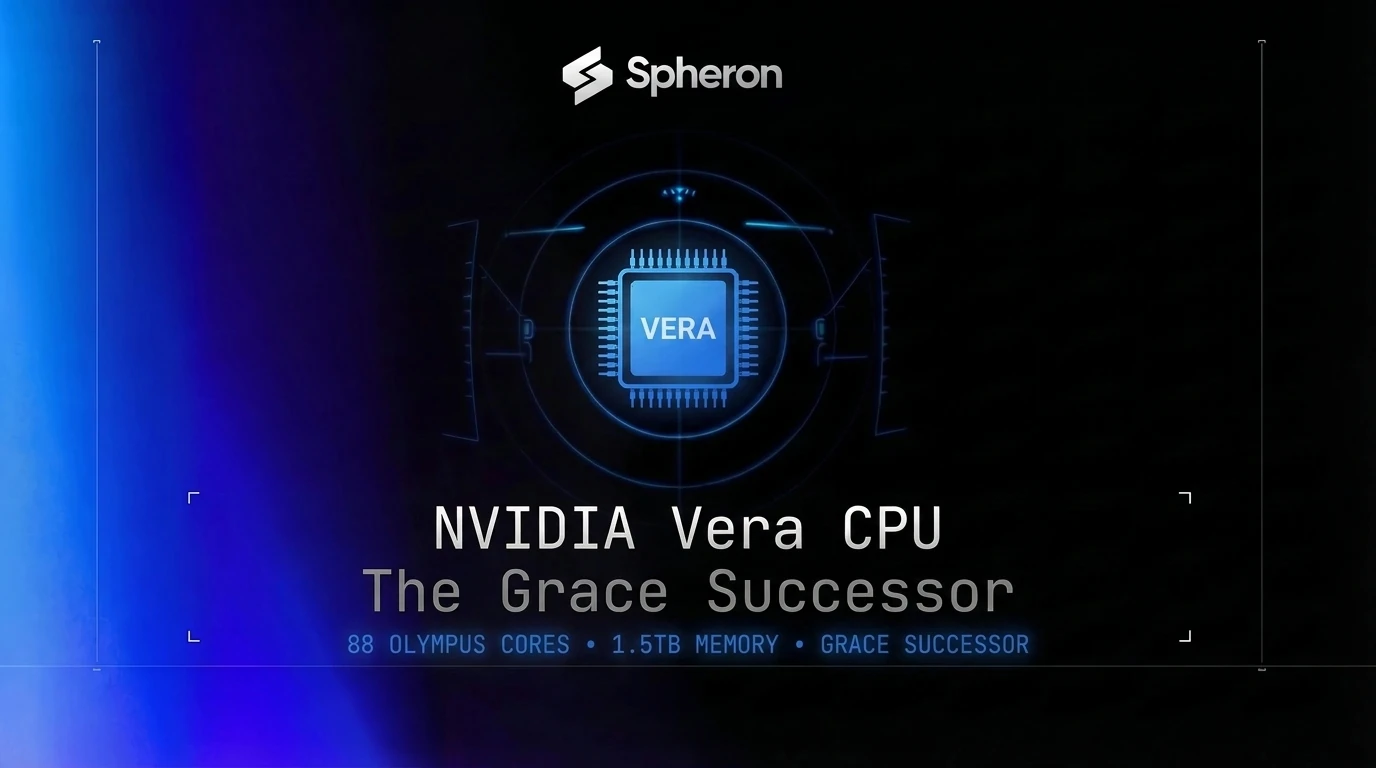
NVIDIA's Vera CPU is an 88-core, NVIDIA-designed Arm-compatible processor that replaces the licensed Grace CPU as the host chip in Vera Rubin NVL72 racks, and Oracle just proved it ships independently of the Rubin GPU too.
- Cores: Vera packs 88 custom NVIDIA Olympus cores with spatial multithreading for 176 threads.
- Memory: Up to 1.5 TB of SOCAMM2 LPDDR5X at up to 1.2 TB/s, roughly 3x Grace's 480 GB and 512 GB/s.
- Rack role: A Vera Rubin NVL72 rack pairs 72 Rubin GPUs with 36 Vera CPUs, a 2:1 ratio, connected over NVLink-C2C at up to 1.8 TB/s per link.
- Spheron: Vera Rubin rack reservations are open on the Vera Rubin pre-order page, with GB300 NVL72 and GB200 NVL72 available today as reservation alternatives while Rubin supply scales.
NVIDIA Vera CPU Specs: Full Table
Here's every published Vera CPU spec against the Grace CPU it replaces, sourced from NVIDIA's own Vera CPU product page and NVIDIA's developer blog on Vera's agentic workload design.
| Spec | Vera CPU | Grace CPU |
|---|---|---|
| Cores | 88 custom NVIDIA Olympus cores | 72 licensed Arm Neoverse V2 cores |
| Threads | 176 (spatial multithreading) | 72 (no SMT) |
| ISA | Armv9.2-compatible, NVIDIA microarchitecture | Arm Neoverse V2 reference design |
| Memory | Up to 1.5 TB SOCAMM2 LPDDR5X | Up to 480 GB LPDDR5X |
| Memory bandwidth | Up to 1.2 TB/s | Up to 512 GB/s |
| On-die fabric | 2nd-gen Scalable Coherency Fabric, 3.4 TB/s bisectional | 1st-gen SCF |
| NVLink-C2C to GPU | Up to 1.8 TB/s | Up to 900 GB/s |
| Configurable TDP | 250W to 450W | Lower, fixed-range envelope |
Three numbers in that table explain most of what changed: core count, memory capacity, and the GPU link. Each gets its own section below, because "more of everything" undersells what NVIDIA actually did with the design.
Vera vs Grace CPU: What Actually Changed (and the Benchmarks)
The headline change is who designed the core. Grace used a licensed Arm Neoverse V2 core, the same reference design other vendors can license for their own server chips. Vera's Olympus core is Armv9.2 instruction-set compatible, meaning existing Arm software runs on it, but the microarchitecture itself is NVIDIA's own design, not a stock Neoverse block. That answers a question worth stating plainly: Vera is still Arm based, in the sense that it runs the Arm instruction set and existing Arm toolchains and operating systems work on it unmodified, but NVIDIA no longer depends on Arm's own core roadmap for how fast each generation gets. That's the same move NVIDIA made with Blackwell's Tensor Cores, owning the part of the stack that decides the generation-over-generation gain instead of inheriting someone else's cadence.
The practical result shows up in two places: raw CPU throughput and memory behavior. On the throughput side, NVIDIA's benchmarks put Vera at 925 against 898 for an AMD EPYC 9755. A 3% rate-integer edge isn't the story on its own; what it shows is that NVIDIA's custom core design is competitive with the best shipping x86 server chips on general-purpose integer work, not just on the memory-bound jobs Grace was already good at.
Memory is where the gap widens. RuntimeWire reported that Tom's Hardware's benchmarking of a Vera server found more than twice the memory bandwidth of a dual Xeon 6 server, and NVIDIA's own developer blog claims Vera sustains over 90% of peak memory bandwidth under load with 40% lower peak memory latency than comparable x86 CPUs. For a chip whose main job in an AI factory is feeding GPUs, checkpointing, running data pipelines, and now hosting agentic workloads directly, bandwidth and latency under real load matter more than a synthetic peak number, and that's the comparison NVIDIA chose to publish.
Grace's 72 cores versus Vera's 88 is a 22% increase on paper, but spatial multithreading doubles the thread count to 176, which matters for workloads that are thread-count bound rather than per-core bound, like running many lightweight agent sandboxes concurrently on one socket. That's not a hypothetical use case either; it's the exact workload Oracle's first named Vera customer is running, covered below.
How Vera and Rubin Share the NVLink Domain in NVL72
A Vera Rubin NVL72 rack pairs 72 Rubin GPUs with 36 Vera CPUs, a 2:1 GPU-to-CPU ratio, the same pairing structure Grace Hopper and Grace Blackwell used before it. Each Vera CPU sits adjacent to a pair of Rubin GPUs on the board, and the link between them is NVLink-C2C running at up to 1.8 TB/s, double the 900 GB/s link Grace had to Hopper and Blackwell GPUs. That's the chip-to-chip link within a single Vera-Rubin pair, separate from the NVLink 6 fabric that connects all 72 GPUs to each other across the rack.
Why the CPU needs that much bandwidth to its GPU pair comes down to what the CPU is actually doing in an AI factory: staging training data, managing checkpoints for models too large to hold entirely in GPU memory, and, increasingly, running the orchestration and tool-execution layer for agentic workloads without round-tripping to a separate CPU fleet. Vera's 1.5 TB of SOCAMM2 memory and 1.2 TB/s bandwidth exist to keep that pipeline from stalling the GPUs sitting next to it, the same bottleneck NVLink-C2C was built to solve on Grace Hopper, just scaled up.
It's worth being precise about naming here, since it trips up a lot of searches: "Vera Rubin" is the platform name for the whole rack-scale system, "Rubin" by itself refers to the GPU, and "Vera" by itself refers to the CPU. Neither chip is "Vera Rubin" on its own. The GPU side of that pairing, including HBM4 capacity and NVLink 6 fabric bandwidth across all 72 Rubin GPUs, is covered in full in the Vera Rubin NVL72 system guide and the Rubin GPU spec breakdown; this page is about the CPU half of that pair.
Oracle's 150,000-CPU Rollout: What GA on OCI Actually Means
Oracle's October 27 announcement is the clearest real-world signal yet of where Vera CPUs actually land first, and it's worth separating from the rack-scale Rubin GPU availability race. Oracle's initial deployment covers 150,000 Vera CPUs. Regions and pricing weren't published alongside the announcement, which keeps this closer to a capacity-and-customer story than a buy-it-now product listing.
The named customer is the interesting part. OpenAI is running agentic sandbox workloads on OCI's Vera CPUs, specifically the kind of workload where an agent executes code and tools in an isolated environment. That's exactly the use case Vera's core and thread count were built for: many concurrent, relatively lightweight execution contexts per socket, rather than one large monolithic job. It also lines up with NVIDIA's own framing of Vera as an "agentic workloads" chip rather than purely a GPU feeder.
The detail that matters most for anyone evaluating this against Rubin GPU capacity: Oracle is selling these Vera CPUs as standalone compute, independent of any Rubin GPU attachment. That's a genuinely different product from a Vera Rubin NVL72 rack reservation. A standalone Vera instance on OCI gets you Olympus cores, high-bandwidth memory, and fast local storage for CPU-bound agent orchestration, data prep, or general compute, with no Rubin GPU in the box at all. A Vera Rubin NVL72 rack reservation, by contrast, gets you the paired CPU-GPU system for training and inference at the hardware's actual target workload. If you're evaluating cloud capacity right now, that's the question to ask first: do you need Vera's CPU characteristics on their own, which currently means Oracle, or do you need the full NVL72 rack with Rubin GPUs attached, which is still a reservation product everywhere, including on Spheron.
Where Vera CPUs Show Up Outside Rubin NVL72 Racks
Oracle's standalone instances are the clearest example that Vera isn't locked to a Rubin GPU pairing, and it's a deliberate design choice, not a leftover SKU. A chip built with 1.5 TB of fast memory, 176 threads, and an on-die fabric good for 3.4 TB/s of bisectional bandwidth is genuinely useful for CPU-only jobs: data pipeline staging ahead of a training run, checkpoint management for models too large to fit a single GPU's memory, and the agent-sandbox orchestration pattern OpenAI is already running on OCI. None of those need a GPU physically attached to the same board.
That split matters for how you should think about renting capacity right now. If you want a Vera Rubin NVL72 rack, reservations are open on Spheron's Vera Rubin pre-order page, alongside GB300 NVL72 and GB200 NVL72, both available today as reservation-based alternatives for teams that don't want to wait on Rubin supply. Spheron doesn't currently sell a standalone Vera CPU instance the way Oracle does; its Vera Rubin product is rack-scale GPU capacity with Vera CPUs attached, not bare CPU rental. If what you actually need today is a priced, on-demand GPU to build against while Rubin supply scales, B300 and B200 are live on Spheron with per-minute billing: B300 runs $12.42/hr on-demand as of 31 Oct 2026. For a closer look at where Vera Rubin NVL72 is actually shipping across providers right now, the cloud availability tracker has the dated scoreboard.
Pricing fluctuates based on GPU availability. Spheron rates above are live as of 31 Oct 2026; no hourly or on-demand rate exists yet for Vera Rubin NVL72 or the standalone Vera CPU on any provider's published rate card. Check current GPU pricing → for live rates on hardware available today.
Vera's standalone rollout on Oracle is the first real evidence of where this generation of NVIDIA CPU lands before the full Rubin rack does. Reserve Vera Rubin NVL72 capacity ahead of broader availability, or start renting B300 GPUs today while Rubin supply scales.
Frequently Asked Questions
Yes, with a catch. Vera's 88 Olympus cores are Armv9.2 instruction-set compatible, so Arm software runs on them, but unlike Grace, NVIDIA designed the Olympus core itself instead of licensing a stock Arm Neoverse core. That gives NVIDIA full control over the microarchitecture, cache hierarchy, and how each core talks to the Scalable Coherency Fabric.
No. Vera Rubin is the name of the full platform, and it's actually two separate chips: the Vera CPU and the Rubin GPU, linked by NVLink-C2C. 'Rubin' alone refers to the GPU; 'Vera' alone refers to the CPU. A Vera Rubin NVL72 rack pairs 72 Rubin GPUs with 36 Vera CPUs, so neither chip is the whole product on its own.
36. NVIDIA's Vera Rubin NVL72 rack holds 72 Rubin GPUs and 36 Vera CPUs, a 2:1 GPU-to-CPU ratio, with each Vera CPU connected to its pair of Rubin GPUs over NVLink-C2C at up to 1.8 TB/s.
Oracle Cloud Infrastructure sells standalone Vera CPU instances (Bare Metal and Flex VM) independent of any Rubin GPU attachment, as of its October 27, 2026 general availability announcement. Spheron's Vera Rubin page is reservation-based rack-scale capacity paired with Rubin GPUs, not a standalone CPU product; GB300 NVL72 and GB200 NVL72 are available today on Spheron as reservation alternatives.