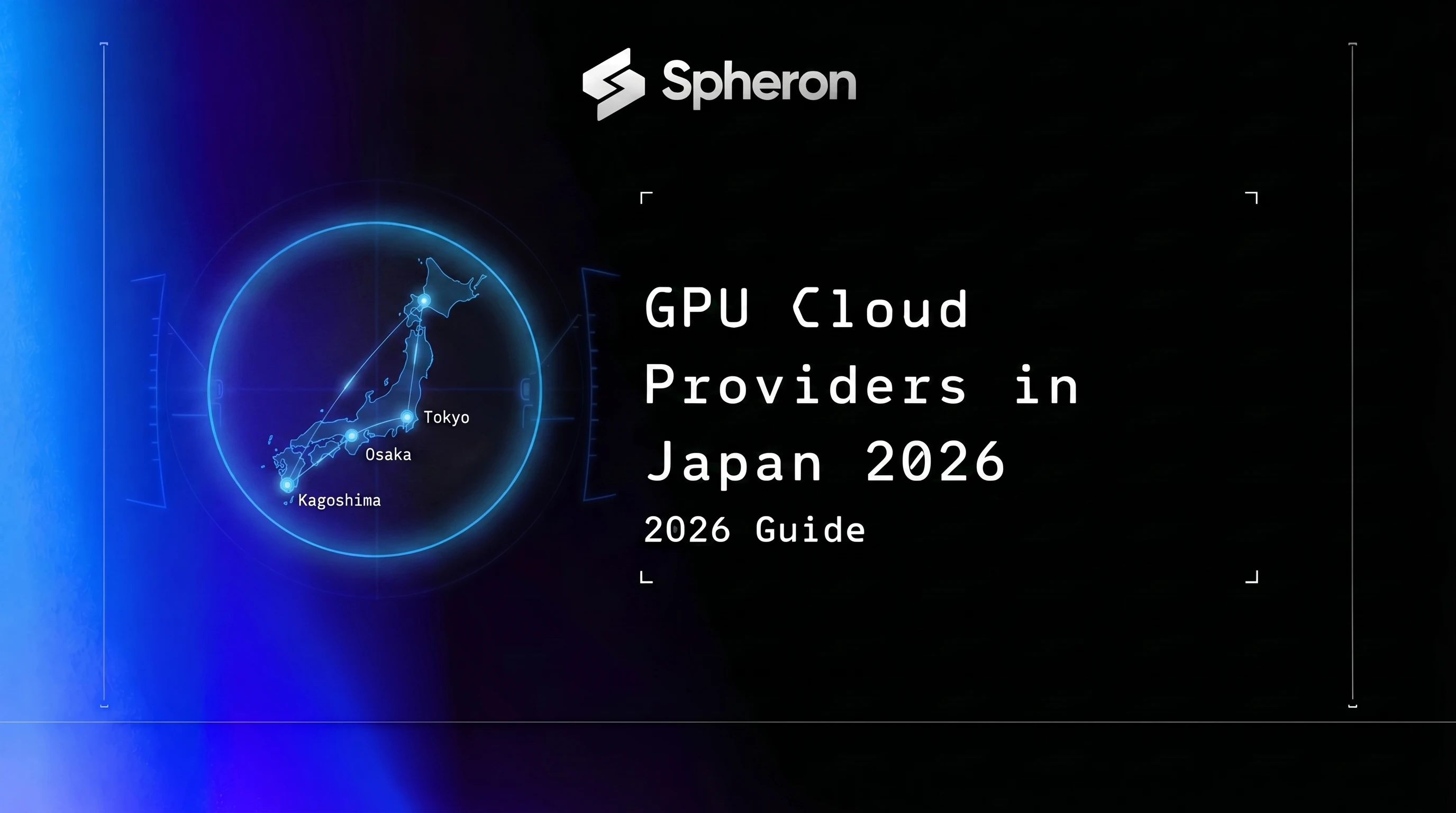
Japan spent two years talking about sovereign AI compute. In late 2026, it started shipping it. SoftBank's GB200-based neocloud goes commercial in October, five domestic providers are splitting a JPY72.5 billion government subsidy pool, and Japan just signed on for 27,500 next-generation Rubin GPUs, the largest national Rubin procurement announced anywhere in the world. If you are choosing GPU cloud in Japan for the first time, or re-evaluating now that a real domestic option exists, this is what's actually buyable today, not just promised.
This guide compares hyperscaler, domestic, and global neocloud pricing, walks through what's launching and when, and breaks down what Japan's APPI and ISMAP rules mean for training data that touches Japanese users. For the wider Asia-Pacific picture, including Tokyo latency and PDPA/Privacy Act rules for Singapore and Australia, see our GPU cloud guide for Asia-Pacific. For the equivalent buildout in Korea, see our South Korea GPU cloud guide.
TL;DR: GPU Cloud Providers in Japan 2026, Pricing and Data Residency
In-country H100 capacity in Japan runs about $6-14 per GPU-hour as of 24 Jul 2026, and that premium buys APPI-friendly placement and ISMAP registration that a global marketplace cannot offer.
| Provider | H100 per GPU-hour | Japan residency |
|---|---|---|
| AWS Tokyo | ~$12.30, checked 24 Jul 2026 | Yes, ISMAP-registered |
| Azure Tokyo | ~$14.00, checked 24 Jul 2026 | Yes, ISMAP-registered |
| Sakura Internet | ~$6.07 (990 yen), checked 24 Jul 2026 | Yes, ISMAP and METI-subsidized |
| Spheron | $2.64/hr on-demand as of 23 Oct 2026 | No in-Japan compute |
SoftBank's GB200 NVL72 neocloud goes commercial in October 2026. Compare live global GPU rates.
Why Japan Is Pushing Sovereign AI Compute Now
Japan's push isn't a research paper exercise anymore; it has line items attached. METI approved GPU cloud subsidies totaling up to 72.5 billion yen under the Economic Security Promotion Act, split across five recipients: Sakura Internet took the largest share at roughly 50.1 billion yen (about 69% of the entire pool), followed by KDDI (~10.24 billion yen), Highreso and Highreso Kagawa jointly (~7.70 billion yen), the RUTILEA/AI Fukushima joint application (~2.56 billion yen), and GMO Internet Group (~1.93 billion yen). METI's stated rationale is blunt: domestic companies account for only about 30% of Japan's basic cloud services market, and the subsidy program exists to change that.
That's on top of a much larger compute and foundation-model commitment. Japan set aside JPY387.3 billion for its FY2026 program, with officials citing potential funding of up to JPY1 trillion over five years, though the money is conditional: contracts cover only the first two years, and continued funding depends on an annual stage-gate review. Separately, Japan has committed roughly JPY10 trillion (about $65 billion) through 2030 toward AI infrastructure leadership overall.
Then there's Noetra, the national project behind Japan's biggest compute bet yet. In July 2026, METI and NVIDIA CEO Jensen Huang announced a plan to procure 27,500 next-generation Rubin GPUs for Japan's sovereign AI buildout, the largest national-level Rubin GPU order announced globally to date. Noetra involves 44 companies with SoftBank as lead, alongside NEC, Honda, and Sony Group, backed by roughly 1 trillion yen in planned investment over five years. GENIAC, Japan's earlier compute-access grant program for domestic model developers, fed directly into this: Preferred Networks' PLaMo 2.0 Prime, one of the three models running Japan's government AI platform, came out of GENIAC's second phase.
Worth being clear about what's real right now versus what's still on paper. The METI subsidies, Sakura Internet's live GPU cloud, and SoftBank's October launch are things you can buy or are about to be able to buy. Noetra's 27,500 Rubin GPUs are a procurement commitment for 2026-2027 capacity, not a product you can rent this quarter.
GPU Cloud Pricing in Japan: Hyperscaler vs Neocloud vs Domestic Providers
Here's what a single H100-class GPU actually costs across the options available to a team building in or for Japan right now:
| Provider | Region | H100 (per GPU/hr, on-demand) | Notes |
|---|---|---|---|
| AWS | Tokyo (ap-northeast-1) | ~$12.30/hr (P5.48xlarge / 8) | ISMAP-registered; matches US-East list pricing |
| Azure | Tokyo (japaneast) | ~$14.00/hr (ND H100 v4 / 8) | ISMAP-registered |
| Google Cloud | Tokyo (asia-northeast1) | ~$12.49/hr (A3 High) | ISMAP-registered |
| Sakura Internet | Ishikari, Japan (domestic) | ~$6.07/hr (990 yen/hr, Koukaryoku VRT H100 SXM) | ISMAP-registered, METI-subsidized |
| Spheron (global neocloud) | Global marketplace, no in-Japan compute | $2.64/hr on-demand, $2.20/hr spot | Aggregates 5+ providers; no in-country data residency |
Pricing fluctuates based on GPU availability. Spheron rates above are live as of 23 Oct 2026; other providers' rates were checked on 24 Jul 2026 and may have changed. AWS, Azure, and Google Cloud figures are cross-referenced from our own GPU cloud pricing survey across Asia-Pacific. Sakura Internet's rate is publicly listed for its Koukaryoku VRT H100 plan and converted from yen at approximately 163 JPY/USD. Spheron figures come from the live API. Check current GPU pricing → for live rates.
The spread is the story here. Hyperscaler Tokyo pricing runs several times Spheron's global on-demand rate and roughly double Sakura's domestic rate. Sakura sits in between: still a real premium over a global marketplace, but it buys you in-country placement and ISMAP registration, which for a regulated Japanese workload is often the deciding factor over price. Our broader AWS H100 pricing breakdown covers the P5 family in more depth if you're weighing AWS specifically against neocloud alternatives, and our hyperscaler-vs-Spheron comparison has the wider global cost argument.
SoftBank's AI Data Center GPU Cloud: Hardware, Timeline, Pricing Signals
SoftBank Corp announced its "AI Data Center GPU Cloud" on May 25, 2026, and confirmed a commercial launch in October 2026, following an internal beta already running across SoftBank group companies. This is the most significant single entrant in Japan's GPU cloud market this year, not because it's the cheapest, but because it's the first credible domestic option running on current-generation Blackwell hardware at scale.
Infrinia AI Cloud OS: Kubernetes-as-a-Service and Inference-as-a-Service
The platform is built on SoftBank's own "Infrinia AI Cloud OS," which packages two managed layers on top of the raw GPU infrastructure: Kubernetes-as-a-Service (KaaS) for multi-tenant workload orchestration, and Inference-as-a-Service (Inf-aaS) for serving LLM inference through APIs. That's a meaningfully more managed offering than a bare-metal GPU rental; it's closer to how a hyperscaler packages GPU access than how a typical neocloud does.
GB200 NVL72 Deployment and the October 2026 Commercial Launch
Under the hood, SoftBank's cloud runs on NVIDIA GB200 NVL72 systems connected over NVLink, with high-performance storage attached. GB200 NVL72 is NVIDIA's current top-tier training and inference rack, pairing Grace CPUs with Blackwell GPUs in a liquid-cooled, 72-GPU NVLink domain designed for the largest model training and inference jobs. SoftBank is not alone in betting on this hardware inside Japan: KDDI and HPE are deploying the same GB200 NVL72 platform at their Osaka Sakai data center, targeting an early 2026 launch, months ahead of SoftBank's own commercial date.
How It's Positioned Against AWS, Azure, and GCP's Limited Japan Sovereign Options
The three hyperscalers all run ISMAP-certified, full-service Tokyo and Osaka regions, and that certification is genuinely sufficient for most government and regulated workloads. What none of them offer is a "built by a Japanese company, for Japanese sovereignty" narrative: the underlying entities remain US-headquartered, subject to US legal process regardless of where the physical servers sit. SoftBank's pitch is explicitly the opposite: a Japanese telecom incumbent running Japanese-controlled infrastructure, positioned as the neocloud alternative to renting hyperscaler capacity for workloads where full sovereignty, not just in-region hosting, is the requirement.
Other Japan-Based and Japan-Available GPU Cloud Options
SoftBank isn't building in a vacuum. Several other Japan-based providers already have GPUs running, and a few more have capacity coming online through 2027.
Sakura Internet: ISMAP-Registered, METI-Subsidized, Live H100/H200 Capacity
Sakura Internet is the incumbent domestic GPU cloud, and one of the few Japanese-owned providers ISMAP-registered alongside AWS, Azure, Google Cloud, and Oracle. It has about 2,000 NVIDIA H100 GPUs installed at its Ishikari data center in Hokkaido, sold through the Koukaryoku VRT and PHY product lines, plus a separate container-type facility that came online in mid-2025 with roughly 1,000 H200 GPUs. Sakura plans to add 8,000 more H100s at Ishikari alone by the end of 2027, bringing that single site to roughly 10,000 GPUs and shifting new capacity to NVIDIA HGX B200; separately, Bloomberg reported the company is building a second data center elsewhere in Hokkaido designed to house another 10,800 GPUs when it comes online, also by 2027.
Sakura's other distinguishing feature: it hosts Japan's government generative AI platform, "Gennai," which runs on three domestic foundation models, NTT's tsuzumi 2, Fujitsu's Takane 32B, and Preferred Networks' PLaMo 2.0 Prime, on infrastructure the Digital Agency describes as the only domestic offering registered on Japan's Government Cloud. If your buyer is a Japanese government agency, Sakura's compliance posture is hard to match.
GMI Cloud's Kagoshima AI Factory: 1GW, $12B, Physical AI Focus
GMI Cloud is building a $12 billion, up-to-1-gigawatt "AI Factory" in Satsumasendai City, Kagoshima Prefecture, with construction starting late 2026 at an initial 350MW. Unlike SoftBank and Sakura, GMI Cloud's Japan bet is explicitly aimed at physical AI: robotics, autonomous vehicles, and manufacturing workloads, not general-purpose LLM training or inference. "Japan has built some of the world's most sophisticated industrial and manufacturing systems," said GMI Cloud CEO Alex Yeh. "The next frontier is ensuring those systems are powered by AI that Japan owns, controls, and can trust." VAST Data co-founder Jeff Denworth, whose storage platform underpins the buildout, called it a design meant "to deliver national-scale performance and operational control." This is a 2027-and-later capacity story, not something you can rent today.
KDDI, Fujitsu, and NTT: Telecoms and Manufacturers Building Their Own Stack
Beyond the GB200 deployment at Osaka Sakai, KDDI plans to offer the resulting cloud-based AI compute through WAKONX, its enterprise AI business platform. Separately, Fujitsu began domestic manufacturing of "Made in Japan" sovereign AI servers at its Kasashima Plant starting March 2026, built on NVIDIA HGX B300 and NVIDIA RTX PRO 6000 Blackwell Server Edition GPUs, with full traceability from circuit board manufacturing through final assembly. NTT's contribution is tsuzumi 2, the lightweight foundation model already running on Sakura's Gennai platform. None of these three currently sell GPU capacity as a self-serve rental product the way SoftBank or Sakura do; they're building supply chain and enterprise infrastructure plays first.
AWS, Azure, and Google Cloud in Tokyo and Osaka
All three hyperscalers run full GPU regions in Japan: AWS ap-northeast-1 (P5 H100 instances), Azure japaneast (ND H100 v4), and GCP asia-northeast1 (A3 High H100 instances). All three are ISMAP-registered, which matters if you're selling into government or regulated enterprise buyers, since ISMAP-registered services handling government data are generally expected to store and process it inside Japan unless an exception applies. What you're paying for at $12-14/hr per H100 is that certification, mature managed-service integration (S3, BigQuery, Azure OpenAI Service), and SLA-backed capacity, not the cheapest way to run a training job.
Global Neoclouds: Where Spheron Fits Without In-Japan Compute
Spheron doesn't operate a Japan data center, and it isn't pretending to. What it offers instead is H100 GPU rental at pricing typical of a global neocloud GPU-as-a-Service marketplace, per-minute billing, and no reservation requirements, aggregated across 5+ providers so availability doesn't depend on one facility's capacity. For Japanese teams running training or batch inference on data that isn't personally identifiable, this is the cheapest path by a wide margin: the gap between Spheron's $2.64/hr on-demand H100 rate and AWS Tokyo's $12.30/hr is enough to fund months of additional experimentation on the same budget. Spot pricing ($2.20/hr for H100), documented in Spheron's instance-type reference, is another option, though spot capacity can be reclaimed without notice, so it's the wrong choice for anything you can't checkpoint and resume. For teams that need larger memory headroom on 70B+ models, H200 GPU pricing starts from $5.52/hr on-demand, and B200 access is available from $5.22/hr for Blackwell-class training.
Pricing fluctuates based on GPU availability. Spheron rates above are live as of 23 Oct 2026; other providers reflect their most recent published rates and may have changed. Check current GPU pricing → for live rates.
The tradeoff is the same one every APAC team weighs: no in-country placement means anonymized training data and model weights are fine, but personal data covered by APPI needs to stay put or move under a compliant agreement, covered below.
Data Residency Requirements for Japanese Enterprises Deploying LLMs
Two frameworks govern most of what a Japanese AI team needs to think about: APPI for personal data, and ISMAP for anything touching a government buyer.
APPI and Extraterritorial Third-Party Provision Rules
Japan's Act on the Protection of Personal Information, revised in 2022, applies extraterritorially to foreign businesses handling data belonging to Japanese residents. The operative provision for GPU cloud decisions is Article 24, which governs third-party provision of personal data to a foreign recipient: if your training or inference pipeline sends identifiable personal information about Japanese residents to a foreign GPU cloud, you need either the individual's consent or an alternative legal basis, such as a data processing agreement meeting Japan's specified standards. Model weights and aggregated statistics generally fall outside this scope, which is the practical reason so many teams train on global infrastructure using de-identified datasets and keep raw personal data in Japan-controlled storage. For a technical alternative to full in-country compute, confidential computing with encrypted VRAM is worth evaluating for workloads that need hardware-level attestation without moving the compute itself into Japan.
ISMAP Certification: What It Means for Government and Regulated Workloads
ISMAP is Japan's cloud security assessment program for vendors serving government agencies. As of early 2026, registered providers relevant to GPU cloud include AWS, Microsoft Azure, Google Cloud, Oracle, and Sakura Internet. Registration signals that a provider meets Japan's own government security bar, and ISMAP-registered services handling government data are expected to store and process it within Japan unless a specific exception is approved. For a private-sector AI team with no government customers, ISMAP isn't a legal requirement, but treat it as a proxy for enterprise trust: buyers evaluating vendors for regulated data will ask about it even outside a formal government contract.
Sector Overlays: Financial Services and Government Data Handling
APPI and ISMAP are the baseline, not the ceiling. Financial services firms in Japan layer on Financial Services Agency guidance around outsourcing and data handling, and government agencies procuring through Gennai or similar platforms are currently restricted to domestically-registered, Government Cloud-listed infrastructure, which as of mid-2026 effectively means Sakura Internet for GPU-backed AI workloads. If you're building for either sector, budget for a compliance review specific to that overlay rather than assuming APPI and ISMAP alone clear you.
How to Choose: Decision Framework by Workload and Compliance Need
| Workload / Requirement | Recommended Option | Why |
|---|---|---|
| Government or Government Cloud-listed workloads | Sakura Internet | Only domestically-owned ISMAP-registered provider; hosts Gennai |
| Regulated enterprise data (finance, healthcare) staying in Japan | Sakura Internet, or hyperscaler Tokyo/Osaka regions | ISMAP registration, in-country storage and processing |
| Large-scale training on Blackwell-class hardware, in-country | SoftBank AI Data Center GPU Cloud (from Oct 2026) | GB200 NVL72, Kubernetes-as-a-Service, Japanese-controlled infrastructure |
| Physical AI, robotics, manufacturing (2027+) | GMI Cloud Kagoshima | Purpose-built for physical AI at gigawatt scale |
| Cost-sensitive training/inference on anonymized data | Spheron or another global neocloud | Several times cheaper than hyperscaler Tokyo pricing; no in-country residency needed |
| Enterprise integration with existing AWS/Azure/GCP stack | Hyperscaler Tokyo or Osaka region | Managed services, ISMAP registration, existing tooling |
If you're not sure which bucket you're in, the fastest filter is one question: does any of the data your model touches identify a real Japanese person? If yes, APPI is in scope and you need either in-country compute or a compliant transfer agreement. If no, and you don't have a government or Government Cloud requirement, price wins, and that's where a global neocloud like Spheron makes the most sense. Our top 10 GPU cloud providers guide is a useful baseline if you want the non-regional version of this comparison, and our GPU cloud pricing comparison tracks rates across 15+ providers globally.
Japan's AI Infrastructure Outlook
The next 18 months tell you where this market is heading. SoftBank's commercial launch in October 2026 is the near-term milestone to watch; if it hits capacity and pricing targets, it becomes the default recommendation for Japanese teams that need in-country Blackwell-class compute without going to a hyperscaler. Sakura Internet's shift from roughly 2,000 to a targeted 10,000 GPUs at Ishikari alone by 2027, plus a second Hokkaido facility planned to add another 10,800 GPUs the same year, moving to HGX B200, is the steadiest capacity growth story in the market. GMI Cloud's Kagoshima facility and the KDDI-HPE Osaka deployment both add meaningful capacity on a 2026-2027 timeline, though both hinge on the same constraint every large buildout does now: power availability, which we cover in more depth in our AI data center power constraints guide.
Noetra's 27,500 Rubin GPUs sit furthest out. It's a national procurement commitment, not a product, and the companies involved (SoftBank as lead, alongside NEC, Honda, Sony Group, and 40 others) will spend the next two years turning that commitment into deployed, rentable capacity. For comparison, teams weighing sovereign-AI approaches elsewhere in the region can see how India and the Middle East are tackling the same problem in our GPU cloud guide for India and GPU cloud guide for the Middle East.
For now, the practical answer for most teams building AI products for the Japanese market is a split: run non-regulated training and experimentation on whichever GPU cloud is cheapest, and reserve in-country, ISMAP-registered capacity for the data that actually needs it.
If your workload doesn't need in-country placement, Spheron gives you H100, H200, and B200 access from 5+ providers at a fraction of hyperscaler Tokyo pricing, with per-minute billing and no reservation contracts.
Spheron's H100 instances → | H200 GPU cloud pricing → | View all GPU pricing →
Frequently Asked Questions
SoftBank plans a commercial launch in October 2026, after running the platform in beta internally across SoftBank group companies. It runs on NVIDIA GB200 NVL72 systems connected over NVLink, with Kubernetes-as-a-Service and Inference-as-a-Service layered on top through SoftBank's own Infrinia AI Cloud OS, and it is explicitly built to keep AI workloads inside Japan.
AWS, Azure, and GCP charge roughly $12-14/hr per H100 GPU in their Tokyo regions, in line with their US list pricing. Sakura Internet, Japan's ISMAP-registered domestic option, prices a single H100 SXM VM at 990 yen an hour, about $6/hr at current exchange rates. Spheron, a global marketplace with no in-Japan compute, prices H100 access at $2.64/hr on-demand or $2.20/hr spot.
ISMAP (Information system Security Management and Assessment Program) is Japan's cloud security certification for vendors serving government agencies. AWS, Microsoft Azure, Google Cloud, Oracle, and Sakura Internet are all ISMAP-registered as of early 2026. For government or regulated-sector contracts it is close to mandatory. For general private-sector AI workloads it is not a legal requirement, but it is a strong trust signal that enterprise buyers look for.
Not automatically. APPI's Article 24 governs the transfer of personal information to a foreign third party, so if your training or inference data contains identifiable information about Japanese residents, you need consent or a compliant data processing agreement before it leaves the country. Anonymized datasets and model weights themselves generally fall outside APPI's scope, which is why many teams train on a global neocloud using de-identified data and keep raw personal data in Japan-based storage.
SoftBank (GB200 NVL72, commercial launch October 2026), Sakura Internet (H100 and H200 today, moving toward B200), GMI Cloud (Kagoshima, construction starting late 2026), KDDI with HPE (Osaka, GB200 NVL72, targeted early 2026), and all three hyperscalers in Tokyo and Osaka. Global neoclouds like Spheron have no in-Japan facilities; they compete on price for workloads that do not require in-country placement.