Most "challenger chip vs NVIDIA" pieces cover a startup nobody outside the industry has heard of, making a claim nobody has independently checked. A Rebellions AI chip vs NVIDIA comparison is different: this one covers a chip NVIDIA itself is currently evaluating.
Rebellions is South Korea's first AI-chip unicorn, and it got there by merging with SK Telecom's chip subsidiary, raising roughly $850 million total, and shipping NPUs that are already running commercially at KT Cloud, inside SK Telecom's own AI platform, and at LG Electronics). This post walks through what the ATOM and Rebel100 architectures actually do differently from a GPU, where Rebellions' own efficiency numbers hold up and where they don't, whether you can rent one outside Korea, and what the NVIDIA talks mean if you're deciding what to deploy on this quarter.
TL;DR: Rebellions AI Chip vs NVIDIA GPUs for Korea Inference
- The claim: Rebellions says REBEL-Quad delivers 3.2x more transactions per second per watt than top-tier GPUs on Llama 3.3 70B in FP8, a vendor-run 2026 benchmark with no named GPU baseline.
- Availability: Rebellions NPUs rent only inside Korea, through KT Cloud's NPU-as-a-service and the KT NPU LLM Station appliance launched 19 Aug 2026.
- Backing: Rebellions has raised roughly $850 million, with Samsung, SK Hynix and SK Telecom among its backers.
- Spheron: for capacity this quarter outside Korea, Spheron H100 runs $2.75/hr on-demand as of 20 Oct 2026, billed per minute. Compare live GPU rates.
Who Is Rebellions, and Why Is NVIDIA Suddenly Talking to Them
Jinwook Oh holds a PhD from KAIST and spent seven years at IBM's T.J. Watson Research Center as a lead architect for AI semiconductor design. The founding team's first bet was specialized chips for financial trading. Once large language models took off, they pivoted toward general-purpose AI inference accelerators.
In March 2026, the company closed a $400 million pre-IPO round at a $2.34 billion valuation, led by Mirae Asset Financial Group and Korea's National Growth Fund, bringing cumulative funding to $850 million. The National Growth Fund's 250 billion won share of that round made Rebellions the first company in which the fund would participate as a shareholder, under the government's "K-NVIDIA Fostering Project," a push to build a domestic chip company that plays something like NVIDIA's role at home.
What Rebellions' NPU Architecture Actually Does Differently
Rebellions builds two active product lines: ATOM, a GDDR6-based chiplet card aimed at cost-efficient inference, and Rebel100, an HBM3e-based design aimed at larger models and higher bandwidth. The certified vLLM RBLN container supports "continuous batching, chunked prefill, prefix caching, speculative decoding, LoRA, sliding window attention, tensor/pipeline/data/expert parallelism, structured output, and w4a16 group quantization". That's the same feature list you'd check for on a serving stack running on H100 or H200, which matters more for adoption than any single spec: a team already running vLLM doesn't have to rewrite its serving code to try Rebellions hardware, only reconfigure the backend.
ATOM and ATOM-Max: GDDR6 and a Chiplet Card, Not a Monolithic Die
ATOM is Rebellions' second-generation SoC, the chip that moved the company from high-frequency-trading hardware into general-purpose AI inference.
The GDDR6 choice is the interesting part. GDDR6 is cheaper and more available than HBM, which is exactly the supply constraint that's kept HBM prices high and hyperscaler GPU allocations tight. Rebellions is betting that a chiplet design with more, cheaper memory beats a smaller amount of faster memory for a meaningful slice of inference workloads, the same logic Qualcomm is running with LPDDR5X on its AI200 accelerator, just with a different memory technology and a smaller capacity gap over NVIDIA.
REBEL100 and REBEL-Quad: Moving to HBM3e and UCIe-Advanced Chiplets
Rebel100 is Rebellions' third-generation SoC, and it drops GDDR6 for HBM3e entirely.
Four chiplets over an on-package interconnect rather than one large monolithic die is the same manufacturing bet AMD and Intel have made on their own data center chips: it costs less to fabricate four smaller dies than one large one at comparable total transistor count, at the cost of needing a fast chip-to-chip interconnect to keep them acting like a single accelerator.
REBEL-Quad, unveiled at Hot Chips 2025 as a 4-homogeneous-chiplet design rated at up to 2,048 TFLOPS FP8, the same specs Rebellions now ships as Rebel100, is the configuration Rebellions has actually benchmarked against GPUs on Llama 3.3 70B, and it's the number the rest of this post leans on for the cost-per-token comparison below.
Rebellions AI Chip vs NVIDIA: Where It Wins and Loses on Cost Per Token
The short answer: Rebellions has one credible, specific efficiency claim on one specific workload, and NVIDIA still wins decisively on raw compute, ecosystem maturity, and the ability to actually get capacity this week. Both of those things are true at once, and neither cancels the other out.
The Efficiency Claim: 3.2x TPS/Watt on Llama 3.3 70B
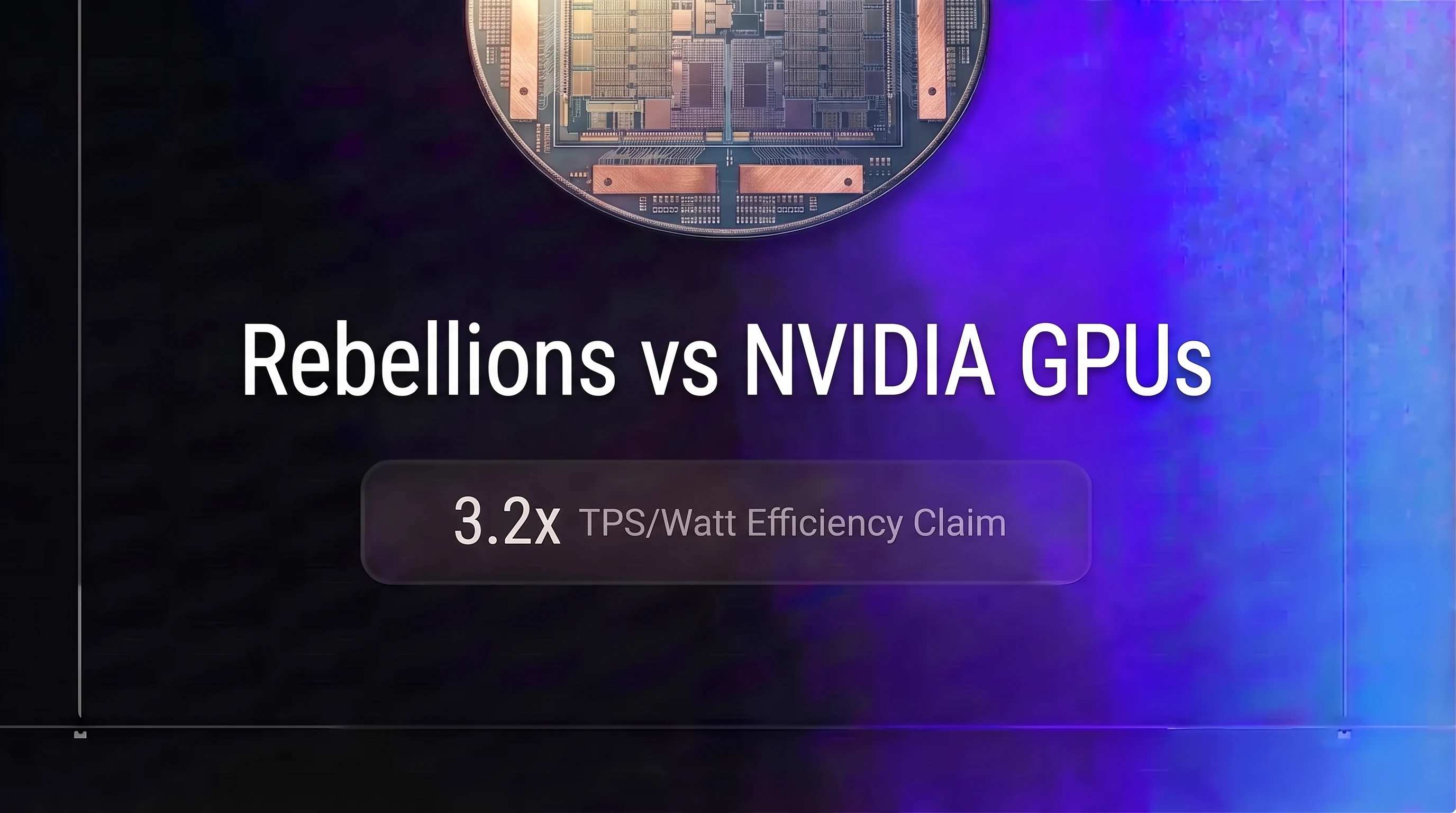
Synopsys puts the number plainly: "REBEL-Quad delivers 1.6× higher throughput and 50% lower power consumption, resulting in 3.2× more transactions per second per watt (TPS/W) than top-tier GPUs (tested on Llama 3.3 70B in FP8)". Read that as two separate claims stacked together, not one. The 1.6x throughput figure says REBEL-Quad moves more tokens per second on the same workload. The 50% power cut says it does that at half the wattage. Multiply the two and you get the headline 3.2x TPS/W figure, which is the metric that actually maps to cost per token, since power draw is what a data center bills for and throughput is what determines how many racks you need.
Rebellions CTO Jinwook Oh frames it as a TCO play more than a raw-speed one: "We believe REBEL-Quad delivers the highest performance per TCO ever and will make a huge impact in the AI inference market."
Two things keep this from settling the argument outright. First, "top-tier GPUs" isn't named more specifically than that in the source, so there's no way to confirm which NVIDIA part, generation, or precision configuration is the baseline. Second, this is a vendor-run benchmark on one model, in one precision format, published by a partner rather than reproduced by an independent lab. Treat it the way you'd treat any single-vendor number: directionally credible given Rebellions' engineering pedigree, not yet a substitute for a third-party benchmark you can point a procurement decision at.
Where NVIDIA Still Wins: Ecosystem, Availability, and Peak Compute
Set the two platforms side by side and NVIDIA's advantages are structural, not just about raw numbers on a spec sheet.
| Factor | Rebellions (ATOM-Max / Rebel100) | NVIDIA H100 SXM5 |
|---|---|---|
| Software stack | RBLN SDK: native support for PyTorch 2.x, vLLM, Triton | CUDA, TensorRT-LLM, vLLM, every major framework |
| Global rental availability | Korea only (KT Cloud NPUaaS) | Every major cloud and neocloud worldwide |
| Independent benchmarks | One named vendor claim, no third-party reproduction found | Years of published, reproduced benchmarks across every serving stack |
Those raw numbers aren't a fair fight between ATOM-Max and H100, and shouldn't be read as one. ATOM-Max is Rebellions' cost-efficient tier, built for workloads where GDDR6 capacity and low power matter more than peak FLOPS. Rebel100 is the chip actually positioned against high-end GPUs, and even at its published 2,048 TFLOPS FP8 rating, Rebellions hasn't put out an independently reproduced Rebel100-vs-H100 benchmark in a matched test. What is comparable across both tiers is the software story: RBLN SDK's decision to build on native PyTorch 2.x, vLLM, and Triton support rather than a closed stack is the single biggest thing narrowing the gap, because it means the switching cost for a team already running open serving infrastructure is a hardware backend swap, not a rewrite.
New AI Inference Chip 2026: Where Rebellions Fits Among the Non-GPU Challengers
Rebellions is one entry in a genuinely crowded field of companies betting that inference-specific silicon beats a general-purpose GPU on cost or efficiency for at least some workloads. Each one is making a different architectural bet, and Rebellions' specific angle, a chiplet-based NPU with an open software stack and a national government behind it, is distinct from all of them.
- Qualcomm's AI200 bets on sheer memory capacity: 768GB of commodity LPDDR5X per card, roughly 10x an H100's HBM3. Our Qualcomm AI200 vs NVIDIA breakdown covers that tradeoff.
- d-Matrix's Corsair takes a co-processor approach, pairing with NVIDIA Blackwell in the same rack rather than replacing it outright. See our d-Matrix Corsair comparison for how that positioning plays out.
- Tenstorrent is chasing NVIDIA from the open-hardware side, with RISC-V cores and a fully open software stack instead of a closed SDK. Our Tenstorrent vs NVIDIA writeup covers that architecture.
- Huawei's Ascend 950 is shaped by a different pressure entirely: export controls, not a pure engineering bet.
- SambaNova's SN40L runs a reconfigurable dataflow architecture with a similarly thin public pricing story to Rebellions.
What sets Rebellions apart from that list isn't the silicon, it's the backing. Every other name above is a private company selling on its own merits. Rebellions has a national government treating its success as strategic infrastructure, and that changes the risk calculus around whether it survives long enough for its roadmap to matter.
Where You Can Actually Rent a Rebellions Chip Today
Only inside Korea, and only through one channel that matters for a self-serve deployment: KT Cloud's NPU-as-a-service offering. There's no general-purpose international cloud, no neocloud, and no self-serve marketplace listing Rebellions ATOM or Rebel100 capacity outside Korea today.
There's a more concrete example of that appliance model, too. On August 19, 2026, KT launched the KT NPU LLM Station, an integrated AI appliance built around Rebellions' ATOM-MAX neural processing unit and KT's own Mi:dm K 2.5 Pro large language model. KT is pitching it at "public agencies, defense companies, pharmaceutical firms, manufacturers and financial institutions" that need generative AI running fully offline inside network-separated environments where an external API was never a legal option in the first place. That's a real, specific commercial deployment, not a pilot announcement. It's also not a rental in any sense a cloud buyer would recognize: it's a hardware appliance you install on-premise, not an hourly rate you turn on and off.
If your team needs inference capacity you can provision this week, from outside Korea, there currently isn't a Rebellions path. That's not a knock on the hardware, it's the state of the go-to-market: what exists today is one national cloud's NPUaaS offering and an on-premise appliance, not a self-serve global rental market.
Government Money, Samsung, SK Hynix, and the K-Nvidia Bet
Rebellions' backer list reads like a list of Korea's industrial policy priorities: "Aramco, Arm, Kindred Ventures, KT, Mirae Asset Group, Samsung, SK Hynix, and SK Telecom". Samsung and SK Hynix aren't passive investors here. Both are also HBM suppliers, which means Korea's two memory giants have a direct commercial stake in Rebellions actually shipping chips that use their memory, not just a portfolio bet.
The government layer is explicit rather than implied. Naming the initiative after the company it's trying to compete with is about as unambiguous as industrial policy gets.
Wait for Rebellions or Deploy on NVIDIA Now
If you're deciding what to run this quarter, the answer isn't close: nothing about Rebellions changes an active NVIDIA deployment decision today. There's no international rental path, the efficiency numbers are vendor-reported on one workload, and the NVIDIA talks, if they go anywhere, are preliminary and would take quarters to reshape any roadmap.
| Your situation | What to do |
|---|---|
| Need inference capacity to deploy this quarter | NVIDIA GPU cloud. Rebellions has no rental path outside Korea. |
| Building or already running on KT Cloud in Korea | Worth evaluating NPUaaS directly against your current GPU cost per token, since it's the one place a real comparison is possible today. |
| Watching for the NVIDIA-Rebellions outcome | Expect a Groq-style technology license and talent absorption before a full acquisition, based on NVIDIA's recent precedent. |
| Planning 2027+ vendor diversification | Track Rebellions' RebelRack/RebelPOD global expansion and its IPO timeline; a Korea listing in 2027 would be the clearest signal of how seriously to weight it. |
For teams renting GPUs right now, H100, H200, and B200 instances are live, with per-minute billing and no reserved commitment, aggregated across 5+ providers so you're not stuck negotiating with one data center operator. If you're sizing out a serving cluster and want the practical side of the cost-per-token math Rebellions is trying to beat, our best NVIDIA GPUs for LLMs guide ranks the current lineup by use case, and the Spheron API docs cover provisioning if you're spinning up multi-GPU capacity for the first time. Rebellions is a genuinely interesting bet, backed by more government and industrial weight than most challenger chips ever get. It just isn't a bet you can act on outside Korea yet.
Rebellions might be the most credible NVIDIA challenger to watch in 2026, but you can't rent one outside Korea today. H100, H200, and B200 are live on Spheron right now, no waitlist required.
H100 on Spheron → | Rent H200 GPU → | View all GPU pricing →
Frequently Asked Questions
Not confirmed. [Bloomberg reported in August 2026 that NVIDIA and Rebellions are discussing a possible partnership, technical agreement, investment, or acquisition](https://www.eweek.com/news/nvidia-rebellions-ai-chip-potential-deal-apac-south-korea/), but the talks are preliminary and nothing has been finalized. NVIDIA's late-2025 arrangement with Groq, a nonexclusive technology license plus hiring most of its engineering staff rather than an outright acquisition, is the likelier template than a straight buyout.
REBEL-Quad, a multi-chip configuration, is the version Rebellions has benchmarked against GPUs on Llama 3.3 70B, claiming [3.2x more transactions per second per watt through 1.6x higher throughput and 50% lower power](https://www.synopsys.com/blogs/chip-design/energy-efficient-ai-accelerator-data-centers.html).
Only inside Korea, through KT Cloud's NPU-as-a-service offering and KT's on-premise NPU LLM Station appliance. There is no general-purpose international cloud listing Rebellions ATOM or Rebel100 capacity as a self-serve rentable instance.
The two chips aren't on the same memory technology or precision format, so any comparison has to account for that before drawing conclusions about cost per token.
It's the label Korea's government has put on its push to build a domestic AI-chip champion, backed by the National Growth Fund, Samsung, and SK Hynix. The government's ambition, explicitly, is a Korean company that plays the role NVIDIA plays in the US.