Type "mi355x vs b300" into a search bar and you'll find AMD claiming up to 40% better tokens-per-dollar, and a widely shared benchmark putting AMD's cost edge even higher, around 45%. Neither number survives contact with what either GPU actually rents for. The MI355X rate behind that bigger claim is roughly $2.50/GPU-hr, a price no verified provider currently sells at; the only real on-demand MI355X listing right now is Oracle OCI at $8.60/GPU-hr, more than three times higher. Re-run the math at rates you can actually pay, and AMD's advantage over NVIDIA's B300 shrinks to single digits on most models, and flips to NVIDIA's favor on others.
TL;DR: MI355X vs B300 Inference Cost Per Token
AMD's MI355X beats NVIDIA's B300 on modeled cost per token for one model family; priced at real on-demand rates instead, the gap shrinks to single digits.
- Throughput: B300 outran MI355X on DeepSeek V4.1 Flash, 114,784 vs 59,646 tok/s/chip at 210 tok/s/user.
- Rental reality: The only verified on-demand MI355X rate is Oracle OCI at $8.60/GPU-hr; B300's median on-demand rate across 20 providers is $7.85/GPU-hr.
- Real cost per token: At actual on-demand rates, MI355X hits 13.8 tok/sec per dollar against B300's 13.1 on Kimi K3, a 6% AMD edge, not the ~45% some benchmarks imply.
- Spheron: B300 rents on-demand at $12.42/hr as of 03 Nov 2026, aggregated across 5+ providers. Check current GPU pricing for live rates.
Specs That Matter for Serving: HBM3e Capacity, Bandwidth, and Dense Compute
Both chips are built for the same job, serving large mixture-of-experts models at FP4, and on paper they're closer than the marketing suggests. MI355X is AMD's CDNA 4 part; B300, badged Blackwell Ultra, is NVIDIA's second Blackwell-generation chip.
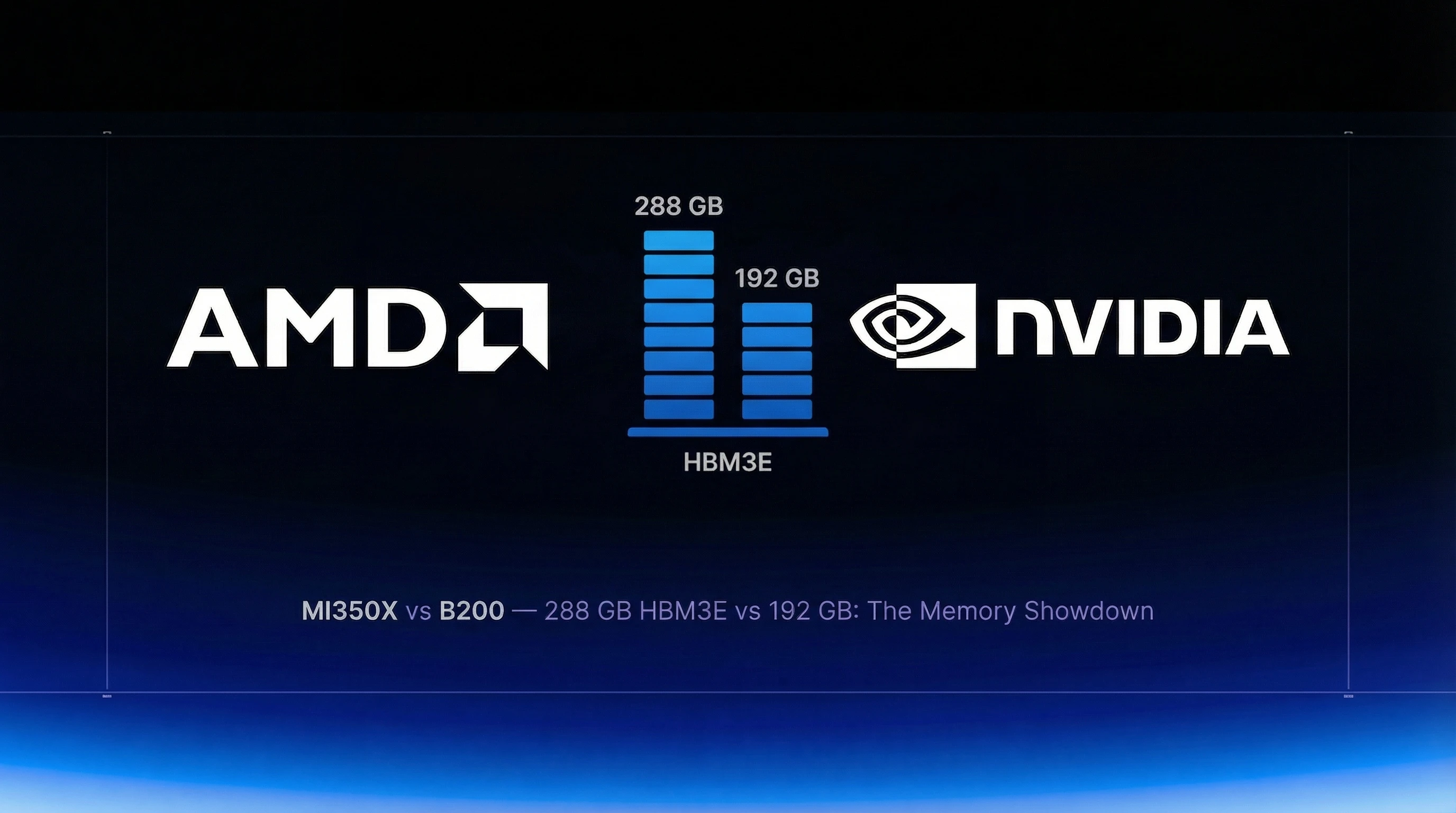
AMD's MI355X ships 288 GB of HBM3e at 8 TB/s of bandwidth, with 10,066 dense FP4 TFLOP/s and 5,033 dense FP8 TFLOP/s, connected over 4th-gen Infinity Fabric at 538 GB/s per chip.
NVIDIA's B300 ships 268 GB usable HBM3e at 8 TB/s with 13,500 dense FP4 TFLOP/s.
| Spec | AMD MI355X | NVIDIA B300 |
|---|---|---|
| Memory | 288 GB HBM3e | 288 GB HBM3e (268 GB usable) |
| Bandwidth | 8 TB/s | 8 TB/s |
| Dense FP4 | 10,066 TFLOP/s | 13,500 TFLOP/s |
| Dense FP8 | 5,033 TFLOP/s | 4,500 TFLOP/s |
| Dense BF16 | 2,516 TFLOP/s | 2,250 TFLOP/s |
| TDP | 1,400W | 1,200W |
| Scale-up interconnect | Infinity Fabric, 538 GB/s/chip | NVLink 5, 900 GB/s/chip |
The split compute profile explains a lot of what shows up later in this post. NVIDIA leads on dense FP4, the precision both chips actually serve MoE models at in production; AMD leads on dense FP8 and BF16, formats that matter more for training and for models that haven't been requantized to FP4. NVIDIA's NVLink 5 fabric also moves data between chips at nearly twice MI355X's Infinity Fabric rate, which matters for expert-parallel MoE serving, where tokens get routed across GPUs on every forward pass.
Measured Throughput: Same Models, Both GPUs
On the model families SemiAnalysis's InferenceX project has benchmarked across both chips, B300 wins on raw chip throughput in almost every case; MI355X wins on modeled cost per token in two of those cases, because InferenceX's assumed hourly rate for MI355X is lower than its assumed rate for B300, not because AMD moves more tokens.
On DeepSeek V4.1 Flash, a 552B model served at FP4, the gap depends heavily on how interactive the deployment needs to be:
| Interactivity target | B300 tok/s/chip | MI355X tok/s/chip | B300 modeled $/M tokens | MI355X modeled $/M tokens |
|---|---|---|---|---|
| 210 tok/s/user | 114,784 | 59,646 | $0.005 | $0.007 |
| 354 tok/s/user | 44,267 | 31,817 | $0.014 | $0.013 |
At 210 tok/s/user, B300 moves nearly twice the tokens per chip and is modeled as cheaper too. At 354 tok/s/user, the chips converge, and MI355X edges ahead on InferenceX's modeled cost, by about 8%, the one case in this post where that's true.
On Kimi K2.6/K2.7-Code, a 1T-parameter model also served at FP4, the pattern flips: B300 still moves more tokens per chip at a 38 tok/s/user target, 4,317 vs MI355X's 4,004, but MI355X is modeled as roughly 40% cheaper per token despite the lower throughput, at $0.10/M tokens against B300's $0.15/M tokens.
Independent of SemiAnalysis's modeled figures, MLPerf Inference v6.0, published 1 April 2026, measured an 8-GPU MI355X node hitting 100,282 tok/s against 115,730 tok/s for an 8-GPU B300-SXM-270GB node on the Llama 2 70B Server scenario, the same chip-level pattern: B300 moves more tokens per node even on a workload where AMD's AITER and ROCm stack is competitive.
We don't have MI355X in our own fleet to benchmark directly, more on why in the next section, but we do run B300 in production. We load-tested open models on our own 8xB200 and 8xB300 Spheron nodes with vLLM at NVFP4, sweeping 1, 8, 16 and 32 concurrent users and running a 32-session agentic load with roughly 32K-token prompts, 85-90% of input served from prefix cache, and 400-token answers. On 8xB300, split into two 4-GPU copies, Kimi K2.7 Code (the same code-focused model family SemiAnalysis benchmarked above) served 161 tok/s for a single user and 62 tok/s at 32 concurrent users, with a 0.41-second time to first token; each 4-GPU copy read 72,000 prompt tokens/sec and wrote 930 output tokens/sec under the agentic load.
That split-node choice has a real tradeoff beyond any single model. Running GLM-5.3 the same week, we found that splitting an 8xB300 node into two 4-GPU copies delivered lower per-user speed than running one 8-GPU copy on 8xB200, 254 vs 324 tokens/sec for a single user, as of October 2026. The upside is concurrency: the split B300 configuration served twice the agent sessions, 64 versus 32. If your deployment is latency-sensitive for a single user, that tradeoff matters as much as the chip-to-chip numbers above.
The On-Demand Rate Problem: Why Most MI355X-vs-B300 Cost Claims Don't Survive Contact With Real Pricing
Every cost-per-token number in the section above, and nearly every MI355X-vs-B300 comparison published this year, is built on a modeled hourly GPU rate, not a rate either chip actually rents for today. That distinction is the whole story.
AMD's own marketing is a good example. AMD hasn't published an equivalent claim against B300 specifically.
A closer look at real market rates tells a sharper version of the same story. Beri.net's survey of GPU rental providers found that the only verified true on-demand MI355X rental rate anywhere is Oracle OCI, at $8.60/GPU-hr. A cheaper Vultr listing at $2.59/hr exists, but it's sold out and sitting behind a waitlist, not a rate you can actually deploy against today. B300 has the opposite availability problem, in reverse: it's listed by 20 of the providers Beri.net surveyed, against just 4 for MI355X, with a median on-demand rate of $7.85/GPU-hr and Oracle itself pricing B300 at $15.00/hr.
Re-run the cost-per-token math at those real numbers instead of a modeled rate, and AMD's advantage mostly evaporates. On Kimi K3, Beri.net calculated MI355X delivering 13.8 tokens/sec per dollar against B300's 13.1, using each chip's own verified on-demand rate: a 6% AMD edge, not the roughly 45% implied by a widely cited benchmark that paired an unrentable $2.50/hr MI355X assumption against a $6.00/hr B300 assumption.
Cost Per Million Tokens: MI355X vs B300 at Real Rental Rates
At the one rate pair Beri.net could verify against both chips' real on-demand listings, Kimi K3 inference costs 13.8 tokens/sec per dollar on MI355X and 13.1 on B300, a 6% AMD edge. For every other model in this post, InferenceX only has modeled hourly rates to work from, not verified on-demand ones, so treat those $/M-token figures as a range of what AMD's advantage could be once a real rental market exists for MI355X, not a settled number.
NVIDIA's B300 is easier to price confidently right now simply because more providers sell it. Spheron lists B300 on-demand at $12.42/hr as of 03 Nov 2026, pulled from a marketplace that aggregates 5+ providers rather than one provider's rate card. AMD's MI355X isn't on Spheron's catalog, so the closest apples-to-apples comparison a renter can run today is Oracle's $8.60/GPU-hr MI355X rate against whichever B300 rate they can actually book, Spheron's included.
Pricing fluctuates based on GPU availability. Spheron rates above are live as of 03 Nov 2026; other providers reflect their most recent published rates and may have changed. Check current GPU pricing → for live rates.
If you're deciding whether B300 itself is worth the premium over B200 before you even get to the AMD comparison, our B300 vs B200 cost-per-token breakdown covers that question on its own, without AMD in the mix.
Which GPU to Rent for Which Model Size
The honest answer depends on three things: which model you're serving, which interactivity target you need, and whether you can actually get an MI355X at a rate that makes AMD's case. On the evidence above, B300 is the safer default for most teams, and MI355X only wins clearly on one model family, and only if you can find a rate close to Oracle's $8.60/hr.
- 400B+ dense or MoE models at moderate interactivity (around 210 tok/s/user, like DeepSeek V4.1 Flash): B300's 114,784 vs 59,646 tok/s/chip gap is wide enough that MI355X would need to be dramatically cheaper than its real Oracle rate to close it. Rent B300.
- The same model family at higher interactivity (354 tok/s/user): the gap narrows to near parity in modeled cost per token, $0.013/M on MI355X against $0.014/M on B300. Worth testing both if your workload actually runs at that target.
- Trillion-parameter code and agent models like Kimi K2.6/K2.7-Code: AMD's modeled 40% cost advantage is the most real of the numbers in this post, but it still assumes an MI355X rate well below Oracle's $8.60/hr, and most other MI355X listings right now are sales-gated or waitlisted, not something you can deploy against this week.
- If you need to deploy today with no waitlist: B300 is the only side of this comparison currently sellable on-demand across multiple providers. Spheron lists it at $12.42/hr, and the closest AMD Instinct part actually rentable on Spheron right now is MI300X, a prior-generation CDNA 3 chip with 192 GB HBM3. It's not a substitute for MI355X's CDNA 4 behavior, but it's a real option if you want to test AMD's software stack today instead of waiting on MI355X capacity.
Whichever chip you pick, remember the two aren't a drop-in swap for each other at the software layer. B300 runs on CUDA and the same TensorRT-LLM/vLLM stack as every other NVIDIA data-center GPU; MI355X runs on ROCm, and while AMD's AITER kernels have closed most of the throughput gap on paper, our own ROCm vs CUDA benchmarking found real framework-support gaps that don't show up in a chip spec sheet. For a narrower, kernel-level look at where AMD's attention kernels stand against NVIDIA hardware, our MI355X vs H200 kernel-level attention benchmark is the deeper dive; this post stays at the chip-and-rental-rate level.
If you're weighing whether to wait for AMD's next generation instead of buying into this comparison at all, AMD's MI400/MI455X roadmap against B300 covers the HBM4 generation due in H2 2026. And if you want AMD hardware you can rent today rather than wait for MI355X capacity to open up, MI300X against NVIDIA's H200 is the current-generation matchup worth reading instead.
A B300 rental is the only half of this comparison you can book on-demand today, across multiple providers, with no waitlist and no sales call.
Frequently Asked Questions
It depends on the model and, more importantly, on which rental rate you compare. AMD's own 'up to 40% better tokens-per-dollar' claim is measured against B200, not B300. On SemiAnalysis's InferenceX benchmarks, MI355X's modeled cost per token beats B300's on Kimi K2.6/K2.7-Code (by about 40%) and on one DeepSeek V4.1 Flash interactivity band (by about 8%), but loses on every other measured case. Priced at real on-demand rates instead of modeled ones, Beri.net found MI355X's edge on Kimi K3 narrows to about 6%, not the roughly 45% a commonly cited benchmark implies using an unrentable MI355X rate.
Oracle OCI, at $8.60/GPU-hr, is the only verified true on-demand MI355X rate according to Beri.net's provider survey. A cheaper Vultr listing at $2.59/hr exists but is sold out and sits behind a waitlist, so it isn't a rate you can actually deploy against. Only 4 of the 20 providers Beri.net surveyed list MI355X at all.
Yes. Spheron lists NVIDIA B300 (Blackwell Ultra, 288GB) on-demand at $12.42/hr as of 03 Nov 2026, aggregated across 5+ providers rather than a single provider's rate card. AMD's MI355X and MI350X aren't on Spheron's catalog yet; the closest rentable AMD Instinct part on Spheron is MI300X, a prior CDNA 3 chip.
Both ship 288 GB of HBM3e at 8 TB/s of bandwidth. B300's 288 GB carries 268 GB usable once NVIDIA's reserved overhead is accounted for, per SemiAnalysis's InferenceX chip pages. Memory capacity and bandwidth are effectively tied between the two chips; the differences that matter for inference cost show up in dense compute, power draw, and interconnect instead.
No. AMD made that claim at Advancing AI 2025 comparing MI355X against NVIDIA's B200 HGX running Llama 3.1 405B at FP4, a generation behind the B300 covered in this post. AMD has not published an equivalent tokens-per-dollar claim against B300 specifically.