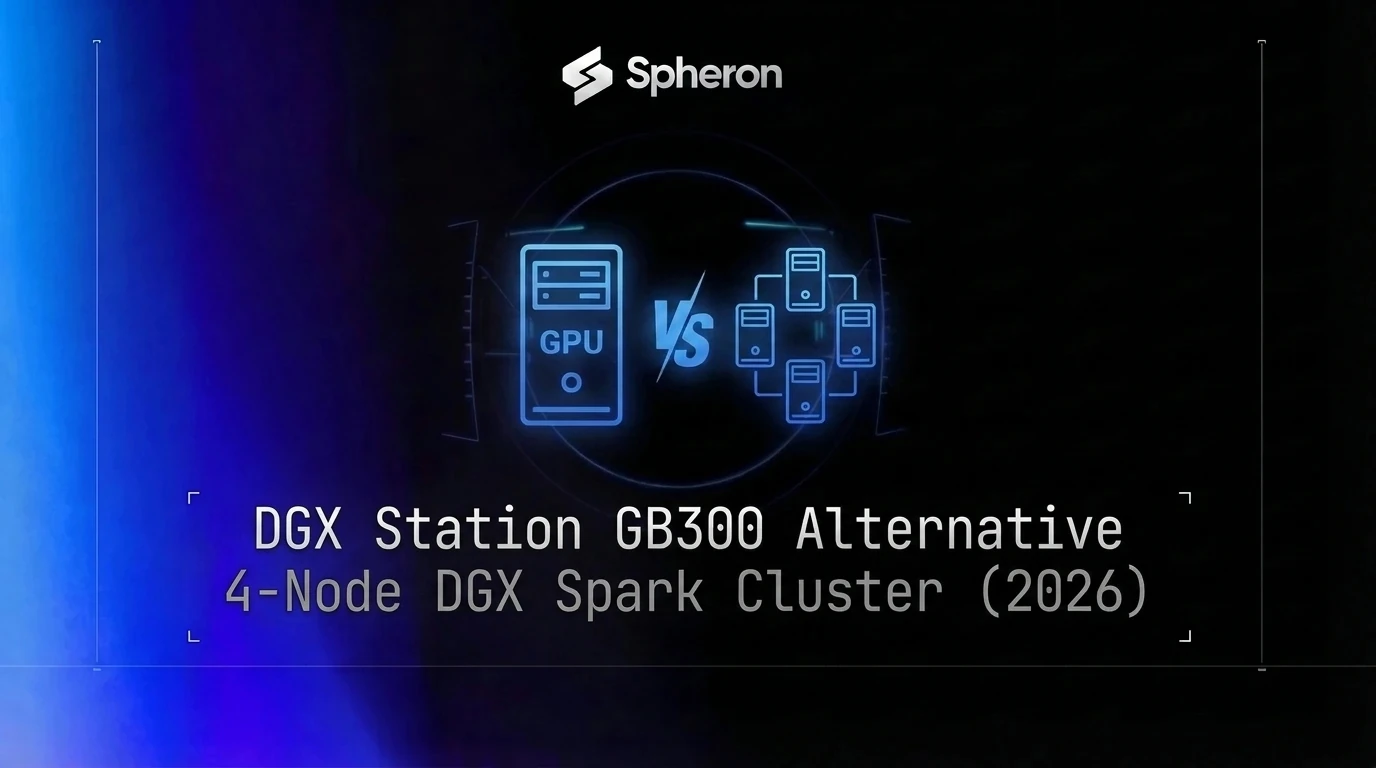
An $85,000 DGX Station GB300 and a $25,000-$40,000 four-node DGX Spark cluster are chasing the same target: fitting a 500B-to-700B-class model on a desk instead of in a data center rack. They don't get there the same way, and that difference is the real DGX Station GB300 alternative question, not just the price gap. The Station is one GPU and one CPU sharing a single 900 GB/s link inside one chassis. The cluster is four separate GB10 chips, each with its own two ConnectX-7 ports, talking to each other over a fabric that runs at a small fraction of that speed. Here's the cost, memory, and throughput math behind which one actually fits a given workload.
TL;DR: Is a 4-Node DGX Spark Cluster a Real DGX Station GB300 Alternative?
A 4-node DGX Spark cluster is a real DGX Station GB300 alternative for 500B-700B MoE models, at about a third of the price.
- Cost: a 4-node, 512GB Spark build runs $25,000-$40,000; DGX Station GB300 is a confirmed $85,000 at MSI.
- Memory: 4 Spark units pool 512GB; DGX Station GB300 holds 748GB, 252GB HBM3e plus 496GB LPDDR5X.
- Networking: NVLink-C2C inside the Station runs at 900 GB/s; a 4-node Spark cluster needs a QSFP switch, since 2 ConnectX-7 ports per chip can't ring 4 nodes.
- Throughput: 3-to-4-node scaling nearly doubled DeepSeek V4.1-Flash decode, from 51.0 to 87.7 tokens/second.
- Beyond both: Spheron rents B300 on-demand at $11.47/hr as of 20 Nov 2026 for workloads past either ceiling: GPU selection guide.
Cost and Memory Math: $25,000-$40,000 Clustered vs $85,000 for One DGX Station GB300
The headline numbers aren't close. A documented 4-node, 512GB DGX Spark switchless-ring build runs roughly $25,000 to $40,000 in hardware, before a QSFP switch, per hardware analyst Patrick Moorhead's build writeup. The only confirmed purchase price anywhere for the DGX Station GB300 is $85,000, at MSI, which is roughly double to triple the Spark cluster's cost before a single GPU-hour runs on either one.
Memory capacity doesn't follow the same ratio, and that's the first place the comparison gets interesting rather than obvious:
| Spec | DGX Station GB300 | 4-Node DGX Spark Cluster |
|---|---|---|
| Price | $85,000 confirmed at MSI | $25,000-$40,000, before a switch |
| GPUs | 1 B300 Blackwell Ultra | 4 GB10 Grace Blackwell chips |
| Total memory | 748GB coherent (252GB HBM3e + 496GB LPDDR5X) | 512GB pooled unified memory |
| Per-chip bandwidth | 7.1 TB/s HBM3e on the one GPU | 273 GB/s per unit over a 256-bit LPDDR5X interface |
| Storage | not the bottleneck at this scale | 16TB combined NVMe across 4 nodes |
| Compute | up to 20 petaFLOPS FP4 with sparsity | 4 petaFLOPS combined FP4 |
NVIDIA's own spec sheet lists the Station's 252GB of HBM3e running at 7.1 TB/s on the GPU side, plus 496GB of LPDDR5X on the Grace CPU side, for 748GB total. That single B300 GPU's memory bandwidth is roughly 26 times higher than a single DGX Spark unit's, whose unified memory runs at 273 GB/s over a 256-bit LPDDR5X interface, per NVIDIA's own DGX Spark spec page. Stacked four-wide, a Spark cluster pools to 512GB of unified memory, 16TB of combined NVMe storage, and 4 petaflops of combined FP4 compute, per Exxact's own build guide, which is more total memory-class capacity per dollar than the Station offers, but spread across four chips instead of concentrated in one fast pool.
Our DGX Spark 4-node cluster deep dive runs the full cost and capacity breakdown for the cluster side, and our DGX Station GB300 specs and fine-tuning guide does the same for the Station's own VRAM math, both of them the primary sources behind every figure above.
Where NVLink Inside the Box Beats ConnectX Clustering Between Four
Here's the variable neither source comparison isolates on its own: how fast the GPU, or GPUs, can actually talk to the memory holding the model. On the DGX Station GB300, that link is a 900 GB/s NVLink-C2C connection joining the B300 GPU's 252GB of HBM3e to the Grace CPU's 496GB of LPDDR5X, inside one sealed chassis. There's no cable, no switch, and no routing decision; the two halves of that 748GB pool behave like one coherent address space because NVIDIA built the interconnect directly into the Superchip.
A 4-node DGX Spark cluster has no equivalent on-chip link between its four separate units. Each GB10 chip carries exactly two ConnectX-7 ports, and NVIDIA's officially documented path for connecting two to four nodes is a QSFP switch, with at least four QSFP56-DD ports running at 200 Gb/s each, rather than a direct cable mesh. That switch requirement isn't a preference, it's a geometry problem: a 3-node ring works switchlessly because three nodes and three cables form a complete triangle, but a 4-node ring leaves two non-adjacent node pairs with no direct cable between them, according to Petronella Technology Group's topology writeup. Traffic between those non-adjacent nodes has no direct layer-2 path without a patched, unsupported NCCL build, which is exactly the fragile workaround NVIDIA's switch-based recommendation exists to avoid.
Run the bandwidth math and the gap is stark. A 200 Gb/s QSFP port works out to 25 GB/s, and even with both ConnectX-7 ports on a chip active at once that's 50 GB/s of node-to-switch bandwidth, against the Station's single 900 GB/s NVLink-C2C link, a difference of roughly 18x. That's before accounting for switch hop latency, which a direct on-chip link doesn't have at all. The Spark cluster's total compute and memory footprint is genuinely useful at 512GB and 4 petaflops combined, but every byte that needs to move between nodes travels at ConnectX speeds, not NVLink speeds, and that's the structural ceiling on how tightly those four chips can actually cooperate on one model.
None of this is a reason to take a vendor's bandwidth number on faith, on either side of this comparison. Our NCCL tests guide for benchmarking cluster interconnect covers the all_reduce_perf acceptance test that confirms whether a cluster fabric, switch or ring, is actually moving data at the rate its topology promises on paper, the same test used on rack-scale InfiniBand clusters applied at this much smaller scale.
Throughput and Concurrency: One Coherent GPU vs Four Networked Nodes
Capacity and bandwidth are the setup; throughput is what a buyer actually feels once a model is loaded and serving requests. The MiaAI-Lab project benchmarked DeepSeek-V4.1-Flash on DGX Spark clusters at both 3 and 4 nodes, using tensor parallelism across the pool, and the jump from the third to the fourth node is not a marginal one:
| Config | Single-Stream Decode | 4 Concurrent Streams | 16 Concurrent Streams |
|---|---|---|---|
| TP=3 (3 nodes) | 51.0 tok/s | 75.1 tok/s aggregate | not reported |
| TP=4 (4 nodes) | 87.7 tok/s | 163.6 tok/s aggregate | 342.7 tok/s aggregate |
Moving from a 3-node to a 4-node cluster nearly doubled single-stream decode, from 51.0 to 87.7 tokens per second, and more than doubled 4-concurrent-stream throughput, from 75.1 to 163.6 tokens per second. A separate, higher-concurrency build reported by Patrick Moorhead hit a peak of 494 tokens per second at 32 concurrent requests on the same 552B model, running within a measured 476GB footprint inside the 512GB pool, leaving about 36GB of margin. That's a real, usable cluster for a model this size, at single-digit-user concurrency.
The DGX Station GB300 doesn't have a comparable multi-node scaling story to tell, because it only has one GPU to begin with. DGX Station GB300 has exactly one GPU; there is no second card to shard optimizer state or tensor-parallel weights across inside the box. Every trick that let the Spark cluster add throughput by adding a fourth chip is unavailable on the Station by design: there's no NVLink peer inside the chassis to split a model across, and no way to add one without buying a second Superchip and finding a way to wire it in. What the Station gets in exchange is a single, very fast GPU with no cross-box latency to account for at all, which is the right trade for a workload that fits one coherent 252GB-to-748GB pool and needs the fastest possible path from memory to compute, not more concurrent users.
Neither desk box competes with what a cloud multi-GPU node does on concurrency. Running DeepSeek V4.1-Flash on 8xB200 on Spheron as one 4-GPU copy with FP8 and FP4 precision, 1M context, image input, and speculative decoding, measured warm on 15 October 2026, a single user gets 500 tokens/second, dropping to 260 at 8 concurrent users, 202 at 16, and 170 at 32, with a 0.45-second time to first token. That's the same model family both desk options are running, at a concurrency neither reaches: the cloud node absorbs 32 simultaneous sessions with graceful degradation, where a 4-node Spark cluster running at single-digit memory margin is built around one or a handful of users at a time, and a single-GPU Station has no second chip to add concurrent headroom at all.
Pricing fluctuates based on GPU availability. Spheron rates above are live as of 20 Nov 2026; other figures in this post reflect their sources' most recently published data and may have changed since. Check current GPU pricing → for live rates.
Which DGX Station GB300 Alternative Should You Actually Buy?
The honest answer depends on what's actually bottlenecking the workload, not just which box has the bigger spec sheet number.
Buy the DGX Station GB300 if: the job needs the fastest possible path from memory to compute for a model that fits one 748GB pool, doesn't need to shard across multiple GPUs, and the team can afford $85,000 and a dedicated 20A circuit for its up-to-1,600W draw. This is the right call for dense models up to roughly 337B parameters under standard LoRA, by this site's own VRAM-formula math against the Station's pool, where low-latency, single-GPU throughput matters more than raw capacity.
Buy the 4-node DGX Spark cluster if: the target model is sparse MoE in the 500B-to-700B range, like DeepSeek V4.1-Flash or DeepSeek-R1 at 4-bit quantization, concurrency needs are low (a handful of users, not dozens), and the budget tops out well under the Station's $85,000. Accept going in that the ConnectX-7 fabric between nodes, not any single chip, sets the real throughput ceiling, and that NVIDIA's supported path requires a QSFP switch at 4 nodes, not a free switchless ring.
Rent instead of buying either one if: the workload's size, concurrency, or uptime requirement already exceeds what a single chip or a four-chip desk cluster can deliver, or the usage pattern is still bursty and unproven. Spheron sells standalone B300 and B200 on-demand at $11.47/hr and $10.20/hr respectively (spot at $12.85/hr and $5.22/hr) as of 20 Nov 2026, billed per minute with no hardware purchase, and reserves GB300 NVL72 capacity from a single node up for jobs that outgrow even a multi-GPU cloud node. Reserve GB300 NVL72 capacity → The honest tradeoff: spot capacity can be reclaimed without notice, which is a real reliability gap against a desk box's always-available, no-meter-running access for a long unattended job. A team choosing cloud spot over buying hardware should keep a second model copy on a different node or region with automatic recovery built in, exactly the caveat that doesn't apply to either box sitting on a desk.
For the dollar break-even math on the Station specifically, our DGX Station GB300 price and break-even guide runs the hourly comparison against renting GB300-class capacity. For the equivalent math on a single DGX Spark unit, our DGX Spark vs cloud rental break-even guide covers the same question at a tenth the scale. And for the node-vs-rack distinction behind the Station's single B300 GPU, our GB300 vs B300 NVL72 comparison explains what changes once a workload needs to move past either desk box entirely.
Whichever desk box fits today, the model, the user count, or the uptime requirement eventually outgrows it. Spheron's on-demand B300 and B200 pick up the same workload the same day, billed by the minute, with GB300 NVL72 reserved from a single node up for anything past that.
Frequently Asked Questions
On hardware cost alone, yes. A documented 4-node, 512GB DGX Spark build runs roughly $25,000 to $40,000 before a QSFP switch, against the DGX Station GB300's $85,000 confirmed price at MSI. The Station still wins on memory per dollar for workloads that need its 748GB coherent pool rather than the cluster's 512GB, and on access speed, since there's no fabric to wire up.
The link between boxes. DGX Station GB300 shares its 748GB pool over a 900 GB/s NVLink-C2C connection inside one chassis. A 4-node DGX Spark cluster connects over each GB10 chip's ConnectX-7 ports, and NVIDIA's officially supported path for 4 nodes is a QSFP switch rather than a direct ring, because the two ports per chip can't form a complete ring at that node count.
Only sparse MoE models land in both boxes' realistic range. The 4-node, 512GB Spark cluster has run DeepSeek V4.1-Flash (552B total) at a measured 476GB footprint. The Station's 748GB pool, run through this site's own fine-tuning VRAM formula, holds roughly 337B dense parameters for standard LoRA. Dense models past the high 300Bs don't fit either box without quantization.
Neither has a published head-to-head benchmark on the same model, so this isn't a settled number. What is measured: moving a Spark cluster from 3 nodes to 4 nearly doubled DeepSeek V4.1-Flash's single-stream decode, from 51.0 to 87.7 tokens per second. Spheron's own 8xB200 cloud node runs the same model family at 500 tokens per second for one user, well past either desk box, for teams whose workload has outgrown a single-chip or four-chip ceiling.