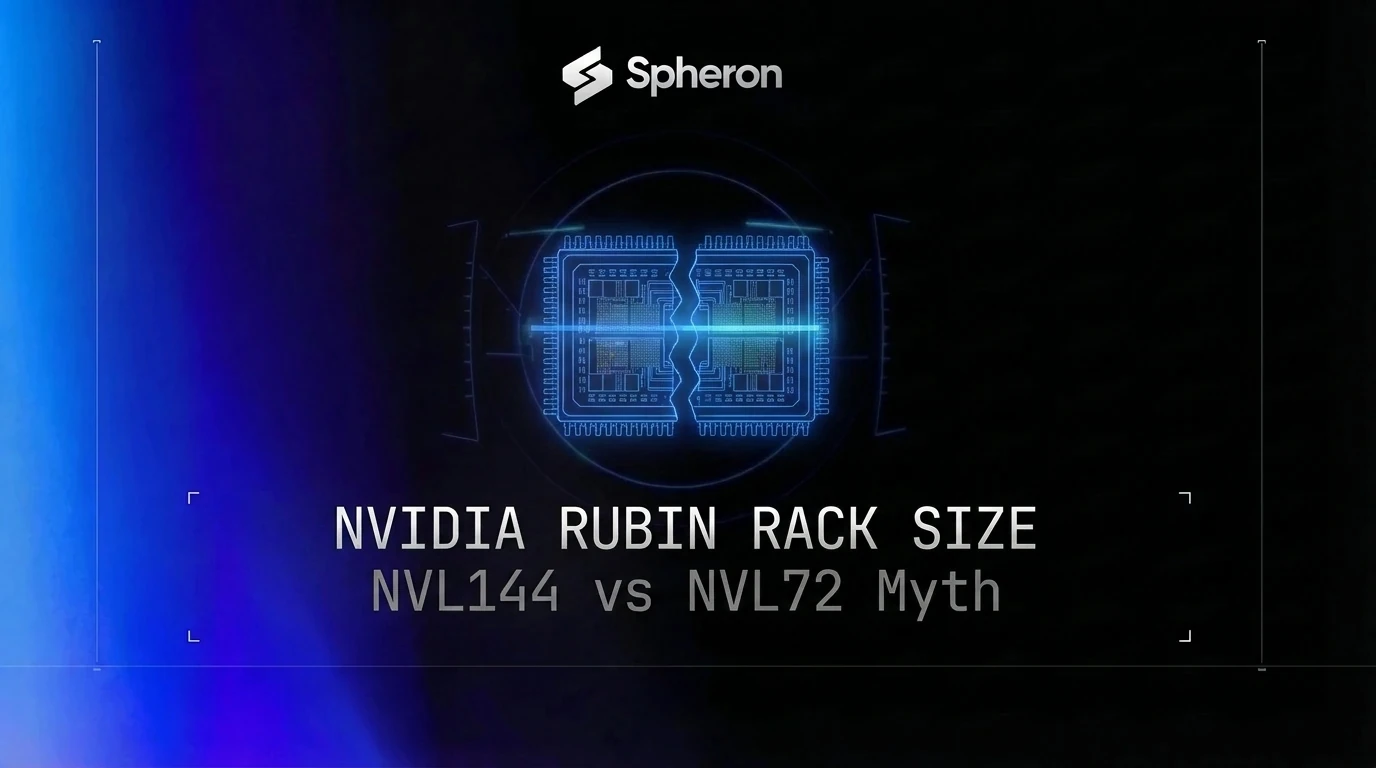
NVIDIA Rubin rack size got confused with itself in early 2026, and the confusion is still showing up in buyer research today. Vera Rubin NVL144 was never a 144-GPU rack sitting next to a smaller, 72-GPU NVL72. It was the exact same rack, counted two different ways, before NVIDIA settled on one name for good. The real doubling of GPU count per rack is a separate, later system, and it still hasn't shipped.
TL;DR: Does Vera Rubin NVL144 Have Double the GPUs of NVL72?
- No. Vera Rubin NVL144 and Vera Rubin NVL72 describe the same physical rack. NVIDIA renamed it once it started counting GPU packages (72) instead of GPU dies (144).
- Current spec: NVIDIA's own Vera Rubin NVL72 page lists 72 NVIDIA Rubin GPUs and 36 NVIDIA Vera CPUs per rack, connected by NVLink 6.
- Why it doubled on paper: each Rubin GPU package is built from two reticle-limited dies, the same dual-die packaging NVIDIA uses on Blackwell, so counting dies instead of packages doubles the headline number for an identical rack.
- Where 144 is still real: Vera Rubin NVL144 CPX pairs 144 Rubin CPX chips with 144 Rubin GPUs in one rack, and NVIDIA's later Kyber chassis for Rubin Ultra is reported under NVL144/NVL576, a genuinely bigger, still-unshipped system.
- Spheron: Vera Rubin capacity is open for reservation ahead of general availability, with B300 renting on-demand today as the closest capacity match a buyer can book by the hour.
The NVIDIA Rubin Rack Size Myth: "NVL144 Has Double the GPUs of NVL72"
The myth goes like this: Vera Rubin NVL144 is a bigger, newer rack that packs twice the GPUs of Vera Rubin NVL72, so a buyer comparing the two should expect roughly double the throughput and double the price. That comparison never existed. NVIDIA used the name "Vera Rubin NVL144" for the same flagship rack it now calls "Vera Rubin NVL72," before settling on package-based counting partway through 2026. Nothing about the physical hardware changed between the two names. It's the same 72-GPU, 36-CPU rack, on the same NVLink fabric, counted two different ways at two different points in NVIDIA's own announcements.
Where the NVL144 Number Actually Came From: Dies, Not Packages
NVIDIA builds the Rubin GPU the way it built Blackwell: as a dual-die package, because a single reticle-limited die can't hold enough transistors for the compute NVIDIA wants in one GPU. Each Rubin GPU package is actually two separate dies fused together, so anyone counting dies instead of packages across a rack gets a number exactly double the GPU count that rack actually ships with. Our Rubin GPU specs guide covers what one of those packages carries: 288GB of HBM4 and NVLink 6 at 3.6 TB/s, all counted per package, not per die.
Seventy-two packages at two dies each is 144 dies. That's the entire origin of the number: not a second, bigger rack, just the same rack counted at a smaller unit of silicon.
Blackwell set the precedent for this. B200 and B300 are also dual-die packages, and NVIDIA always counted those as one GPU per package, never two, the same packaging approach it carried over to Rubin's own dual-die design. Applying that identical convention to Rubin's rack is what took the flagship system from "NVL144" to "NVL72" without changing a single transistor inside it.
NVIDIA's Current Rubin Rack Size: 72 GPUs, 36 Vera CPUs, One Rack
Today, NVIDIA's own Vera Rubin NVL72 product page states the rack configuration plainly: 72 NVIDIA Rubin GPUs and 36 NVIDIA Vera CPUs, connected by NVLink 6. That's the number to plan around, whether you're sizing a reservation, a rack-cost estimate, or an NVLink domain.
| Spec | Vera Rubin NVL72 |
|---|---|
| GPU count | 72 NVIDIA Rubin GPUs |
| CPU count | 36 NVIDIA Vera CPUs |
| Interconnect | NVLink 6 |
| Rack-level NVLink bandwidth | 260 TB/s |
| Per-GPU NVLink bandwidth | 3.6 TB/s |
That roughly 260 TB/s figure is a rack total built from 72 GPUs at 3.6 TB/s each, not 144. Divide the rack total across the wrong denominator and the per-GPU bandwidth comes out at half of what it should be, which is exactly the kind of error the old NVL144 name invited for most of 2026.
No cloud marketplace, Spheron included, has a live hourly rate for Vera Rubin yet. Spheron's own pricing page lists Vera Rubin alongside GB300 and GB200 with a reservation action rather than a published rate, while B300, B200, H200 and H100 all carry live on-demand per-GPU pricing on the same page, since prices move with partner supply and are current only as of the day you check them. If you need Rubin-class memory capacity now rather than in H2 2026, B300 runs on Spheron at $13.37/hr as of 28 Nov 2026, with 288GB of HBM3e per GPU, the closest capacity match a buyer can actually book by the hour right now.
Pricing fluctuates based on GPU availability. Spheron rates above are live as of 28 Nov 2026; other providers reflect their most recent published rates and may have changed.
Where "144" Still Correctly Shows Up in the Rubin Family
"144" isn't wrong everywhere, it's just attached to two different products now, and neither one is the flagship Vera Rubin rack this myth is about.
The first is Vera Rubin NVL144 CPX, a separate, disaggregated-inference rack that NVIDIA announced in September 2025. It combines 144 Rubin CPX chips built for the compute-heavy prefill phase of inference with 144 standard Rubin GPUs built for the memory-heavy decode phase, plus 36 Vera CPUs. That's 288 total GPU-class chips across two different kinds of silicon, not 144 of the same chip, and it's a genuinely different product from the 72-GPU Vera Rubin NVL72 rack covered above. Our Vera Rubin NVL144 CPX breakdown has the full spec comparison against the standard Rubin GPU.
The second is Rubin Ultra's Kyber rack, a later generation that NVIDIA is reportedly building under the names NVL144 and NVL576. Unlike the renamed Vera Rubin NVL72, Kyber is a real architectural jump: it switches from horizontal compute trays to vertical trays connected through a dense PCB midplane, aiming to fit twice the GPU packages of an NVL72 rack in roughly the same floor footprint. That midplane is also the reported source of Kyber's delay, which pushed the system from an original 2027 target out to 2028. NVIDIA shares fell 1.4% to $194.83 on 6 July 2026, the day the Kyber delay report first circulated, a reminder that this is treated as material news for a system distinct from anything shipping today. Our Kyber rack delay writeup covers the reported cause and what stays unaffected in the meantime.
Why This Confusion Changes Your Rack Cost and NVLink Domain Math
Get the GPU count wrong and two numbers downstream get wrong with it: rack cost and NVLink domain size.
Press reporting in March 2026 put Vera Rubin NVL72 at roughly $5M to $7M per rack. A separate $7M to $8.8M range has circulated in headlines since, and it belongs to the later Rubin Ultra NVL144 generation, not the Vera Rubin NVL72 covered in this post, per Spheron's own Vera Rubin NVL72 pricing breakdown. Treat any article citing an "$8.8M Vera Rubin rack" as conflating the two systems the same way the NVL144 name itself did.
NVLink domain size is the other number at risk. A Vera Rubin NVL72 rack's 72 GPUs can all reach each other in a single NVLink hop, and that domain size hasn't grown since GB200 shipped, across two full NVLink generations, as our NVLink domain size comparison across GB200, GB300 and Rubin tracks in detail. Size an expert-parallel group assuming a 144-GPU domain because of the old name, and you're planning for a domain that doesn't exist on any shipping rack today. The system that actually doubles the domain, Rubin Ultra's Kyber rack, is the one slipping to 2028.
Vera Rubin NVL72's rack count isn't changing before it ships, so size your reservation and your cost model against 72 GPUs, not 144. Spheron takes Vera Rubin reservations now and prices B300 on-demand today for capacity you can book this week.
Frequently Asked Questions
No. Vera Rubin NVL144 and Vera Rubin NVL72 are the same physical rack. NVIDIA originally counted the rack's silicon by GPU die (144) and later switched to counting by GPU package (72), the same convention it already used for Blackwell. Nothing about the GPU count, the NVLink fabric, or the rack itself changed between the two names.
72. NVIDIA's own Vera Rubin NVL72 product page lists 72 NVIDIA Rubin GPUs and 36 NVIDIA Vera CPUs per rack, connected over NVLink 6. That is the number to use for any rack-cost, power, or NVLink domain calculation.
Two places, and neither is the flagship Vera Rubin rack. Vera Rubin NVL144 CPX pairs 144 Rubin CPX chips with 144 standard Rubin GPUs in one rack for disaggregated inference. Separately, NVIDIA's Kyber chassis for the later Rubin Ultra generation is reported under the name NVL144 (and NVL576 for the larger linked pod), and that system genuinely does carry twice the GPU packages of an NVL72 rack. It has not shipped and has slipped from a 2027 target to 2028.
NVIDIA has never published a list price. Press reporting in March 2026 put Vera Rubin NVL72 at roughly $5M to $7M per rack. A separate $7M to $8.8M figure also circulates in headlines, but that range belongs to the later Rubin Ultra NVL144 generation, not the Vera Rubin NVL72 covered here, and conflating the two is the same naming mistake that produced the GPU-count myth in the first place.